Graphical method
At a Glance
- Frequency: 5 sub-parts across 5 of 13 years (2014, 2016, 2017, 2019, 2023)
- Priority tier: T2
- Marks (count): 10 (5)
- Average solve time: ~9 min
- Difficulty mix: easy 3, medium 2
- Section: A | Dominant type: computation
Why This Chapter Matters
This atom appears in 5 of the last 13 years — always as a 10-mark Section A sub-part — making it one of the most predictable linear-programming questions in Paper 2. Two variants have appeared: the standard bounded feasible region where you enumerate corner points, and the trickier unbounded case (2019) where the maximum does not exist. The method is fully mechanical: no calculus, just careful geometry and arithmetic at vertices.
Minimum Theory
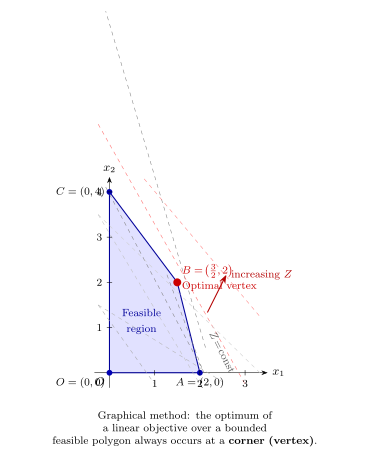
Five-step graphical procedure. For a two-variable LPP with decision variables :
- Plot each constraint as a line in the – plane; shade the feasible half-plane (the side satisfying the inequality, including , ).
- Identify the feasible region = intersection of all half-planes. If , the problem is infeasible — report that.
- Locate corner points (vertices) = points where two boundary lines (or a boundary line and a coordinate axis) meet and all other constraints are satisfied. Solve each pair of active-constraint equations simultaneously.
- Evaluate the objective at every vertex.
- Report the optimum: for a bounded region the optimum is the vertex giving the largest (maximisation) or smallest (minimisation) value. For an unbounded region see the criterion below.
Fundamental Theorem. If the feasible region is a non-empty bounded polygon, the linear objective attains its maximum and minimum at (at least one) vertex of . Consequently, evaluating at all vertices and taking the extreme value is both necessary and sufficient.
Unboundedness criterion. If is unbounded and the objective can increase (for maximisation) or decrease (for minimisation) indefinitely along a feasible recession direction (i.e.\ as for all feasible ), then the problem has no finite optimum. To confirm: exhibit the direction and show the objective is unbounded along it.
Infeasibility. If the constraints are contradictory — no point satisfies all of them simultaneously — the feasible region is empty and no solution exists. A typical sign is that a ” region” and a ” region” of the same constraint strip do not overlap.
Question Archetypes
| Archetype | Recognition cue |
|---|---|
| graphical-method | ”Solve by graphical method”, bounded feasible polygon, evaluate objective at vertices |
| graphical-unbounded | Feasible region is an unbounded wedge; “determine whether the maximum/minimum is finite” |
graphical-method (4 questions; 2014, 2016, 2017, 2023)
Solve a two-variable LPP by the graphical (vertex-enumeration) method.
Recognition Cues
- The instruction says “graphical method” or “geometrically”.
- There are 2–5 linear inequality constraints plus .
- A mix of and constraints may appear; the feasible region is bounded (it is a polygon with a finite number of vertices).
- The objective is to maximise or minimise a linear function.
Solution Template
- Write each constraint as an equation; find its two intercepts; draw the line.
- Determine which side of each line is feasible (test the origin, or use the inequality direction).
- Shade/identify the feasible polygon; list all vertices.
- For each vertex, compute ; tabulate.
- State the optimum value and the achieving vertex. If the question asks for a real-world interpretation (jars, units of goods), translate back.
Worked Example 1
2014 Paper 2, 2014-P2-Q1e (10 marks)
Maximise subject to , , , , .
Step 1 — Boundary lines and intercepts.
| Constraint | Line | Intercepts |
|---|---|---|
| , | ||
| , | ||
| , | ||
| , |
Step 2 — Feasible half-planes. : origin-side (). : away from origin (, origin gives ).
Step 3 — Vertices. Solve intersections that satisfy all constraints:
| Vertex | Active constraints |
|---|---|
| , | |
| , | |
| , | |
| : solve , | |
| , |
(Check each vertex satisfies all five constraints before accepting it.)
Step 4 — Objective values.
| Vertex | |
|---|---|
Step 5 — Optimum.
Worked Example 2
2016 Paper 2, 2016-P2-Q1e (10 marks)
By graphical method, find the maximum of subject to , , .
Step 1 — Boundary lines.
- : ; intercepts , .
- : ; intercepts , .
Step 2 — Feasible half-planes. : away from origin (); : origin-side (, origin gives ✓).
Step 3 — Vertices.
- Axis corner : on boundary, satisfies ? ✓. Feasible.
- Axis corner : on boundary, satisfies ? ✓. Feasible.
- Intersection : solve , subtract: ; then . Check non-negativity ✓.
Note: The axis point violates : . Infeasible.
Step 4 — Objective values.
| Vertex | |
|---|---|
Step 5 — Optimum.
Worked Example 3
2017 Paper 2, 2017-P2-Q1e (10 marks)
Using the graphical method, maximise subject to , , , .
Step 1 — Boundary lines.
- : ; intercepts , .
- : ; intercepts , .
- : ; intercepts , .
Step 2 — Feasible half-planes. All three constraints are ; origin satisfies all ✓.
Step 3 — Vertices.
- : both axes; satisfies all three ✓.
- : , active; check : ✓; : ✓.
- : : solve , , . Check : ✓.
- : , active; check : ✓; : ✓.
Step 4 — Objective values.
| Vertex | |
|---|---|
Step 5 — Optimum.
() is redundant at the optimum: it is satisfied with slack at every vertex.
Worked Example 4 (Minimisation)
2023 Paper 2, 2023-P2-Q1e (10 marks)
A gardener uses two chemicals (products and ). Each kilogram of product contains 1 unit of chemical A, 4 units of B, and 1 unit of C. Each kilogram of contains 1 unit of A, 1 unit of B, and 5 units of C. Minimum requirements: 12 units of A, 24 units of B, 20 units of C. Product costs ₹30/kg, product costs ₹50/kg. Find the amounts that minimise cost.
Formulation. Let = kg of , = kg of .
Minimise
subject to:
Step 1 — Boundary lines and intercepts.
| Constraint | Line | Intercepts |
|---|---|---|
| , | ||
| , | ||
| , |
Step 2 — Feasible half-planes. All three are ; feasible region is above/right of all lines.
Step 3 — Vertices.
- : , . Check : ✓.
- : , . Check : ✓.
- Axis vertex : on ; check : ✓; : ✓.
- Axis vertex : on ; check : ✓; : ✓.
Step 4 — Objective values.
| Vertex | |
|---|---|
Step 5 — Optimum (minimisation: take the smallest value).
The gardener should buy 10 kg of and 2 kg of at a minimum cost of ₹400.
Common Traps — graphical-method
- Not checking all constraints at each candidate vertex. Two boundary lines intersect at a unique point, but that point need not satisfy every other constraint. Always verify the full set before including a vertex in the table.
- Missing a vertex because of an off-axis intersection. Draw the lines carefully; intersections between two non-axis lines (e.g. in examples 1 and 3) are easy to overlook if you only pick up axis intercepts.
- Assuming the origin is always feasible. When a constraint is , the origin is on the wrong side. In the 2016 example the feasible region does not contain the origin; the vertex looks attractive but violates .
- Minimisation: choosing the maximum. The objective table looks the same; for a minimisation problem take the row with the smallest value. (2023 answer is 400, not 1200.)
- Non-binding constraints. in the 2017 problem plays no role at the optimum. Sketch all constraints regardless; the region is the intersection of all half-planes.
graphical-unbounded (1 question; 2019)
Detect when the linear objective has no finite optimum over an unbounded feasible region.
Recognition Cues
- The feasible region has no upper (for maximisation) or lower (for minimisation) bound — it extends to infinity in the direction of increasing .
- Sometimes a “superfluous” variable appears in only one constraint but not in the objective; this variable can be chosen freely to satisfy that constraint, effectively removing it.
- The question may say “determine whether the LPP has an optimal solution” or simply ask for the maximum.
Solution Template
- Identify all variables in the problem; note which appear in the objective and which appear only in constraints.
- Eliminate variables that appear only in non-negativity constraints (or constraints trivially satisfied) by choosing them appropriately.
- Reduce to the effective two-variable (or one-variable) problem.
- Plot the reduced feasible region. If it is unbounded in the direction of increasing , demonstrate a feasible ray along which .
- Conclude: “The LPP has no finite maximum; is unbounded.”
Worked Example
2019 Paper 2, 2019-P2-Q1e (10 marks)
Maximise subject to , , .
Trap: appears in the second constraint but not in the objective.
For any , we can always choose to satisfy . The second constraint therefore imposes no restriction on . The effective problem reduces to:
Reduced feasible region. The constraint (i.e. ) combined with defines an unbounded wedge: the boundary line passes through with slope 1; the feasible region lies on and below this line in the first quadrant (with ).
Show unboundedness. Along the boundary ray for :
Every point on this ray is feasible (satisfies with equality, for , and ), so takes arbitrarily large values over the feasible region.
Common Traps — graphical-unbounded
- Treating as if it forces . The constraint is , not . Since is free, it can absorb any deficit. Mistakenly writing introduces a false lower bound on and may lead to a spurious finite answer.
- Reporting a “boundary vertex” as the optimum. The unbounded wedge does have a finite vertex at with . This is the minimum value of over the feasible region, not the maximum. For maximisation, never stop at a vertex without checking whether the region is bounded in the direction of increasing .
- Forgetting to state the conclusion explicitly. In UPSC marking, writing ” is unbounded” (or “no finite maximum exists”) earns the conclusion mark. Simply leaving the table blank or writing without justification does not.
Marks-Aware Writing
What a full-marks 10-mark answer must show:
- Formulation (if the question gives a word problem): define variables, write objective and constraints clearly — 2 marks.
- Graph/vertex identification: either sketch the region or solve each pair of active constraints — 4 marks. Show the algebra; do not “read off” approximate coordinates from a rough sketch.
- Objective table: evaluate at all vertices and display the values — 2 marks.
- Conclusion: state the optimal value and the optimal point in a box or highlighted sentence — 2 marks.
For the unbounded case (2019): replace the objective table with a proof-of-unboundedness (exhibit the feasible ray and compute ). The conclusion “unbounded” is mandatory.
General tips:
- Solve vertex coordinates exactly (fractions), not as decimal approximations.
- Check each candidate vertex against every constraint (not just the two active ones).
- For minimisation, explicitly say “minimum” to avoid losing the conclusion mark.
Practice Set
- 2024-P2-Q3c (15 m) — — larger LPP; use the same five-step template; watch for redundant constraints
- 2018-P2-Q1e (10 m) — — standard bounded maximisation; good warm-up before attempting the 2014 variant