LPP: standard form; basic, basic feasible, optimal solutions
At a Glance
- Frequency: 6 sub-parts across 4 of 13 years (2015, 2018, 2020, 2025)
- Priority tier: T3
- Marks (count): 10 (5), 15 (1)
- Average solve time: ~10 min
- Difficulty mix: medium 4, easy 2
- Section: A | Dominant type: computation
Why This Chapter Matters
This atom covers the foundational vocabulary of LP theory: what a basic solution is, how to count and enumerate them, and how to pose a real problem as a standard-form program. Questions here are purely definitional or formulative — no simplex needed — and they appear almost every time LP appears on Paper 2. The basic-solutions archetype is a guaranteed 10–15 mark question whenever the examiner wants to test LP foundations; the lpp-formulation type appears as a compulsory Q1 sub-part. Mastering the column-singularity shortcut (for counting basic solutions) is the difference between 8 minutes and 18 minutes on the basic-solutions questions.
Minimum Theory
Standard form. A linear program in standard form has all constraints as equalities with non-negative variables: where is with . Inequality constraints become equalities by adding a slack ; inequality is converted by subtracting a surplus .
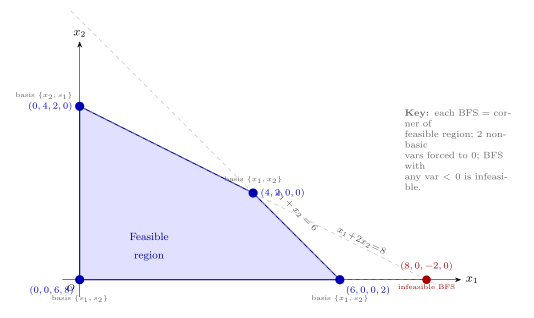
Basic solution. Choose columns of forming a non-singular submatrix (the basis matrix). Set the remaining variables (non-basic) to zero and solve . The resulting solution (with the non-basic variables set to zero) is a basic solution. The maximum number of basic solutions is ; those where the corresponding submatrix is singular yield no solution and are not counted.
Feasibility and degeneracy. A basic solution is a basic feasible solution (BFS) if (equivalently, all variables are non-negative). It is non-degenerate if every basic variable is strictly positive. Geometrically, BFS = extreme points (vertices) of the feasible polytope.
Fundamental theorem of LP. If the feasible region is non-empty and the objective is bounded on it, the optimum is attained at a BFS. This is the license to restrict attention to vertices when proving optimality.
Question Archetypes
| Archetype | Recognition cue |
|---|---|
| basic-solutions | ”Find all basic solutions”; “classify degenerate/non-degenerate BFS” |
| lpp-formulation | ”Pose an LPP”; “formulate in standard form” |
| optimum-without-simplex | ”Without solving, show it has an optimal solution”; “which BFS is optimal?“ |
basic-solutions (3 questions; 2015, 2018, 2025)
Recognition Cues
- “Find all basic solutions of the following system.”
- “How many basic solutions are there? Find all of them.”
- “Classify feasible/non-feasible/degenerate/non-degenerate.”
All three UPSC appearances use the same system: , . The 2015 question uses a different (easier) system; 2018 and 2025 use this one. Know the column-proportionality trick cold.
Solution Template
- Identify and . = number of equations, = number of variables. Maximum basic solutions: .
- Check for proportional columns. Write out all columns as -vectors. If any subset of columns are scalar multiples of each other, every pair drawn entirely from that subset is singular. Count the singular pairs — subtract from .
- Enumerate non-singular pairs. For each non-singular pair of columns : set all other variables to 0, solve the system for .
- Classify each. Feasible: all components . Degenerate: a basic variable equals 0 (non-basic variables are always 0 by definition, so degeneracy is about the basic values only).
Worked Example(s)
2015 Paper 2, 2015-P2-Q3c-i (10 marks)
Find all basic solutions of , ; classify degenerate vs non-degenerate BFS.
, , so at most basic solutions.
Check for singular pairs. Columns of : , so the pair gives — singular, no basic solution. All other pairs have independent columns.
Five non-singular pairs (and their solutions):
| Basis | Non-basic | Solve | Solution | Feasible? | Degenerate? |
|---|---|---|---|---|---|
| Yes | No | ||||
| Yes | No | ||||
| No () | — | ||||
| Yes | No | ||||
| Yes | No |
Four BFS, all non-degenerate. No basic variable equals 0 in any feasible solution.
2018 / 2025 Paper 2 (10–15 marks)
, . Find all basic solutions; classify.
, . At most .
Key observation: columns are all multiples of : Any pair from is singular. That accounts for 3 singular pairs: , , .
The remaining 3 pairs all contain , which is not parallel to , so each is non-singular. Exactly 3 basic solutions exist.
| Basis | Solution | Feasible? | Degenerate? |
|---|---|---|---|
| Yes | No | ||
| No () | — | ||
| Yes | No |
The 2025 version of this question additionally asks to count non-degenerate solutions: all 3 are non-degenerate (no basic variable is zero in any of the three solutions).
Common Traps
- is only an upper bound; singular column pairs reduce the count. Always check for proportional columns before grinding through all pairs.
- Degeneracy means a basic variable equals 0 — not a non-basic variable. Non-basic variables are always set to 0 by definition. So with basis is non-degenerate because both and are nonzero.
- In the 2015 system, makes singular — easy to miss since the columns look different at first glance (one has a leading 2, the other a leading 1).
lpp-formulation (2 questions; 2018, 2020)
Recognition Cues
- “Pose a linear programming problem.”
- “Formulate an LP in standard form; give a basic feasible solution to it.”
- A word problem with quantities to maximise/minimise subject to resource limits.
Solution Template
- Name the decision variables. What does the candidate control? Typically: number of units of each type produced/purchased.
- Objective function. Profit (maximise) or cost (minimise) per unit × number of units.
- Constraints. For each resource/requirement: (usage per unit of type 1) + (usage per unit of type 2) (available). Add non-negativity .
- Standard form. Convert to by adding slacks .
- Check. Units consistent; constraints are (not ) unless exhaustion is mandated.
Worked Example(s)
2018 Paper 2, 2018-P2-Q1e (10 marks)
An agricultural firm has 180 t nitrogen, 250 t phosphate, 220 t potash. Mixture I (ratio 3:3:4) yields Rs 1500/t profit; Mixture II (ratio 2:4:2) yields Rs 1200/t. Pose the LP.
Variables: = tonnes of Mixture I, = tonnes of Mixture II.
Per-tonne resource use: Ratio 3:3:4 sums to 10, so Mixture I uses t nitrogen, t phosphate, t potash per tonne. Ratio 2:4:2 sums to 8, so Mixture II uses , , respectively.
LPP (cleared of fractions by multiplying constraints by 20):
Maximise subject to:
The question only asks to pose the LP; solving is not required.
2020 Paper 2, 2020-P2-Q1e (10 marks)
Stock pieces are 17 ft. Requirements: 5 ft (700), 9 ft (400), 7 ft (300). Minimise trim loss; give a BFS.
This is a cutting-stock problem. Decision variables: = number of pieces cut to pattern .
Maximal cutting patterns (no more curtain of any length fits):
| Pattern | 5 ft | 7 ft | 9 ft | Trim loss |
|---|---|---|---|---|
| 0 | 1 | 1 | 1 ft | |
| 0 | 2 | 0 | 3 ft | |
| 1 | 0 | 1 | 3 ft | |
| 2 | 1 | 0 | 0 ft | |
| 3 | 0 | 0 | 2 ft |
Objective:
Demand constraints (standard form with surplus and artificial ):
A BFS: use for 5-ft demand, for 7-ft, for 9-ft: Trim loss ft. (This is a valid BFS, not necessarily optimal.)
Common Traps
- Normalize mixture ratios by their sum (10 and 8), not raw numbers.
- Constraints are , not : the firm need not exhaust every resource.
- “Standard form” = equalities; constraints need slack variables, need surplus + artificial.
- The cutting-stock question asks only to formulate + give a BFS, not solve.
optimum-without-simplex (1 question; 2015)
Recognition Cues
- “Without solving, show that it has an optimal solution.”
- “Which of the basic feasible solutions is/are optimal?”
- This always appears as the follow-up to a basic-solutions question on the same LPP.
Solution Template
- Existence. Quote the fundamental theorem: feasible region non-empty (cite a known BFS) + objective bounded on the region optimum attained at a BFS.
- Bound the objective. Substitute the equality constraints to eliminate variables. Express in terms of the free (non-basic) variables, all of which are . A coefficient of on with immediately gives .
- Identify the optimal BFS. Plug each BFS into the simplified -formula; the one achieving is optimal.
Worked Example
2015 Paper 2, 2015-P2-Q3c-ii (10 marks)
(Continuation of Q3c-i above.) Without solving, show the LPP has an optimal solution; find which BFS are optimal.
LPP: Maximise subject to , , .
Step 1 — Existence. From Q3c-i, is a BFS, so the feasible region is non-empty.
Step 2 — Bound . From the two constraints, express and . Substitute into : Since , we have . So is bounded above, and by the fundamental theorem the LPP has a finite optimal solution.
Step 3 — Find optimal BFS. is maximised when :
| BFS | ||
|---|---|---|
| 0 | 20 | |
| 4 | ||
| 0 | 20 | |
| 3 |
Two BFS are optimal: and , both achieving .
The entire line segment between them is also optimal (alternative optima).
Common Traps
- Existence proof requires two parts: non-empty feasible region (produce a BFS) and bounded objective. Both must appear.
- The substitution may not eliminate all free variables — if still has multiple free variables, bound them separately (all non-basic variables are ).
- Two BFS with the same objective value signals alternative optima — the whole edge between them is optimal. Mentioning this earns the final mark.
Marks-Aware Writing
10-mark answer (basic-solutions): Write the count up front; identify singular column pairs with a one-line determinant check; tabulate all non-singular solutions (basis, solution, feasible Y/N, degenerate Y/N). State the answer. No more, no less.
15-mark answer (basic-solutions): Same structure, but add a brief explanation of why certain pairs are singular (proportional columns), verify at least one solution by back-substitution, and explicitly state the count of feasible vs infeasible basic solutions.
10-mark formulation: Variables → objective → constraints → non-negativity → standard form. Each on its own line; dimensions/units checked in one sentence. The question says “pose” — do not solve.
Practice Set
- 2024-P2-Q4c (20 m) — transportation + LP context;
- 2023-P2-Q1e (10 m) — formulation;
- 2013-P2-Q1e (10 m) — formulation;
- 2020-P2-Q3b (15 m) — basic solutions;
- 2017-P2-Q1e (10 m) — formulation;
- 2016-P2-Q1e (10 m) — formulation;