Euler’s equation of motion for inviscid flow
At a Glance
- Frequency: 2 sub-parts across 2 of 13 years (2017, 2024)
- Priority tier: T3
- Marks (count): 15 (1), 20 (1)
- Average solve time: ~15 min
- Difficulty mix: hard 1, medium 1
- Section: B | Dominant type: computation
Why This Chapter Matters
Euler’s equation is the foundation of inviscid fluid mechanics: it appears in Section B (optional), carries up to 20 marks, and connects directly to Bernoulli’s theorem — the primary computational tool in both questions. The 2024 question (20 marks) asks for pressure in a 2D doublet-flow field after verifying incompressibility and irrotationality, while the 2017 question (15 marks) requires the compressible-flow version of Bernoulli to prove a velocity ratio formula. Both question types are entirely mechanical once you know the two Bernoulli forms and one algebraic identity: .
Minimum Theory
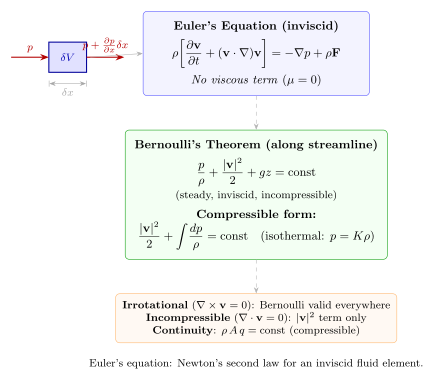
Euler’s Equation. For an inviscid fluid (viscosity ) the Navier-Stokes equation reduces to Euler’s equation:
There is no viscous term. For steady flow () this becomes .
Bernoulli’s Theorem (incompressible, irrotational). For steady, inviscid, incompressible flow that is also irrotational (), Bernoulli’s equation holds throughout the fluid (not just along a streamline):
Equivalently (neglecting gravity or setting ).
Bernoulli’s Theorem (compressible, isothermal). For steady compressible flow with (isothermal, constant), the compressible Bernoulli integral along a streamline is . With , , giving:
Continuity for steady compressible flow: (mass flux), where is the cross-sectional area.
Question Archetypes
| Archetype | Recognition |
|---|---|
| bernoulli-pressure | Given a 2D velocity field; verify incompressible and irrotational; find pressure |
| compressible-bernoulli | Steady flow in a pipe; constant; prove a velocity or density ratio |
bernoulli-pressure (1 question(s); 2024)
Recognition Cues — The question hands you and with a rational form involving in the denominator. You are asked to “verify” the flow satisfies the equations of motion and to “determine the pressure”. The phrase “inviscid incompressible” tells you Euler applies; you must first check (incompressibility) and (irrotationality) before invoking Bernoulli.
Solution Template
- Compute using the quotient rule. Show the sum is zero (incompressibility).
- Compute . Show it is zero (irrotationality).
- Compute . Simplify using the identity if applicable.
- Apply Bernoulli: .
Worked Example(s)
2024 Paper 2, 2024-P2-Q7c (20 marks)
Let , , satisfy the equations of motion for inviscid incompressible flow. Determine the pressure.
Step 1 — Incompressibility. Compute by quotient rule:
Compute :
Sum: Incompressible. ✓
Step 2 — Irrotationality. Compute :
Compute :
So , hence . Irrotational. ✓
Step 3 — Compute .
Apply the identity :
Step 4 — Pressure via Bernoulli.
As , and (far-field pressure). ✓
Common Traps
- Verify both conditions before invoking Bernoulli. Incompressibility alone is not enough; irrotationality is what allows Bernoulli to hold everywhere (not just along a streamline). Check both and .
- The key identity. makes collapse to . Without this simplification the pressure formula looks intractable.
- Quotient-rule bookkeeping. Each partial derivative requires careful application of the quotient rule. Setting up the numerator systematically avoids sign errors.
compressible-bernoulli (1 question(s); 2017)
Recognition Cues — The problem involves “steady” flow through a pipe or nozzle of varying cross-section. A density–pressure relation is given, typically (isothermal) stated as a constant. You are asked to prove a ratio formula relating velocities at the two ends. The key is that density is not constant (compressible), so mass continuity keeps rather than just .
Solution Template
- Write the mass continuity equation . Note (diameter squared). Express .
- Write the compressible Bernoulli integral: .
- Use the given thermodynamic relation to evaluate . For (isothermal): .
- Apply Bernoulli at both ends; solve for in terms of the velocities.
- Substitute into the continuity result to obtain the required formula.
Worked Example(s)
2017 Paper 2, 2017-P2-Q7c (15 marks)
A stream rushes through a conical pipe with end diameters and . If and are the corresponding velocities and is constant, prove .
Step 1 — Continuity. For steady flow, mass flux is constant: . With :
Step 2 — Compressible Bernoulli. Along a streamline with :
Applying at both ends:
Hence:
Step 3 — Combine (1) and (2):
Common Traps
- Do not cancel density in continuity. The fluid is compressible, so . Cancelling as in incompressible flow eliminates the exponential entirely and gives only .
- Pressure integral is , not . The isothermal relation gives , so . This logarithm is what produces the exponential in the final formula.
- Area scales as diameter squared. The circular cross-section gives , so the continuity ratio picks up , not .
Marks-Aware Writing
15-mark answer (compressible-bernoulli). Three clear steps: (1) continuity with the ratio explicitly derived; (2) compressible Bernoulli integral with the isothermal substitution shown step by step; (3) algebraic combination. Each step should display one key equation. The result must match the boxed formula exactly — leave nothing implicit.
20-mark answer (bernoulli-pressure). Four steps, each needing workings: (1) full quotient-rule computation of and ; (2) full computation of and ; (3) algebra showing via the identity; (4) Bernoulli giving the pressure formula. The derivations in steps 1 and 2 are the main marks-earners — a final answer without the algebra will lose most of the credit.
Practice Set
- 2013-P2-Q8b (15 m) — — Hint: irrotational flow and Bernoulli; check the vorticity condition before applying the theorem.
- 2019-P2-Q8b (15 m) — — Hint: verify incompressibility and find the pressure via Bernoulli for a given 2D velocity field.