Motion of rigid bodies in two dimensions
At a Glance
- Frequency: 4 sub-parts across 3 of 13 years (2019, 2023, 2024)
- Priority tier: T3
- Marks (count): 10 (3), 15 (1)
- Average solve time: ~10 min
- Difficulty mix: medium 3, hard 1
- Section: B | Dominant type: application
Why This Chapter Matters
Rigid-body motion questions in Section B span three types: (a) steady precession of a rotating rod (take moments about the fixed end); (b) conservation of horizontal centre of mass when a body slides on a smooth surface; and (c) harder problems involving rolling or pendulum-like motion. The steady-precession template is identical every time — take moments about the hinge, integrate the centrifugal moment using or as appropriate, and balance against the gravity moment. The momentum-conservation template has no integration: write the CG before and after.
Minimum Theory
Moment of inertia. For a uniform rod of mass , length , about one end: . About the centre: .
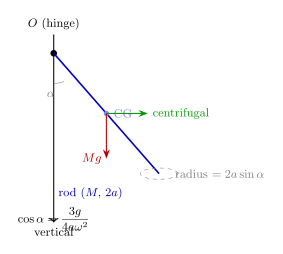
Steady precession of a rod. A uniform rod of mass , length , hinged at and revolving at steady angular velocity making angle with the vertical:
- Gravity moment about (tending to decrease ): .
- Centrifugal moment about (tending to increase ): .
For rod of length : .
Balancing at steady state: , giving
Conservation of horizontal CG. If no external horizontal force acts (smooth floor), the horizontal centre of mass of the system is constant. Use this to find the displacement of one body when another moves.
Question Archetypes
| Archetype | Recognition |
|---|---|
| steady-precession | Uniform rod revolves steadily at angle to vertical; find |
| momentum-conservation | Man walks along board on smooth floor; find board displacement |
steady-precession (1 question(s); 2019)
Solution Template
- Identify: rod mass , length , hinged at , angle , angular velocity .
- Gravity moment about : .
- Centrifugal moment about : where .
- Balance: ; cancel , , (for non-vertical steady state).
- Solve: .
- State existence condition: requires .
Worked Example
2019 Paper 2, 2019-P2-Q5c (10 marks)
A uniform rod of length is hinged at and revolves at angular velocity at constant angle to the vertical. Find .
Centrifugal moment: .
Gravity moment: .
Balance (): .
Physical meaning: equivalent to a simple conical pendulum of effective length .
Common Traps
- Two factors of in the centrifugal integral. The centrifugal force on element is (proportional to horizontal radius ), and the moment arm about the horizontal axis through is (vertical distance). Together: , giving .
- for length rod. , not .
- Check validity. If , the equation has no solution; the only steady configuration is (rod hangs down). Always report the existence condition.
momentum-conservation (1 question(s); 2024)
Solution Template
- No external horizontal force → CG of the whole system is conserved.
- Write: initial CG final CG.
- Initial positions of all bodies; final positions after displacement.
- Solve for the unknown displacement.
Worked Example
2024 Paper 2, 2024-P2-Q5d (10 marks)
A board of mass , length rests on a smooth horizontal plane. A man of mass walks from one end to the other. Find the distance moved by the board.
Let board’s CG initially at ; man initially at (one end). Let the board shift by .
Initial CG: .
Final CG (board shifted by , man at the other end ): .
Setting equal: , giving .
Common Traps
- The floor is smooth (no external horizontal force). “Rough board” refers to friction between man and board (internal); it’s the floor that must be smooth for CG conservation to apply.
- The man walks a distance relative to the board. His displacement relative to the ground is (he moves on the board while the board moves opposite). The CG equation handles this automatically.
- Direction: the board moves opposite to the man. If the man walks in the direction, the board shifts in the direction (momentum conservation: no net horizontal momentum initially).
Marks-Aware Writing
For steady precession (10 marks): draw or describe the forces (gravity, hinge reaction, centrifugal); take moments about (state why: to eliminate hinge reaction); write the centrifugal integral with both and factors; evaluate ; balance and solve. Show the existence condition.
For momentum conservation (10 marks): state “no external horizontal force → CG conserved”; write the CG equation; solve for ; state direction. Four clear steps.
Practice Set
- 2023-P2-Q7b (15 m) — — Rolling rigid body on a surface; more complex but uses the same inertia integrals.