Navier-Stokes equation for a viscous fluid
At a Glance
- Frequency: 3 sub-parts across 3 of 13 years (2014, 2023, 2025)
- Priority tier: T3
- Marks (count): 20 (3)
- Average solve time: ~17 min
- Difficulty mix: hard 2, medium 1
- Section: B | Dominant type: derivation
Why This Chapter Matters
Navier-Stokes questions carry 20 marks each and appear in Section B — the highest-value slot in the paper. Two distinct archetypes have appeared: deriving the parabolic velocity profile for channel (Poiseuille) flow by reducing and integrating the NS equations (2014), and verifying that a given velocity field satisfies the full NS equations and recovering the pressure distribution (2023, 2025). The verification type has appeared twice in the last three years and is likely to recur. Both types reduce to straightforward algebra once the student knows the Navier-Stokes equation, the continuity equation, and the structure of the inertia term — there is no need to know the full derivation of NS from first principles.
Minimum Theory
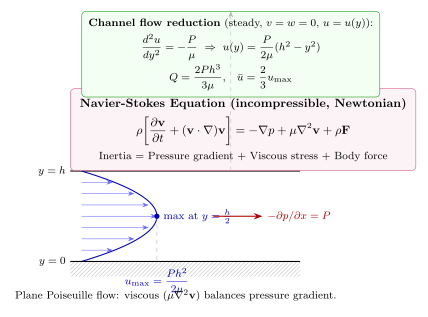
Navier-Stokes Equation. For an incompressible Newtonian viscous fluid with constant viscosity :
together with the incompressibility condition . The four terms on the two sides are: inertia (left), pressure gradient, viscous stress , and body force. For steady flow .
Channel-Flow Reduction (Poiseuille/Couette–Poiseuille). For parallel flow : continuity gives automatically; the convective term ; the -momentum equation reduces to:
With (constant, drives flow) and no-slip at the walls, the solution is the parabolic (Poiseuille) profile. For Couette–Poiseuille flow (one wall moving at speed ), the profile has an additional linear term.
Verification Approach. When a velocity field is given and you must “show it satisfies the equations of motion”: (1) check continuity; (2) compute the inertia and viscous terms; (3) substitute into each component of NS; (4) show the residual in each component is zero or is balanced by ; (5) integrate to find , checking compatibility (mixed partial conditions).
Question Archetypes
| Archetype | Recognition |
|---|---|
| navier-stokes-verification | Given velocity field; show it satisfies NS; find pressure distribution |
| navier-stokes-channel | ”Find the velocity profile for laminar flow between parallel plates” |
navier-stokes-verification (2 question(s); 2023, 2025)
Recognition Cues — The question provides explicit velocity components , , (or a profile ) and asks you to “show that this satisfies the equation of motion” or “determine under what conditions” it is a solution. The task is substitution and verification, not derivation.
Solution Template
- Continuity: compute and show it equals zero.
- Inertia term: for each component, compute .
- Viscous term: for each component, compute .
- NS equations: for each component, the equation is . If inertia and viscous terms are both zero, . Otherwise, set (viscous term) (inertia term).
- Pressure: integrate for each ; check compatibility (); assemble .
Worked Example(s)
2023 Paper 2, 2023-P2-Q8c (20 marks)
Determine under what conditions , , is a solution to Navier-Stokes with , .
Step 1 — Continuity.
Incompressibility is satisfied for any constant .
Step 2 — Viscous terms. Each velocity component is harmonic:
Viscous stresses vanish, so NS reduces to Euler form: .
Step 3 — Inertia terms.
Step 4 — Conditions. From the NS equations:
Compatibility check: ✓. The system is consistent for any constant and any viscosity . The only condition needed is incompressibility — which already holds.
Step 5 — Pressure. Integrate in :
Differentiate in and match : .
Match : .
Noting :
This is the Bernoulli form since (by the same identity as MF-08).
2025 Paper 2, 2025-P2-Q7c (20 marks)
Show that , , , satisfies the equation of motion with no body force.
Step 1 — Continuity. since depends only on ; . So . ✓
Step 2 — Inertia term vanishes. (since has no -dependence). The convective acceleration is zero.
Step 3 — -momentum. The NS -equation reduces to .
Let (constant). Expand :
Then:
So . Satisfied. ✓
Step 4 — and momentum. and gives and , so both equations read . ✓
The balance is : viscous stress equals the pressure gradient. This is the plane Couette–Poiseuille profile (linear Couette part parabolic Poiseuille part).
Common Traps
- Not showing the inertia term vanishes. In the 2025 problem the convective acceleration is zero because has no -dependence. This must be stated explicitly; examiners award marks for it.
- Viscous terms vanishing (2023). The Laplacian because each component is harmonic (linear in second-order terms that cancel). This is the key condition that removes from the equations. State it after the computation.
- Checking only the -momentum equation. The and equations (with ) also need to be addressed — even if they reduce trivially to , show the step.
- Pressure integration constants. When integrating for a 2D or 3D flow, the “constant” after integrating in is a function of and , not a number. Carry it through and pin it down with the remaining equations.
navier-stokes-channel (1 question(s); 2014)
Recognition Cues — “Find the Navier-Stokes equation for steady laminar flow between two parallel plates” or “derive the velocity distribution for viscous flow in a channel”. You are expected to start from the full NS equation, apply the symmetry assumptions, reduce to an ODE, and integrate with no-slip boundary conditions.
Solution Template
- Assume . State why: steady + parallel laminar flow.
- Continuity: ✓ (since depends only on ).
- Convective term: (no -gradient of ). State this makes the problem linear.
- - and -momentum: , so only.
- -momentum: . Set (const).
- Integrate twice: .
- Apply no-slip at : determine , .
- State key results: , volume flux , mean velocity .
Worked Example(s)
2014 Paper 2, 2014-P2-Q8c (20 marks)
Find the Navier-Stokes equation for steady laminar flow of a viscous incompressible fluid between two infinite parallel plates.
Plates at ; flow in the -direction driven by pressure gradient .
Step 1 — Assumptions and NS. With , steady flow:
Steady: . Continuity: ✓. Convective: .
Step 2 — Reduced equations.
- : .
- : .
Set :
Step 3 — Integrate.
Step 4 — Boundary conditions. No-slip at :
Subtract: . Add: .
Step 5 — Profile and derived quantities.
Maximum at : .
Volume flux per unit width:
Mean velocity: .
Common Traps
- Convective term is zero, but it must be shown. Write (since has no -dependence); this is what makes the problem linear.
- Sign of pressure gradient. Setting with gives flow in the direction. Without the minus sign, would be negative everywhere.
- Symmetric BCs give . Using only and forgetting leaves undetermined.
- Volume flux formula. , and the mean velocity is , not .
Marks-Aware Writing
20-mark derivation (channel flow). The examiner wants to see the full NS equation written out, the reduction steps stated with justification (steady, continuity, parallel flow), the ODE, the double integration, the application of both boundary conditions, and the final profile. State and since these are standard results that full-marks answers include. Expect to write 8–10 lines of algebra.
20-mark verification. The examiner wants to see each of the four steps: continuity, inertia calculation, viscous/Laplacian calculation, and pressure integration. For flows where the inertia or viscous term vanishes, state this explicitly and show the computation — do not skip the calculation because the answer is zero. Show the compatibility check when integrating . A complete verification of all three momentum components (not just the -component) is needed for full marks.