Frequency: 10 sub-parts across 9 of 13 years (2014, 2016, 2017, 2018, 2019, 2020, 2021, 2022, 2024)
Priority tier: T1
Marks (count): 10 (2), 15 (4), 20 (4)
Average solve time: ~12 min
Difficulty mix: medium 5, hard 3, easy 2
Section: B | Dominant type: derivation
Why This Chapter Matters
Potential flow has appeared in 9 of the last 11 years with a heavy skew toward 15- and 20-mark questions — the highest average mark of any T1 fluid dynamics atom. The questions always resolve into one of five patterns: find the stream function from a given potential, verify incompressibility and find the potential, compute streamlines via the streamline ODE, analyse a complex potential, or apply unsteady Bernoulli. Mastering the Cauchy–Riemann relations between ϕ and ψ and the two-step streamline integration covers four of the five patterns.
Minimum Theory
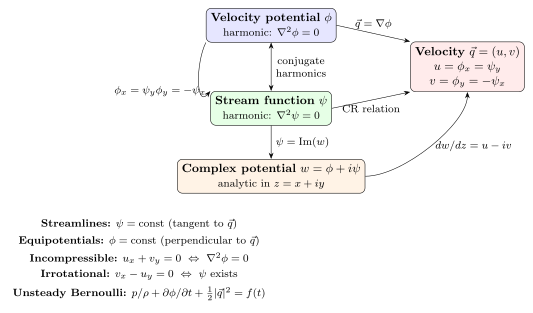
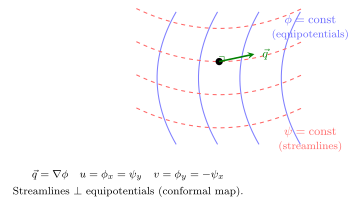
Velocity potential and stream function. For an irrotational incompressible 2D flow, there exists a velocity potential ϕ(x,y) with q=∇ϕ, i.e. u=ϕx,v=ϕy. Incompressibility (∇⋅q=0) forces ϕ to be harmonic: ∇2ϕ=ϕxx+ϕyy=0. The conjugate harmonic ψ (the stream function) satisfies the Cauchy–Riemann relations u=ψy,v=−ψx. Streamlines are ψ=const and are everywhere perpendicular to the equipotentials ϕ=const. The complex potential w=ϕ+iψ is analytic in z=x+iy, and the complex velocity is dw/dz=u−iv.
Sign note. Some authors write q=−∇ϕ. The 2017 and 2016 UPSC solutions use this convention; the 2018, 2020, 2021 solutions use q=+∇ϕ. Either is acceptable — state it clearly at the start of every answer.
Testing motion possibility and finding ψ. A velocity potential ϕ represents a possible (incompressible irrotational) flow iff ∇2ϕ=0. To find ψ: integrate ∂ψ/∂y=u w.r.t. y to get ψ=∫udy+g(x); then differentiate and match −∂ψ/∂x=v to determine g(x).
Streamlines in 3D and special flows. Streamlines satisfy the ODE dx/u=dy/v=dz/w; integrate pairwise to find two independent first integrals. Key building blocks: uniform flow (ϕ=Ux, streamlines horizontal); source/sink (ϕ=mlnr in 2D, ϕ=−m/r in 3D); point vortex (ϕ=Γθ/2π, streamlines = concentric circles, multi-valued); doublet/dipole in 3D (ϕ=−Mcosθ/r2, streamlines sin2θ/r=const). Unsteady irrotational flow satisfies Bernoulli’s equation: p/ρ+∂ϕ/∂t+21∣q∣2=f(t), with f(t)=p∞/ρ when the fluid is at rest at infinity.
Question Archetypes
Five patterns cover every potential flow question in the corpus.
Streamlines. From dx/x=dy/y: meridian planes y/x=C1. In each plane, Stokes stream function ψ=ρ2/r3 (with ρ=x2+y2) gives:
xy=C1,(x2+y2+z2)3/2x2+y2=C2.
(Classical doublet/dipole streamlines — sin2θ/r=C2 in spherical coordinates.)
2022 Paper 2, 2022-P2-Q5e (10 marks)
Spherical velocity: vr=2Mr−3cosθ, vθ=Mr−3sinθ (corrected exponent). Show potential flow; find ϕ and streamlines.
Irrotationality (spherical ψ-component of curl):
(∇×v)ϕ=r1[∂r∂(rvθ)−∂θ∂vr]=r1[−2Mr−3sinθ−(−2Mr−3sinθ)]=0.✓
Velocity potential.vr=∂ϕ/∂r=2Mcosθ/r3; integrate: ϕ=−Mcosθ/r2+g(θ). Match vθ=(1/r)∂ϕ/∂θ=Msinθ/r3: g′(θ)=0.
ϕ=−r2Mcosθ(3D doublet/dipole).
Streamlines via Stokes stream function: ψ=Msin2θ/r, so streamlines are sin2θ/r=const.
Common Traps
Possible flow = ∇2ϕ=0 (not just “irrotational”). A velocity potential automatically implies irrotational; the remaining condition is harmonicity, which is equivalent to incompressibility.
Stream function sign conventionu=ψy,v=−ψx (not u=−ψy). A sign slip flips ψ and gives the wrong conjugate.
The arbitrary constant C in ψ is genuine (stream functions are defined up to an additive constant); don’t set it to zero unless a boundary condition requires it.
In 3D, streamlines require the Stokes stream function (in spherical or cylindrical coords), not naive integration of dz/w. The 2017 doublet streamlines need ψ=ρ2/r3, not y/x=const alone.
ϕ is given; you must find the streamlines (no ψ computation required in full — just identify level curves).
The potential is often a logarithm or simple polynomial; the streamlines are geometric objects (circles, planes, ruled surfaces).
Solution Template
Compute q=∇ϕ to get u,v (2D) or u,v,w (3D).
2D: use the complex potential w=ϕ+iψ; read ψ=Im(w); streamlines are ψ=const.
3D: write the streamline ODEs dx/u=dy/v=dz/w; integrate pairwise to get two independent first integrals f(x,y,z)=C1 and g(x,y,z)=C2.
Identify the geometric shape of the level curves (circles, planes, hyperboloids, etc.).
Worked Example(s)
2014 Paper 2, 2014-P2-Q7c (20 marks)
ϕ=21log[(x−a)2+y2(x+a)2+y2]. Determine the streamlines.
Identify the flow. Write ϕ=lnr1−lnr2 where r1,2=(x±a)2+y2. This is a source at (−a,0) and sink at (a,0) of unit strength.
Complex potential.w=log(z+a)−log(z−a)=logz−az+a.
Stream function.ψ=Im(w)=argz−az+a=θ1−θ2, where θ1,θ2 are the angles from (∓a,0) to (x,y).
Streamlines ψ=k. Setting θ1−θ2=k and using tan(θ1−θ2)=−2ay/(x2+y2−a2):
x2+y2+k2ay−a2=0⟹x2+(y+ka)2=k2a2(k2+1).
Streamlines are circles centred on the y-axis, each passing through (±a,0).
(Inscribed-angle theorem: constant subtended angle ⟺ circular arc through the chord endpoints.)
2024 Paper 2, 2024-P2-Q5e (10 marks)
ϕ=21(x2+y2−2z2). Determine the streamlines.
Velocity.u=x, v=y, w=−2z. (Check: ∇2ϕ=1+1−2=0 ✓.)
Streamline ODEs.dx/x=dy/y=dz/(−2z).
Pair 1 (dx/x=dy/y): y/x=C1.
Pair 2 (dx/x=dz/(−2z)): 2ln∣x∣+ln∣z∣=const, i.e. x2z=C2.
xy=C1andx2z=C2.
(Intersections of meridian planes y=C1x with hyperbolic surfaces z=C2/x2. These are not circles — check ∇2ϕ=0 to confirm this is genuinely a potential flow.)
Common Traps
3D streamlines are curves (two equations), not surfaces. Reporting only one first integral is incomplete.
The inscribed-angle construction for the source-sink potential (2014) converts the algebra into a familiar geometric statement; derive it, don’t just quote it.
Don’t confuse streamlines (ψ=const) with equipotentials (ϕ=const) — in the 2024 problem, ϕ=const gives hyperboloids x2+y2−2z2=const, which are the equipotentials, not the streamlines.
complex-potential-analysis (1 question(s); 2021)
Recognition Cues
A complex function w(z) is given as the “complex potential” (or “complex velocity potential”); you must extract the real and imaginary parts and identify the resulting curves.
The question asks for streamlines, equipotentials, velocity, and singularities.
Solution Template
Write w=ϕ+iψ by expressing w in terms of z=x+iy.
For w involving log or arctan: use log(ReiΘ)=lnR+iΘ to identify ϕ=Θ/2 or ϕ=lnR, etc.
Streamlines: set ψ=const and identify the geometric locus (often a circle or line).
Equipotentials: set ϕ=const — these are the orthogonal family.
Velocity: dw/dz=u−iv; compute this derivative.
Singularities: where dw/dz is undefined or where w has a branch point.
Worked Example(s)
2021 Paper 2, 2021-P2-Q8c (20 marks)
Complex potential w=tan−1z. Show streamlines and equipotential curves are circles; find velocity; check singularities at z=±i.
Logarithmic form.w=tan−1z=2i1ln1−iz1+iz.
Write 1−iz1+iz=ReiΘ. Since Re(w)=Θ/2=ϕ and Im(w)=−lnR/2=ψ.
Compute: R=∣1−iz∣∣1+iz∣=(1+y)2+x2(1−y)2+x2.
Streamlines (ψ= const, i.e. R= const):
x2+(1+y)2x2+(1−y)2=k⟹x2+(y−1−k1+k)2=(1−k)24k.
These are circles with centres on the y-axis passing through (0,±1).
Equipotentials (ϕ= const, Θ= const): the angle subtended at (x,y) by the segment [−i,+i] is constant. By the inscribed-angle theorem, equipotentials are also circles through (0,±1), orthogonal to the streamlines.
Velocity.dw/dz=1+z21.
Singularities.1+z2=0⇒z=±i: logarithmic branch points of w; velocity diverges there.
Both families are circles through (0,±1);V=1/(1+z2);branch points at z=±i.
Common Traps
The denominator factor (1−k) in the streamline circle equation vanishes at k=1 (the x-axis, a degenerate streamline); handle this limiting case separately.
The inscribed-angle theorem applies to both families: Θ=const and lnR=const each describe a Steiner circle pencil through the two branch points ±i.
potential-boundary-value (1 question(s); 2016)
Recognition Cues
Liquid fills the region between two surfaces (spheres, cylinders); each boundary moves with a specified velocity.
You must find ϕ matching the normal-velocity condition (−∇ϕ)⋅n^=W⋅n^ on each boundary.
Solution Template
Write ϕ as a linear combination of the elementary harmonic functions appropriate to the geometry (e.g. x,x/r3 for each Cartesian direction in 3D spherical geometry).
Compute the normal velocity ∂ϕ/∂r on each shell.
Match to the specified boundary velocity component in the normal direction — this gives one equation per shell per direction.
Solve the linear system for the coefficients.
Compute q=−∇ϕ to find the velocity at any interior point.
Worked Example(s)
2016 Paper 2, 2016-P2-Q7b (20 marks)
Liquid between concentric spheres r=a (moving Ui^) and r=b (moving Vj^). Show the potential is ϕ=[a3U(1+21b3r−3)x−b3V(1+21a3r−3)y]/(b3−a3) and find the velocity.
Harmonic ansatz. The natural harmonics linear in a direction are x and x/r3 (each satisfies ∇2=0). Take ϕ=(Ax+Bx/r3)+(Cy+Ey/r3), with the x-group carrying the inner-sphere U-condition and the y-group the outer-sphere V-condition.
Boundary conditions (normal velocity on each sphere, q=−∇ϕ, n^=r/r):
Inner r=a, normal velocity =U(x/a): gives two equations for A,B.
Outer r=b, normal velocity =V(y/b): gives two equations for C,E.
Velocity. Differentiating ϕ using ∂x(x/r3)=r−3−3x2r−5 etc.:
q=b3−a3−a3Ui^+b3Vj^+2r3(b3−a3)a3b3[r3(d⋅r^)r^⋅r−d],d=Ui^−Vj^.
Common Traps
Normal-velocity BC: (−∇ϕ)⋅n^=W⋅n^, not (−∇ϕ)⋅W. Use n^=r/r and project W onto n^ explicitly.
The x- and y-motions decouple: solve two 2×2 systems, not one 4×4.
Differentiating x/r3 yields cross terms (∂y(x/r3)=−3xy/r5), so u depends on V and w=0 even though the shells move in the xy-plane.
unsteady-bernoulli (1 question(s); 2019)
Recognition Cues
A sphere (or bubble) of time-varying radiusR(t) is embedded in fluid at rest at infinity; find the surface pressure.
The phrase “vibrating sphere” or “pulsating bubble” signals this archetype.
The unsteady Bernoulli term ∂ϕ/∂t is the distinguishing feature.
Solution Template
Write ϕ=−F(t)/r (radial harmonic for incompressible irrotational flow at infinity, decaying). From u=∂ϕ/∂r=F/r2 and the BC u(R,t)=R˙: determine F(t)=R2R˙.
Compute ∂ϕ/∂t at r=R; compute u2 at r=R.
Apply unsteady Bernoulli: p=Π−ρ(∂ϕ/∂t+21u2) (where Π = pressure at infinity).
Substitute and simplify. Common result: pR=Π+ρ(RR¨+23R˙2).
If required, rewrite using d2(R2)/dt2=2R˙2+2RR¨ to match the stated form.
Worked Example(s)
2019 Paper 2, 2019-P2-Q8b (15 marks)
Sphere radius R(t) vibrates radially in infinite incompressible fluid. Establish the surface pressure Π+21ρ{d2(R2)/dt2+(R˙)2}.
Step 1 — Velocity potential. Radial symmetry: ϕ=−F(t)/r, u=F/r2. BC at r=R: F=R2R˙. So ϕ=−R2R˙/r.
Step 2 — Terms at r=R.∂t∂ϕR=−dtd(R2R˙)=−(2RR˙2+R2R¨),u2∣R=R˙2.
Step 4 — Reconcile with printed form.21ρ{d2(R2)/dt2+R˙2}=21ρ{(2R˙2+2RR¨)+R˙2}=ρ(RR¨+23R˙2). ✓
pR=Π+21ρ{dt2d2(R2)+(dtdR)2}.■
Common Traps
Must use unsteady Bernoulli (keep ∂ϕ/∂t); the quasi-steady form drops this term entirely and gives a wrong answer.
The 23R˙2 arises as +2R˙2 (from ∂ϕ/∂t) minus 21R˙2 (from the −21u2 sign). Tracking the sign of u2 in Bernoulli (−21u2 on the RHS or +21u2 on the LHS) is the main source of errors.
The printed UPSC notation dt2d2R2 means dt2d2(R2)=2R˙2+2RR¨, not(dt2d2R)2 or dt2d2R.
Marks-Aware Writing
10-mark questions (2022-Q5e, 2024-Q5e): One to two sentences of setup (state ϕ or the flow type), then execute the algorithm. For streamlines: write the two ODEs, integrate in pairs, box the result. No lengthy preamble.
15-mark questions (2017, 2018, 2019, 2020): Three to four clear steps. For the stream function: verify possibility (∇2ϕ=0), then integrate step by step. For unsteady Bernoulli: label Steps 1–3 (potential, evaluate at r=R, Bernoulli). The verification step at the end earns the final method marks.
20-mark questions (2014, 2016, 2021-Q7c, 2021-Q8c): Full proof format. For boundary-value problems: state the harmonic ansatz, write both BCs, solve the coefficient system, then differentiate for velocity. For complex potentials: extract ϕ,ψ explicitly, then show each geometric claim separately (streamlines circles, equipotentials circles, velocity, singularities).
Practice Set
Year
Paper/Q
Marks
Archetype
One-line hint
2022
P2-Q5e
10
potential-stream-function
Spherical dipole; check curl-free in spherical; ϕ=−Mcosθ/r2
2024
P2-Q5e
10
streamlines-from-potential
q=(x,y,−2z); pair 1: y/x=C1; pair 2: x2z=C2
2020
P2-Q7c
15
potential-stream-function
ϕ=xy+x2−y2; integrate ψy=y+2x then match ψx
2018
P2-Q8b
15
potential-stream-function
Check ∇2ϕ=0; integrate CR relations to get ψ=x2y+xy2−31(x3+y3)
2017
P2-Q8c
15
potential-stream-function
Divergence cancellation uses x2+y2=r2−z2; ϕ=z/r3 with q=−∇ϕ