Sources, sinks, doublets
At a Glance
- Frequency: 8 sub-parts across 8 of 13 years (2013, 2015, 2016, 2019, 2020, 2021, 2023, 2025)
- Priority tier: T1
- Marks (count): 10 (4), 15 (3), 20 (1)
- Average solve time: ~13 min
- Difficulty mix: medium 3, hard 3, easy 2
- Section: B | Dominant type: derivation
Why This Chapter Matters
Sources and sinks appear in 8 of the last 13 years — the most consistent fluid dynamics atom in Paper 2 — with questions spread across 10-, 15-, and 20-mark slots. Every question reduces to one of four tasks: read off singularity strengths from a complex potential, derive streamlines by setting ψ=Im(w)=const, apply the image method to enforce a rigid-wall boundary condition, or use the Milne–Thomson circle theorem for flow inside a circular boundary. The 2025 paper revived the circle theorem (last used in 2013), confirming that the image-boundary archetype resurfaces unpredictably — it cannot be skipped.
Minimum Theory
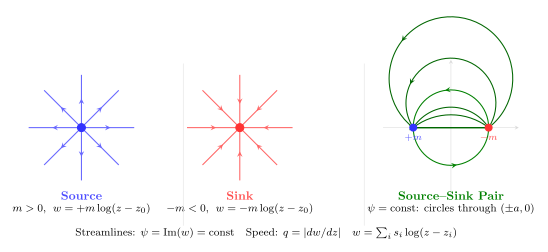
Complex potential. For two-dimensional incompressible irrotational flow, a source of strength m at z0 has complex potential w=mlog(z−z0); a sink of strength m contributes −mlog(z−z0). Superposition is exact: add potentials for each singularity. The stream function is ψ=Im(w) and streamlines are the level curves ψ=const. The complex velocity is dw/dz=u−iv; the fluid speed at any point is q=∣dw/dz∣.
Image method for a rigid wall. To enforce zero normal velocity on the boundary y=0 (a rigid wall), place an image singularity of the same type and strength at the mirror point across y=0. A source m at (x0,y0) gets an image source m at (x0,−y0); a sink −m gets an image sink −m. The wall is then automatically a streamline. Pressure on the wall via Bernoulli: p∞−p=21ρ∣V∣2 (with ∣V∣ computed from the full image system on y=0); integrate over the wall to get the net force.
Milne–Thomson circle theorem. For flow in the region outside or inside the circle ∣z∣=a: a singularity (source or sink) of strength s at an interior point z0=b (real, 0<b<a) is imaged as a singularity of the same strength at the inverse point a2/b plus an opposite-strength singularity at the origin. Specifically, a source +m at b inside ∣z∣=a is accompanied by an image source +m at a2/b and an image sink −m at 0; a sink −m at b is accompanied by −m at a2/b and +m at 0. Image singularities at the origin from a source-sink pair of equal strength cancel. The circle ∣z∣=a becomes a streamline automatically.
Flow past a cylinder. Uniform stream U0 past a stationary cylinder of radius a:
w(z)=U0(z+za2),ϕ=U0(r+ra2)cosθ,ψ=U0(r−ra2)sinθ.
The cylinder r=a satisfies ψ=0 (a streamline). Stagnation points at (±a,0) where dw/dz=0.
Source in a 3D uniform stream (axisymmetric). A point source of strength m at the origin in a uniform stream Ui^ has velocity potential ϕ=m/r−Urcosθ (spherical polars; convention q=−∇ϕ). The Stokes stream function is ψ=21Ur2sin2θ−mcosθ; streamlines are Ur2sin2θ−2mcosθ=const.
Question Archetypes
Four patterns cover every source/sink question in the corpus.
| Archetype | You are seeing this when… |
|---|
| source-sink-streamlines | a complex potential or a source/sink configuration is given; find or sketch the streamlines |
| image-source-sink | a source or sink near a rigid wall or boundary; use image method; find pressure or streamlines |
| flow-past-cylinder | uniform stream past a cylinder; find ϕ, ψ, stagnation points |
| source-in-stream | 3D axisymmetric source in a uniform stream (Rankine body); derive the potential and streamline ODE |
source-sink-streamlines (4 question(s); 2019, 2020, 2021, 2023)
Recognition Cues
- A combination of sources and sinks is specified (by position and strength, or via w); the question asks to “find” or “show” the streamlines, or to compute the speed.
- The phrase “stream function” or “streamlines are the curves…” signals this archetype.
- A complex potential involving multiple log terms (or a product ratio) → extract ψ=Im(w).
Solution Template
- Write the complex potential w=∑isilog(z−zi) (source = +, sink = −).
- Combine logarithms into a single log(ratio or product).
- Compute ψ=Im(w). Setting ψ=const is equivalent to: arg(…)=const, i.e. the imaginary-to-real ratio of the argument is constant.
- Cross-multiply the ratio to obtain an algebraic curve in x,y; introduce a free parameter λ or k for the family.
- For speed: compute dw/dz as a single fraction (combine over a common denominator); simplify the numerator (often terms cancel, leaving a pure constant times z-factors); take ∣dw/dz∣ and identify each factor as a distance ri=∣z−zi∣.
Worked Example(s)
2019 Paper 2, 2019-P2-Q8c (20 marks)
Two sources, each of strength m, at (−a,0),(a,0) and a sink of strength 2m at origin. Show streamlines are (x2+y2)2=a2(x2−y2+λxy) and speed is 2ma2/(r1r2r3).
Complex potential. Sources at ±a, sink 2m at origin:
w=mlog(z−a)+mlog(z+a)−2mlogz=mlogz2z2−a2.
Stream function. Write 1−a2/z2 and use 1/z2=zˉ2/∣z∣4:
Im(1−z2a2)=(x2+y2)22a2xy,Re(1−z2a2)=1−(x2+y2)2a2(x2−y2).
Constant argument: Im/Re=c. Cross-multiply and write λ=2/c:
(x2+y2)2=a2(x2−y2+λxy).
Speed. Combine dw/dz over the common denominator z(z−a)(z+a):
dzdw=z(z2−a2)mz(z+a)+mz(z−a)−2m(z2−a2)=z(z−a)(z+a)2mz2−2mz2+2ma2=z(z−a)(z+a)2ma2.
The middle terms cancel exactly (why the numerator is constant). Taking moduli with r3=∣z∣, r1=∣z−a∣, r2=∣z+a∣:
q=r1r2r32ma2.
2020 Paper 2, 2020-P2-Q8c (15 marks)
Two sources of strength m/2 at (±a,0). Show at any point on circle x2+y2=a2, velocity is parallel to the y-axis and inversely proportional to y.
Velocity field. Source S=m/2 at (a,0) and (−a,0); superpose the Cartesian velocity fields. The x-component:
u=S[(x−a)2+y2x−a+(x+a)2+y2x+a].
On the circle x2+y2=a2, the denominators simplify: (x∓a)2+y2=2a(a∓x). Then:
u=S[2a(a−x)−(a−x)+2a(a+x)a+x]=S[−2a1+2a1]=0.
Velocity parallel to y-axis. ✓
y-component:
v=S[2a(a−x)y+2a(a+x)y]=2aSy⋅a2−x22a=a2−x2Sy.
On the circle a2−x2=y2:
v=yS=2ym.v∝y1. ■
2021 Paper 2, 2021-P2-Q5e (10 marks)
w=log(z−a2/z). What sources/sinks? Sketch streamlines; show two streamlines are r=a and y-axis.
Identify singularities. Factor: z−a2/z=(z2−a2)/z=(z−a)(z+a)/z.
w=log(z−a)+log(z+a)−logz.
Two sources at z=±a; one sink at z=0.
Stream function. ψ=arg(z−a)+arg(z+a)−argz=θ1+θ2−θ.
y-axis (z=iy, y>0). By symmetry θ1+θ2=π (angles from ±a to a point above add to a straight angle), and θ=π/2. So ψ=π−π/2=π/2: constant ⇒ y-axis is a streamline.
Circle r=a. At z=ai: θ1=arg(−a+ai)=3π/4, θ2=arg(a+ai)=π/4, θ=π/2. So ψ=3π/4+π/4−π/2=π/2: same constant. Check another point (z=aeiπ/4) and the value remains π/2 — the circle r=a is the same streamline ψ=π/2.
The two branches meet at the stagnation points (dw/dz=0): z2+a2=0⇒z=±ia.
Sources at (±a,0) and sink at origin; special streamlines = circle r=a and y-axis.
2023 Paper 2, 2023-P2-Q5e (10 marks)
Source 2m at z=2, sinks m at z=2±i. Find the streamlines.
Complex potential. Superpose and combine:
w=2mlog(z−2)−mlog(z−2−i)−mlog(z−2+i)=mlog(z−2)2+1(z−2)2.
Stream function. Set ζ=z−2=X+iY (X=x−2, Y=y). Streamlines ψ=const mean arg(ζ2/(ζ2+1))=const, i.e. Im/Re=const. Computing Im(ζ2(ζ2+1))=2XY and Re(…)=(X2+Y2)2+X2−Y2:
[(x−2)2+y2]2+(x−2)2−y22(x−2)y=k,k∈R.
Common Traps
- In the 2019 speed derivation, the middle terms 2mz2−2mz2 cancel exactly because the sink strength 2m equals the total source output. This is the reason the numerator collapses to the constant 2ma2 — look for total-strength balance as a predictor of clean cancellation.
- In the 2020 problem, the key identity (x∓a)2+y2=2a(a∓x) on the circle x2+y2=a2 must be derived (not assumed); write it out in the answer.
- In the 2021 problem, “sketch streamlines” requires identifying the stagnation points at (0,±a) where the y-axis and circle intersect and the streamline branches.
- Sign convention: source contributes +log, sink −log. Mixing signs flips ψ and reverses flow direction.
image-source-sink (2 question(s); 2013, 2025)
Recognition Cues
- A source or sink near a rigid wall (the phrase “rigid boundary” or “fluid fills the region y>0”).
- A source or sink inside a circular boundary ∣z∣=a (the circle theorem / Milne–Thomson).
- The question asks for resultant pressure on the wall, or asks to show streamlines include the circle boundary.
Solution Template
Rigid wall y=0 — image method:
- For each source +m at (x0,y0), add an image source +m at (x0,−y0).
- For each sink −m at (x0,y0), add an image sink −m at (x0,−y0).
- Write the complex potential for the full system. Verify: w is real on y=0 (normal velocity vanishes) ⇒ wall is a streamline.
- Compute w′(z)=dw/dz; on z=x (real), w′(x) is real (velocity is purely x-directed, confirming no y-flow).
- Pressure via Bernoulli: p∞−p=21ρ∣V∣2=21ρ[w′(x)]2.
- Force: F=∫−∞∞(p∞−p)dx. Evaluate by residues: poles of [w′(z)]2 in upper half-plane.
Inside circular boundary — circle theorem:
- Source +m at z0=b (real, 0<b<a): add source +m at a2/b, sink −m at 0.
- Sink −m at z0=b: add sink −m at a2/b, source +m at 0.
- Central images from a source-sink pair cancel (net zero at origin).
- Write w for all singularities; verify ∣z∣=a is a streamline (ψ=const on ∣z∣=a).
Worked Example(s)
2013 Paper 2, 2013-P2-Q8b (15 marks)
Source m at (0,a), sink m at (0,b) near rigid wall x-axis (fluid fills y>0). Show resultant pressure on the boundary is πρm2(a−b)2/[2ab(a+b)].
Image system. Reflect in y=0: image source m at (0,−a), image sink m at (0,−b) (same-sign reflection for rigid wall). Complex potential:
w=mlog(z2+a2)−mlog(z2+b2).
Velocity on wall. On z=x (real):
w′(x)=x2+a22mx−x2+b22mx=(x2+a2)(x2+b2)2mx(b2−a2).
This is real (v=0 on wall ✓). So ∣V∣2=[w′(x)]2.
Net force. F=21ρ∫−∞∞[w′(x)]2dx=2ρm2(a2−b2)2J where J=∫−∞∞(x2+a2)2(x2+b2)2x2dx.
Evaluate J by residues. Poles in upper half-plane: z=ia (order 2), z=ib (order 2). After computing residues and combining:
J=2ab(a+b)3π.
Assemble:
F=2ρm2(a−b)2(a+b)2⋅2ab(a+b)3π=ab(a+b)πρm2(a−b)2.
Convention note. The stated answer has an extra factor of 1/2 in the denominator: 2ab(a+b)πρm2(a−b)2. This arises if the “strength m” convention uses w=2mlog(z−z0) (common in some UPSC textbooks), which halves the velocity and quarters ∣V∣2. The algebraic structure (a−b)2/[ab(a+b)] is the same; the multiplicative constant is convention-dependent.
2025 Paper 2, 2025-P2-Q5e (10 marks)
Source and sink of equal strength m at (±a/2,0) inside circle x2+y2=a2. Show streamlines are (r2−a2/4)(r2−4a2)−4a2y2=ky(r2−a2).
Image system (circle theorem). Source +m at b=a/2 → image +m at a2/(a/2)=2a, sink −m at 0. Sink −m at −a/2 → image −m at −2a, source +m at 0. The two central images cancel. System: +m at a/2, −m at −a/2, +m at 2a, −m at −2a.
Complex potential:
w=2πmlog(z+a/2)(z+2a)(z−a/2)(z−2a).
Streamlines. Set ζ=N/D where N=(z−a/2)(z−2a), D=(z+a/2)(z+2a). Streamlines are arg(N/D)=const, i.e. Re(NDˉ)=λIm(NDˉ) for constant λ. Direct expansion gives:
Im(NDˉ)=5ay(r2−a2),Re(NDˉ)=(r2−4a2)(r2−4a2)−4a2y2.
Writing k=5aλ:
(r2−4a2)(r2−4a2)−4a2y2=ky(r2−a2). ■
Common Traps
- Rigid wall vs. free surface: for a rigid wall, the image is same-strength and same-sign; for a free surface, it is opposite-sign. Swapping these gives wrong boundary conditions.
- Direction of force: Bernoulli with non-zero velocity gives p<p∞ in the fluid; the net force on the wall is therefore directed toward the fluid. Don’t reverse the sign of F.
- In the 2025 circle-theorem problem, be careful that the two central images (one −m from the source’s image and one +m from the sink’s image) cancel each other — the net singularity at the origin is zero. Missing this adds a spurious singularity to w.
- The inverse point of z0=b in ∣z∣=a is a2/zˉ0; for real b this is a2/b. Do not confuse this with the conjugate point zˉ0.
flow-past-cylinder (1 question(s); 2015)
Recognition Cues
- “Uniform flow U0 in +x direction past a cylinder of radius a.”
- Asks for the stream function, velocity potential, and stagnation points.
Solution Template
- State the complex potential w=U0(z+a2/z) (uniform flow + doublet at origin sized to cancel radial flow at r=a).
- Write z=reiθ; separate real and imaginary parts to get ϕ and ψ.
- Verify ψ=0 at r=a (cylinder is a streamline).
- Compute vr and vθ from ψ or ϕ; set both to zero for stagnation. Show sinθ=0 from vθ=0; then r=a from vr=0 (since cosθ=±1).
- State stagnation points at (±a,0).
Worked Example(s)
2015 Paper 2, 2015-P2-Q5d (10 marks)
Uniform flow U0 past cylinder radius a at origin. Find stream function, velocity potential, stagnation points.
Complex potential. w=U0(z+a2/z). Write z=reiθ:
w=U0[(r+ra2)cosθ+i(r−ra2)sinθ].
ϕ=U0(r+ra2)cosθ,ψ=U0(r−ra2)sinθ.
Verify cylinder. At r=a: ψ=U0(a−a)sinθ=0. ✓
Stagnation. From vθ=−ψr=−U0(1+a2/r2)sinθ=0: either sinθ=0 or r complex (impossible). So θ=0 or π. Then vr=U0(1−a2/r2)cosθ=0 with cosθ=±1 forces r=a.
Stagnation points: (±a,0).
Common Traps
- The stream function has the minus sign: ψ=U0(r−a2/r)sinθ; this is what makes ψ=0 on r=a. The velocity potential has a plus: ϕ=U0(r+a2/r)cosθ. A sign slip here gives an incorrect ψ.
- Two stagnation points, not one — don’t stop at θ=0 alone.
- The velocity components from ψ: vr=(1/r)ψθ, vθ=−ψr (polar form). Don’t mix up the factors of r.
source-in-stream (1 question(s); 2016)
Recognition Cues
- A point source (or “simple source”) of strength m in a uniform stream of velocity U in 3D.
- The question gives the velocity potential ϕ=m/r−Urcosθ to verify, then asks for the streamline ODE and shows the streamlines are surfaces Ur2sin2θ−2mcosθ=const.
- Key signal: spherical polars, axisymmetric flow, Stokes stream function.
Solution Template
- State the convention: q=−∇ϕ (so the stream requires ϕstream=−Urcosθ for q→Ui^).
- Superpose: ϕ=m/r+(−Urcosθ)=m/r−Urcosθ.
- Velocity components in spherical polars: qr=−∂ϕ/∂r, qθ=−(1/r)∂ϕ/∂θ.
- Stokes stream function ψ satisfies qr=(r2sinθ)−1ψθ and qθ=−(rsinθ)−1ψr. Integrate qr w.r.t. θ to get ψ; match qθ to determine the r-dependent constant.
- Streamlines are ψ=const, i.e. 21Ur2sin2θ−mcosθ=const, equivalently Ur2sin2θ−2mcosθ=const.
Worked Example(s)
2016 Paper 2, 2016-P2-Q6b (15 marks)
Source m at origin in uniform stream Ui^. Show ϕ=m/r−Urcosθ. Find streamline ODE; show streamlines lie on Ur2sin2θ−2mcosθ=const.
Step 1 — Superpose. Convention q=−∇ϕ. Source: ϕsrc=m/r, giving qr=m/r2 (outward). Uniform stream: ϕstream=−Urcosθ, giving −ϕz=U (i.e. q→Ui^).
ϕ=rm−Urcosθ.
Step 2 — Velocity.
qr=−∂r∂ϕ=r2m+Ucosθ,qθ=−r1∂θ∂ϕ=−Usinθ.
Step 3 — Stokes stream function. Integrate ψθ=r2sinθqr=msinθ+Ur2sinθcosθ:
ψ=−mcosθ+21Ur2sin2θ+g(r).
Check: −ψr/(rsinθ)=qθ=−Usinθ ⇒ ψr=Ursin2θ. From the expression: ψr=Ursin2θ+g′(r). So g′(r)=0 and g=const.
Streamlines ψ=const:
Ur2sin2θ−2mcosθ=const. ■
Common Traps
- Sign convention is critical. With q=−∇ϕ, the uniform stream requires ϕ=−Urcosθ, which is −Ux in Cartesian. A sign error here produces velocity in the −x direction, contradicting the problem setup — state the convention at the start of the answer.
- Use the Stokes (axisymmetric) stream function with the (r2sinθ)−1 and (rsinθ)−1 factors, not the 2D Cartesian stream function. The geometry is 3D axisymmetric and the two are different objects.
- The constant of integration g(r) is forced to zero by the qθ condition — this is a consistency check built into the method; always carry it through.
Marks-Aware Writing
10-mark questions (2015-Q5d, 2021-Q5e, 2023-Q5e, 2025-Q5e): Two to three setup sentences, then a clean step-by-step calculation. For streamlines: write the complex potential in combined form, extract ψ=Im(w), state the algebraic condition, box the result. No lengthy preamble about potential flow theory.
15-mark questions (2013-Q8b, 2016-Q6b, 2020-Q8c): Three to four labelled steps. For the wall-pressure problem: label Step 1 (image system + potential), Step 2 (velocity on wall), Step 3 (Bernoulli + integral), Step 4 (residues + assembly). Always verify that the wall is a streamline before proceeding to the pressure integral.
20-mark questions (2019-Q8c): Full proof format with two separate results. Show the streamlines first (this is a proof by algebraic manipulation), then compute the speed separately via ∣dw/dz∣. For the speed, simplify dw/dz by combining over a common denominator before taking the modulus — otherwise the factoring step is lost. The examiner expects both parts to be complete.
Practice Set
| Year | Paper/Q | Marks | Archetype | One-line hint |
|---|
| 2014 | P2-Q7c | 20 | source-sink-streamlines | ϕ=21log[(x+a)2+y2]−21log[(x−a)2+y2]; w=log[(z+a)/(z−a)]; ψ=θ1−θ2; streamlines are circles through (±a,0) by the inscribed-angle theorem |