Vortex motion; circulation
At a Glance
- Frequency: 6 sub-parts across 4 of 13 years (2013, 2016, 2022, 2024)
- Priority tier: T3
- Marks (count): 20 (1), 15 (2), 10 (3)
- Average solve time: ~12 min
- Difficulty mix: hard 3, medium 3
- Section: B | Dominant type: derivation
Why This Chapter Matters
Vortex motion is the highest-frequency T3 atom in Paper 2, appearing in Section B at 10–20 marks. The three most common question types are: (a) compute vorticity and circulation for a given velocity field; (b) show a flow is irrotational, find its streamlines, and identify a velocity potential; and (c) prove vortex lines are orthogonal to streamlines under a given condition. All three reduce to computing , , and solving simple differential equations. The key identity: any gradient field is curl-free; the key insight for (b): irrotational + incompressible = potential flow.
Minimum Theory
Vorticity. The vorticity of a velocity field is . The flow is irrotational if everywhere.
Circulation. The circulation around a closed curve is . By Stokes’ theorem, . If on the enclosed surface, then .
Potential flow. If on a simply-connected region, there exists a velocity potential with .
Incompressibility. (solenoidal flow). Required for the equation of continuity.
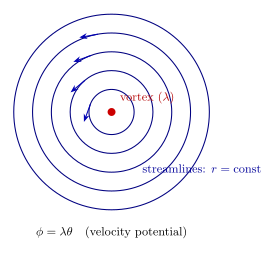
Point vortex. The fundamental irrotational, incompressible 2D flow with non-zero circulation around the origin: Streamlines: concentric circles . Velocity potential: (multi-valued; circulation ). Irrotational everywhere except at the origin singularity.
Gradient split. If (polynomial part plus a gradient), then (gradient is curl-free). This reduces vorticity calculations to the polynomial part only.
Question Archetypes
| Archetype | Recognition |
|---|---|
| vorticity-circulation | Given ; compute ; find circulation via Stokes |
| potential-stream-function | Show is incompressible; find streamlines; check irrotational; find |
| vortex-stream-orthogonality | Prove under a given condition |
vorticity-circulation (1 question(s); 2016)
Worked Example
2016 Paper 2, 2016-P2-Q5b (10 marks)
where . Find vorticity; find circulation around , .
Split: .
Since is a gradient: .
Vorticity of :
Circulation: by Stokes (zero curl on the disc).
Recognition pattern: when the velocity field splits as “polynomial + ”, check if is a gradient; radial fields are gradients of .
potential-stream-function (1 question(s); 2021)
Worked Example
2021 Paper 2, 2021-P2-Q7c (20 marks)
. Show incompressible, find streamlines, check irrotational, find velocity potential.
Incompressibility: . ✓
Streamlines: (cancel ). Cross-multiply: . Streamlines: concentric circles .
Irrotational: . (Away from origin.) ✓
Velocity potential: . So .
Note: is multi-valued (jumps by around the origin). The flow is the classical point vortex — irrotational everywhere except the singular origin, with circulation .
vortex-stream-orthogonality (covered in T2/neighbouring atoms)
The 2013 question (P2-MF-09 primary) asks to prove vortex lines are orthogonal to streamlines when . Key: (scalar triple product with a repeated factor). This is the pure curl-gradient orthogonality identity.
Common Traps
- is the key split. Recognising the radial part as a gradient saves computing directly. The identity is the foundation.
- Vorticity is zero, but circulation can be non-zero. The point vortex has away from the origin, but circulation around any curve enclosing the origin (the domain is not simply connected). Stokes only works for curves whose enclosed surface avoids the singularity.
- Velocity potential is multi-valued. is locally well-defined but globally multi-valued. UPSC accepts this for “find the velocity potential” — just state and note the multi-valuedness.
- Streamlines velocity. The streamlines of the point vortex are circles, which are everywhere perpendicular to the radial direction but the velocity itself is tangential (along the circles). Students sometimes confuse “streamline direction” with “velocity direction” — they are the same thing (streamlines are tangent to ).
Marks-Aware Writing
For vorticity + circulation (10 marks): split the field, identify the gradient part, compute component by component (show all three components vanish), then invoke Stokes. Four visible steps.
For the potential-flow question (20 marks): each of the four sub-tasks (incompressible, streamlines, irrotational, potential) earns separate marks. The streamlines step needs the ODE written out and solved. The potential step needs both partial derivatives of verified.
Practice Set
- 2013-P2-Q8c (20 m) — — Complex potential for point vortices; the sum identity is the key step.