Boolean algebra
At a Glance
- Frequency: 15 sub-parts across 12 of 13 years (2014, 2015, 2016, 2017, 2018, 2019, 2020, 2021, 2022, 2023, 2024, 2025)
- Priority tier: T1
- Marks (count): 10 (3), 15 (7), 5 (3), 7.5 (2)
- Average solve time: ~8 min
- Difficulty mix: easy 13, medium 2
- Section: B | Dominant type: computation
Why This Chapter Matters
Boolean algebra appears in 12 of the last 13 years — the most consistent T1 atom in Paper 2 — and the questions are almost always rated easy to medium. The examiner rotates through four tasks: simplify an expression (and draw its gate network), find the canonical DNF (sum of minterms), find the canonical CNF (product of maxterms), or read a Boolean function off a truth table. Each task has a mechanical algorithm. Unlike most Paper 2 topics, no creativity is needed — only a reliable procedure and careful bookkeeping. That makes Boolean algebra one of the most bankable 10–15 marks in the entire paper.
Minimum Theory
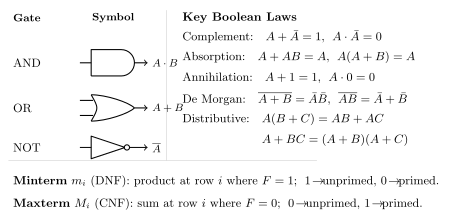
Boolean algebra. A Boolean algebra is a set with operations (OR), (AND), and (NOT), satisfying commutativity, associativity, distributivity, identity (, ), complement (, ), and idempotence (, ). The key derived laws that drive simplification are absorption (, ), annihilation (, ), and De Morgan (, ). Every simplification step should be named (UPSC awards method marks for this).
Canonical forms. A Boolean function of variables has rows in its truth table. The disjunctive normal form (DNF, sum of minterms) expresses as the OR of all minterms at rows where ; a minterm at row is the AND of all literals (variable unprimed if its bit is , primed if ). The conjunctive normal form (CNF, product of maxterms) expresses as the AND of all maxterms at rows where ; a maxterm at row is the OR of all literals ( unprimed, primed — opposite convention from minterms). The mnemonic: minterms live where ; maxterms live where ; priming conventions are dual.
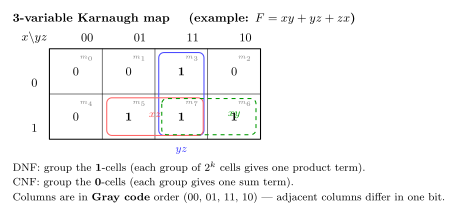
Karnaugh maps. A K-map arranges the truth-table rows in a grid whose adjacent cells differ in exactly one variable (Gray-code order for columns). Grouping adjacent 1-cells (DNF) or 0-cells (CNF) eliminates variables from the corresponding term. Cells wrap around the left/right and top/bottom edges. The minimal SOP or POS is the cover using the fewest, largest groups.
Question Archetypes
Five recurring patterns cover every Boolean algebra question in the corpus.
| Archetype | You are seeing this when… |
|---|---|
| boolean-simplification | ”simplify … and draw a gate/logic diagram” |
| normal-form-cnf | ”express as product of maxterms” / “find CNF / principal conjunctive normal form” |
| normal-form-dnf | ”express as sum of minterms” / “find DNF / principal disjunctive normal form” |
| boolean-from-truth-table | a truth table is given; derive the Boolean function and draw the gate circuit |
| boolean-identity-proof | ”show/prove that [Boolean identity] holds” |
boolean-simplification (6 question(s); 2016, 2017, 2018, 2019, 2022, 2025)
Recognition Cues
- Question gives a Boolean expression and says “simplify”, “minimise”, “reduce to simplest form”.
- Often appended with “draw a block/logic/gate diagram of the simplified expression.”
- Some questions also ask for the minterm normal form from the truth table.
- A circuit-first variant gives the expression as a hierarchical circuit and asks for the truth table then the simplification (2022).
Solution Template
- Write out the expression and scan for immediate opportunities: absorption ( or ), complementation (, ), and .
- Expand any products of sums via the distributive law if no shortcut is visible; then collect and apply laws. Name each rule as you use it.
- Verify the simplified form against the original using an 8-row (or 4-row) truth table. Write both the original and simplified columns and confirm they match.
- Draw the gate diagram for the simplified expression: inputs on the left, one logic gate per operator, output on the right. Label every wire and gate.
- If a minterm normal form is also required: identify the rows where in the truth table and write their full minterms (every variable, primed or unprimed).
Worked Example(s)
2016 Paper 2, 2016-P2-Q8c (15 marks)
Simplify and draw a block diagram.
1 — Scan. The leading factor appears as a bare literal. Three of the four bracketed factors contain a bare ; by absorption , each collapses: Only survives:
2 — Complement elimination.
3 — Truth table. exactly when and at least one of is : rows .
4 — Gate diagram.
  B ──┐
      ├─[OR]──(B+C)──┐
  C ──┘               ├─[AND]── F = A·(B+C)
  A ─────────────────┘
2017 Paper 2, 2017-P2-Q5c (10 marks)
Simplify . Name the rules used. Verify by truth tables.
Step 1. : expand to (distributive, idempotent). Then (absorption/annihilation). Rule: absorption ().
Step 2. : by the same absorption law (), this collapses to . Rule: absorption.
Truth table verification: both expressions produce columns over all 8 rows — identical ✓.
2018 Paper 2, 2018-P2-Q8a (15 marks)
Simplify and write its minterm normal form.
Expand. .
.
Combine. .
Group . Then . Then . Then .
Truth table. only at rows and ; at all others. Minterm form: :
2019 Paper 2, 2019-P2-Q8a (15 marks)
. Draw the logic diagram, minimise, draw reduced diagram.
Logic diagram (original). Four AND gates (, , , ) feed one OR gate; inverters produce .
Minimise.
- (absorption).
- (absorption).
Reduced diagram. NOT gate on → . OR gate on → . AND gate on → . (3 gates vs 5+ originally.)
2022 Paper 2, 2022-P2-Q6b (15 marks)
Find a combinatorial circuit for and write its input/output table.
Circuit (original expression). Gate hierarchy: NOT on → ; OR on → ; AND on → ; OR with → . Components: 1 NOT, 2 OR, 1 AND.
Simplify. . Use (identity ). Then .
Truth table ( irrelevant).
| 0 | 0 | 0 | 0 |
| 0 | 0 | 1 | 0 |
| 0 | 1 | 0 | 1 |
| 0 | 1 | 1 | 1 |
| 1 | 0 | 0 | 1 |
| 1 | 0 | 1 | 1 |
| 1 | 1 | 0 | 1 |
| 1 | 1 | 1 | 1 |
Reduced circuit: one OR gate ( and as inputs). The variable drops out entirely.
2025 Paper 2, 2025-P2-Q6b (15 marks)
Simplify and draw the GATE network.
The four terms are minterms , so .
Pair adjacently (use , idempotent to reuse ):
This is the 3-input majority function ( iff at least 2 of the 3 inputs are 1).
Gate network. Three 2-input AND gates compute , , ; their outputs feed one 3-input OR gate.
  x,y ─►[AND]── xy ──┐
  y,z ─►[AND]── yz ──┼─►[OR]── F
  z,x ─►[AND]── zx ──┘
Common Traps
- Absorption direction: (the lone absorbs a factor containing ); do not confuse with (the OR-absorption direction). All three maxterms containing bare vanish simultaneously (2016).
- Naming rules: UPSC explicitly asks which law was applied at each step. Writing the manipulation without naming the rule costs partial marks (2017).
- Minterm vs simplified form: “minterm normal form” requires every variable in every term, complemented or unprimed — writing only the simplified is not acceptable as the normal form (2018).
- Reusing a minterm: when pairing minterms on a K-map, the same minterm cell can belong to multiple groups (idempotent law ) — see 2025 where appears in all three pairs.
normal-form-cnf (4 question(s); 2020, 2021, 2022, 2023)
Recognition Cues
- “Express as product of maxterms”, “find the CNF”, “principal conjunctive normal form.”
- Function is given as an expression (may already be in POS but not canonical), or implicitly via a formula to evaluate.
- The answer must be a product of full sum terms — every clause must contain all variables.
Solution Template
From a truth table (most reliable):
- Evaluate for all input combinations.
- Identify the rows where .
- For each such row : write the maxterm as the OR of all variables, with variable unprimed if , primed if (opposite of minterms!).
- The CNF is the product (AND) of all these maxterms.
From a partial POS (inflate incomplete clauses):
- For each sum factor missing variable : replace by (since , so ).
- Collect distinct maxterms (remove duplicates by idempotence).
Worked Example(s)
2020 Paper 2, 2020-P2-Q5c (10 marks)
. Find CNF and express as product of maxterms.
Each factor is a partial sum (not all 4 variables); inflate each:
Factor 1 — missing :
Factor 2 — missing :
Factor 3 — missing and . First: . Then add to each:
Collect distinct maxterms (idempotence removes , which appears in factors 2 and 3):
Product-of-maxterms compact form: .
2021 Paper 2, 2021-P2-Q5c-ii (5 marks)
Principal CNF of .
Simplify. . .
Truth table (3 variables, 8 rows). Expression equals 0 at five rows:
| Row | Maxterm | |
|---|---|---|
| ✓ | ||
| ✓ | ||
| ✓ | ||
| ✓ | ||
| ✓ |
Compact: .
2022 Paper 2, 2022-P2-Q5c-ii (5 marks)
Express as product of maxterms.
Truth table. at rows . Maxterms:
- :
- :
- :
- :
2023 Paper 2, 2023-P2-Q7a-i (7.5 marks)
Find CNF of .
Factor. where .
Truth table of (8 rows in ). at .
Maxterms of : , , .
Apply consensus: . So minimal CNF of is .
Re-attach :
For the canonical CNF (every clause uses all 4 variables): enumerate all rows where (11 rows) and list their 4-literal maxterms. (Omit if time is short; the minimal form above is usually accepted.)
Common Traps
- Maxterm vs minterm convention: in a maxterm, a variable is primed when its bit is 1 (opposite of minterms where priming happens when bit is 0). A single confusion here flips every term.
- Inflate, don’t simplify: the canonical CNF asks for full -variable clauses; alone is a valid minimal CNF clause but not a canonical one. Provide both forms if the question says “principal”.
- Idempotence when collecting: if the same maxterm appears from two different inflated factors, count it only once (); missing this gives the wrong count (2020).
normal-form-dnf (3 question(s); 2015, 2023, 2025)
Recognition Cues
- “Express as sum of minterms”, “find the DNF”, “principal disjunctive normal form.”
- Sometimes accompanied by “is the expression a tautology or contradiction?” — if all rows are 1 (tautology), the DNF is all minterms; if all rows are 0 (contradiction), the DNF is empty.
Solution Template
- Simplify the expression algebraically if possible (De Morgan, absorption, etc.).
- Build the truth table for the simplified form over all rows.
- Identify rows where ; for each, write its minterm: AND of all literals, variable unprimed if 1, primed if 0.
- The DNF is the OR of all these minterms.
- Report both minimal form (the simplified expression) and canonical/principal form (the explicit minterm sum) — UPSC often asks for both.
Worked Example(s)
2015 Paper 2, 2015-P2-Q5c (10 marks)
Find the principal DNF of . Tautology or contradiction?
Simplify. Let . Expression .
The expression is a tautology — true for all 8 valuations of .
Principal DNF. A tautology’s DNF is the disjunction of all minterms:
(All 8 three-literal minterms in lexicographic order.)
2023 Paper 2, 2023-P2-Q7a-ii (7.5 marks)
Express in DNF and construct its truth table.
Simplify. Apply De Morgan to the complemented bracket: So .
Now (identity ). Hence
Truth table. only at ; at the other 7 rows.
Canonical DNF (7 minterms): .
2025 Paper 2, 2025-P2-Q5c-ii (5 marks)
Truth table and full DNF of .
Evaluate. only when ; only when .
| 0 | 0 | 0 | 1 |
| 0 | 0 | 1 | 0 |
| 0 | 1 | 0 | 1 |
| 0 | 1 | 1 | 1 |
| 1 | 0 | 0 | 1 |
| 1 | 0 | 1 | 1 |
| 1 | 1 | 0 | 0 |
| 1 | 1 | 1 | 0 |
at rows .
Common Traps
- Tautology DNF: when the formula simplifies to , the principal DNF is the OR of all minterms (2015). Students often write only the non-trivial ones.
- Minimal vs canonical: is the minimal DNF but not the principal (canonical) DNF — the principal form has every variable in every minterm (2023).
- De Morgan direction: and . Mixing these up when stripping the outer complement inverts the whole expression.
boolean-from-truth-table (2 question(s); 2021, 2024)
Recognition Cues
- A truth table is given (all rows filled, column given); derive the Boolean function.
- Often followed by “simplify” and “draw the GATE circuit.”
- A bit-sequence variant (2024): input and output sequences are given as -bit strings; evaluate the formula bit by bit.
Solution Template
- Write the SOP (sum of minterms): identify rows where and write their minterms.
- K-map or absorption: for 3 variables, draw the 3-variable K-map, place the 1-values, and find the minimal groups. For algebraic simplification, look for adjacent minterms differing in one variable.
- Simplified expression from the K-map groups.
- Draw the gate circuit for the simplified form.
- Bit-sequence evaluation (2024 variant): evaluate the simplified expression bit-by-bit across the input columns.
Worked Example(s)
2021 Paper 2, 2021-P2-Q6b (15 marks)
Boolean function from truth table; simplify; GATE network.
Given: at rows .
SOP. .
K-map simplification (3 variables):
| 00 | 01 | 11 | 10 | |
|---|---|---|---|---|
| 0 | 0 | 0 | 1 | 0 |
| 1 | 0 | 1 | 1 | 1 |
Group -column (cells ): . Group row cells : . Group row cells : .
This is the 3-input majority function (1 iff at least 2 inputs are 1).
Gate circuit. 3 AND gates (, , ) feeding a 3-input OR gate.
2024 Paper 2, 2024-P2-Q6b (15 marks)
Logical circuit and truth table for ; evaluate for , , .
Simplify. . So .
Gate circuit. NOT on → . NOT on → . AND on → . AND on → . OR → .
Bit-by-bit evaluation (left to right):
| Bit | ||||
|---|---|---|---|---|
| 1 | 1 | 0 | 1 | 0 |
| 2 | 0 | 0 | 1 | 0 |
| 3 | 0 | 1 | 0 | 1 |
| 4 | 0 | 1 | 0 | 1 |
| 5 | 1 | 1 | 0 | 1 |
| 6 | 1 | 1 | 1 | 0 |
| 7 | 1 | 0 | 0 | 0 |
| 8 | 1 | 0 | 0 | 0 |
Common Traps
- K-map cell adjacency: columns are in Gray-code order (00, 01, 11, 10); column “11” is adjacent to “01” and “10”, not to “00”. Reading the K-map in natural binary order misses valid groupings.
- Bit-sequence direction: read the bit sequences left-to-right and pair positions consistently — mixing up which bit is “position 1” flips all outputs (2024).
- The 3-input majority function (2021, 2025) has the symmetric form ; recognising it avoids algebra.
boolean-identity-proof (1 question(s); 2014)
Recognition Cues
- “Show/prove that [expression] = [expression] for Boolean variables.”
- The identity itself is given; you must justify it from the axioms.
- Accept all three proof styles: algebraic, truth table, logical argument.
Solution Template
- Algebraic proof (primary): manipulate the LHS using named axioms until it equals the RHS. Name every law used.
- Truth table (secondary): build the table for both LHS and RHS; confirm columns match for all rows.
- Logical argument (optional): explain in words why the identity holds.
For full marks on a 15-mark identity question, provide at least two independent proofs.
Worked Example(s)
2014 Paper 2, 2014-P2-Q8b (15 marks)
Show that for Boolean variables .
Proof 1 — Algebraic. Since (annihilation/null law): .
Proof 2 — Truth table.
| 0 | 0 | 0 | 0 |
| 0 | 1 | 0 | 0 |
| 1 | 0 | 0 | 1 |
| 1 | 1 | 1 | 1 |
Last column equals first column () in all 4 rows.
Proof 3 — Logical argument. "" is true iff is true, or both and are true. In either case must be true; and if is already true, the expression is true regardless of . So the expression equals exactly.
Common Traps
- is the asymmetry between Boolean algebra and ordinary arithmetic ( in ). Name this law explicitly (“null law” or “annihilation”).
- The dual identity (AND-absorption) is equally fundamental — expect it to appear in a multi-part question.
- For a 15-mark proof, one-line algebraic manipulation without naming laws or a truth-table check will not earn full marks.
Marks-Aware Writing
5-mark questions (2021-ii, 2022-ii, 2025-ii): These are from the compulsory Section B short-answer slots. One method is sufficient — truth table with maxterms/minterms, compact notation, boxed answer. No gate diagram required.
7.5-mark questions (2023): Give both the minimal form and the canonical form (clearly labelled). Truth table for the sub-function. For CNF questions also briefly verify one maxterm evaluates to 0 at its row.
10-mark questions (2017, 2020, 2022 Q5c-ii): For simplification: named steps + truth table + boxed answer. For normal forms: full truth table + all maxterms/minterms listed. No gate diagram unless asked.
15-mark questions (the majority): Named algebraic steps + full truth table verification + gate diagram + boxed answer. For identity proofs (2014): at least two independent proof methods. For expressions with gate diagrams (2019, 2021, 2024): draw both the original and the reduced circuit.
Practice Set
| Year | Paper/Q | Marks | Archetype | One-line hint |
|---|---|---|---|---|
| 2025 | P2-Q6b | 15 | boolean-simplification | ; pair with each of the others |
| 2025 | P2-Q5c-ii | 5 | normal-form-dnf | only when ; evaluate all 8 rows |
| 2024 | P2-Q6b | 15 | boolean-from-truth-table | (absorption; ); evaluate bit-by-bit |
| 2023 | P2-Q7a-i | 7.5 | normal-form-cnf | Factor out ; build truth table of ; consensus on the last two maxterms |
| 2023 | P2-Q7a-ii | 7.5 | normal-form-dnf | De Morgan on the bracket; then |
| 2022 | P2-Q6b | 15 | boolean-simplification | Circuit hierarchy: NOT→OR→AND→OR; simplify via |
| 2022 | P2-Q5c-ii | 5 | normal-form-cnf | Truth table of ; 4 zero rows; maxterm = OR with unprimed, primed |
| 2021 | P2-Q6b | 15 | boolean-from-truth-table | 4 one-rows → SOP; K-map gives three pairs → majority function |
| 2021 | P2-Q5c-ii | 5 | normal-form-cnf | Truth table of ; 5 zero rows → 5 maxterms |
| 2020 | P2-Q5c | 10 | normal-form-cnf | Inflate each partial clause with ; deduplicate by idempotence |
| 2019 | P2-Q8a | 15 | boolean-simplification | Two absorptions: , ; draw both circuits |
| 2018 | P2-Q8a | 15 | boolean-simplification | Expand, group , then chain absorptions to reach ; list 6 minterms |
| 2017 | P2-Q5c | 10 | boolean-simplification | Two absorptions of the form ; name each rule and verify both truth tables |
| 2016 | P2-Q8c | 15 | boolean-simplification | Three maxterms containing bare vanish by ; only remains |
| 2015 | P2-Q5c | 10 | normal-form-dnf | collapses the formula to True; principal DNF of tautology = all 8 minterms |
| 2014 | P2-Q8b | 15 | boolean-identity-proof | Three proofs: algebraic (), truth table, logical argument |