Euler’s method (and modified Euler)
At a Glance
- Frequency: 2 sub-parts across 2 of 13 years (2013, 2023)
- Priority tier: T3
- Marks (count): 15 (1), 10 (1)
- Average solve time: ~10 min
- Difficulty mix: medium 1, easy 1
- Section: B | Dominant type: computation
Why This Chapter Matters
Euler’s method appears as a 15-mark question in 2013 and a 10-mark compulsory question in 2023. Both are pure computation: apply the recurrence step by step until the target is reached. The algorithm is identical in both cases; only the function and number of steps differ. This is the easiest ODE numerical method to execute, and the only real risks are arithmetic errors and forgetting to carry enough decimal places.
Minimum Theory
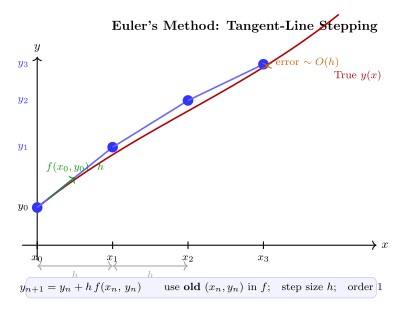
Euler’s method. For the initial-value problem , , with step size :
Each step uses the slope at the current point to step forward. The method is first-order accurate: global error .
Practical execution. Evaluate first, multiply by , add to . Use the old for computing at every step — do not update either variable before using them in the formula. Carry at least 5–6 significant figures in intermediate steps; rounding to 4 decimal places at each step compounds error and corrupts the final digit.
Number of steps. Steps needed . Check this before starting.
Question Archetypes
| Archetype | Recognition |
|---|---|
| euler-method | ”Use Euler’s method with step size to find at ”; ODE given; initial condition given |
euler-method (2 question(s); 2013, 2023)
Recognition Cues
- “Use Euler’s method with step size to compute .”
- “Find correct to decimal places.” (implies carry extra digits internally)
- An ODE and initial condition given.
Solution Template
- Identify , , , , and the target . Compute the number of steps .
- Set up the iteration table: columns , , , , .
- Execute each step: compute , then . Carry 5+ significant digits.
- State the final answer rounded to the required decimal places and boxed.
Worked Example
2013 Paper 2, 2013-P2-Q7b (15 marks)
Use Euler’s method with to compute (to 5 decimal places) from , .
. Steps: .
| Step | ||||
|---|---|---|---|---|
| 0 | 0.00 | 2.00000 | ||
| 1 | 0.15 | 1.70000 | ||
| 2 | 0.30 | 1.44163 | ||
| 3 | 0.45 | 1.22000 | ||
| 4 | 0.60 | 1.03272 | — | — |
Sample computation (Step 1 Step 2):
.
.
2023 Paper 2, 2023-P2-Q5b (10 marks)
Given , , . Find by Euler’s method (4 decimal places).
. Steps: .
| 0 | 0.0 | 1.0000 | 0.10000 | |
| 1 | 0.1 | 1.1000 | 0.08473 | |
| 2 | 0.2 | 1.1847 | 0.07506 | |
| 3 | 0.3 | 1.2598 | 0.06821 | |
| 4 | 0.4 | 1.3280 | — | — |
Common Traps
- Missing the term. In 2013, . Writing (dropping the inside the parenthesis) gives wrong values at every step.
- Wrong number of steps. steps, not 6. Always compute before starting.
- Using new values in the same step. Euler uses the old to compute . Updating first and then using it in is modified Euler (Heun’s method), not plain Euler.
- Insufficient decimal places. The 2013 question asks for 5 decimal places; round only at the end, not at each intermediate step.
Marks-Aware Writing
A 15-mark Euler answer must show: the formula stated, the function identified, the iteration table with all four columns filled for all steps, and sample computations written out for at least one step. A 10-mark answer needs the table and final answer; the formula may be stated briefly.
Practice Set
- 2013-P2-Q7b (15 m) — — Hint: ; 4 steps; carry 7 digits internally to get 5-decimal accuracy at the end.
- 2023-P2-Q5b (10 m) — — Hint: compute separately at each step; 4 steps to reach .