Gauss-Jordan method
At a Glance
- Frequency: 2 sub-parts across 2 of 13 years (2017, 2024)
- Priority tier: T3
- Marks (count): 10 (2)
- Average solve time: ~8 min
- Difficulty mix: easy 2
- Section: B | Dominant type: computation
Why This Chapter Matters
Gauss-Jordan appears in 2017 and 2024 as a 10-mark compulsory question. Both questions are short and mechanical: form the augmented matrix, eliminate above and below each pivot, and read off the answer. The 2017 question asks for both an explanation of the method and a matrix inversion; the 2024 question applies the method to a 3×3 linear system. Knowing the precise distinction between Gauss-Jordan (clears both below and above pivots) and Gaussian elimination (stops at upper-triangular) earns the explanation marks.
Minimum Theory
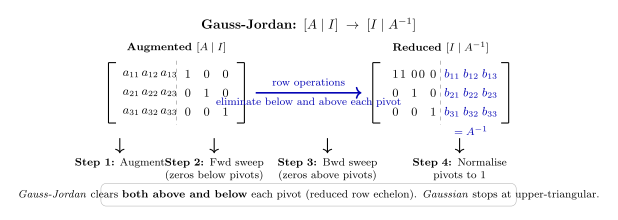
Gauss-Jordan elimination. Append the identity to to form . Apply elementary row operations to reduce to ; the same operations transform into . For a linear system , append instead: .
Key distinction from Gaussian elimination. Gaussian elimination stops at upper-triangular form and uses back-substitution. Gauss-Jordan continues: after creating zeros below each pivot it creates zeros above each pivot too, then normalises each pivot to 1. The result is the reduced row echelon form.
Row operations. Three types: (i) multiply a row by a nonzero scalar; (ii) add a multiple of one row to another; (iii) swap two rows. Pivot normalisation (divide a row by its pivot element) makes all pivots equal to 1.
Question Archetypes
| Archetype | Recognition |
|---|---|
| gauss-jordan | ”Find inverse / solve system by Gauss-Jordan”; augmented matrix reduction |
gauss-jordan (2 question(s); 2017, 2024)
Recognition Cues
- “Explain the Gauss-Jordan method and apply it to find the inverse of the matrix …”
- “Solve the following system of equations by the Gauss-Jordan method.”
- Forms for inversion or for a system.
Solution Template
- Form the augmented matrix. Write (for inversion) or (for a system).
- Forward sweep. Eliminate all entries below the leading pivot in each column using .
- Backward sweep. Eliminate all entries above each pivot: work from the last pivot upward.
- Normalise. Divide each row by its pivot so all pivots become 1.
- Read the answer. Left block is ; right block is (or ).
Worked Example
2017 Paper 2, 2017-P2-Q5b (10 marks)
Explain the main steps of the Gauss-Jordan method and apply this method to find the inverse of the matrix .
Step 1 — Augment:
Step 2 — Eliminate below pivot (col 1): , :
Step 3 — Eliminate above pivots (backward sweep):
Column 2: (removes entry in row 1, col 2):
Column 3: (removes entry in row 1, col 3):
Step 4 — Normalise (divide each row by 2):
2024 Paper 2, 2024-P2-Q5b (10 marks)
Solve the system , , by Gauss-Jordan method.
Augmented matrix , then eliminate below (forward) and above (backward) each pivot.
Forward sweep — eliminate from rows 2,3: , :
Eliminate from row 3: :
Normalise rows: , , :
Backward sweep — clear above pivot in col 3: , ; then col 2: :
Common Traps
- Not clearing above the pivot. Stopping at upper-triangular form is Gaussian elimination; the Gauss-Jordan step requires also clearing the entries above each pivot. The question text usually specifies Gauss-Jordan explicitly — if you just back-substitute, you will lose the method marks.
- Forgetting to normalise pivots to 1. The reduced row echelon form requires each leading entry to be exactly 1 before reading the answer.
- Fraction tracking. Pivot normalisation introduces fractions. Carry them through exactly; decimal approximations accumulate error and the examiner checks individual matrix entries.
Marks-Aware Writing
A 10-mark Gauss-Jordan answer must show: (1) the augmented matrix written out explicitly; (2) each row operation labelled (e.g., ) with the resulting matrix; (3) the final reduced form or written out; (4) the answer stated clearly and boxed. If the question asks you to “explain the method”, add a one-sentence description of each of the four stages before the arithmetic.
Practice Set
- 2017-P2-Q5b (10 m) — — Hint: matrix is nearly diagonal after the first sweep; no fractions appear until the final normalisation step.
- 2024-P2-Q5b (10 m) — — Hint: fractions enter after normalising by ; keep them exact and the backward sweep simplifies cleanly.