Newton-Raphson method (convergence, geometric meaning)
At a Glance
- Frequency: 6 sub-parts across 6 of 13 years (2013, 2014, 2017, 2019, 2020, 2021)
- Priority tier: T2
- Marks (count): 10 (4), 15 (1), 20 (1)
- Average solve time: ~11 min
- Difficulty mix: medium 4, easy 2
- Section: B | Dominant type: computation
Why This Chapter Matters
Newton-Raphson appears in 6 of the last 13 years — always in Section B, compulsory Q5 or an optional in Q7–Q8. Four of the six questions are straightforward numerical root-finding (2–3 iterations to 4 decimal places); the remaining two ask for the algorithm/flowchart and the cases of failure. The 20-mark question (2013) asks you to write a complete algorithm with three safeguards. Knowing the standard iteration and the three failure modes covers every question in this atom.
Minimum Theory
The iteration. To solve , starting from an initial guess :
Geometric meaning. At the current iterate , draw the tangent to . The tangent line crosses the -axis at . The method replaces the curve by its tangent and finds where the tangent meets the -axis.
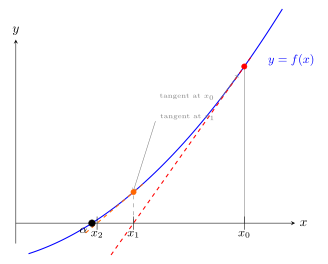
Convergence. Near a simple root (where , ), the method has quadratic convergence: In practice: once the iterate is close, the number of correct decimal digits roughly doubles each step. Three to four iterations are enough for 4–8 significant figures.
Three safeguards (required in algorithm questions).
- Derivative bound: if (user-supplied lower bound), the update would divide by nearly zero — abort and report failure.
- Iteration cap: after iterations without convergence, exit with a warning.
- Relative tolerance: convergence declared when (relative form, not absolute, to handle roots of very different magnitudes).
Cases of failure.
| Failure mode | Cause | Example |
|---|---|---|
| Division by zero | (extremum of near iterate) | Tangent horizontal |
| Divergence | Bad initial guess; curvature pulls iterate away | : |
| Oscillation | Iterate cycles between two values | , large |
| Slow convergence | Multiple root ( and both vanish at root) | Linear convergence instead of quadratic |
| Wrong root | Initial guess in basin of a different root | Must check the found root |
Question Archetypes
| Archetype | You are seeing this when… |
|---|---|
| newton-raphson-root | ”Apply Newton-Raphson to find a root … correct to decimal places.” |
| newton-raphson-algorithm | ”Develop an algorithm / write a flow chart … describe cases of failure.” |
newton-raphson-root (4 question(s); 2014, 2019, 2020, 2021)
Recognition Cues
- “Apply Newton-Raphson method to determine a root of … correct to four decimal places.”
- “Find a real root of the transcendental equation … to three decimal places.”
- “Show that has one root in and one in ; calculate the negative root by Newton-Raphson.”
- “Find positive root of … to 8 significant figures.”
Solution Template
- Define . Rewrite the equation as .
- Compute . Apply product rule, chain rule carefully; watch for vs .
- Bracket the root. Evaluate at a few integers/simple fractions to find a sign change. Quote: “By IVT, a root exists in .” Start with near the midpoint of the bracket.
- Iterate. Apply . Carry at least 5–6 significant figures internally.
- Stop when successive iterates agree to the required decimal places. State the final answer rounded to the requested precision.
Worked Example(s)
2014 Paper 2, 2014-P2-Q5b (10 marks)
Apply Newton-Raphson to determine a root of correct to four decimal places.
, .
Bracket: , . Root in . Refine: . Start .
| 0 | 0.5000 | 0.05322 | −2.9525 | 0.51803 |
| 1 | 0.51803 | −0.00081 | −3.04358 | 0.51776 |
| 2 | 0.51776 | ≈ 0 | — | converged |
Key trap: . The product rule on is easily forgotten.
2019 Paper 2, 2019-P2-Q5b (10 marks)
Apply Newton-Raphson to find a real root of , correct to three decimal places.
, .
Bracket: , . Start .
| 0 | 2.5000 | −0.20515 | 0.83223 | 2.74650 |
| 1 | 2.74650 | 0.00511 | 0.87305 | 2.74065 |
| 2 | 2.74065 | ≈ 0 | — | converged |
Key trap: The derivative of uses , contributing the modulus . Dropping this gives a wrong .
2020 Paper 2, 2020-P2-Q5b (10 marks)
Show that has a root in and in . Calculate the negative root to four decimal places by Newton-Raphson.
Existence: ; ; . Sign changes at and confirm two roots by IVT.
.
Start for the negative root:
| 0 | −0.500000 | +0.000585 | 0.071388 | −0.508199 |
| 1 | −0.508199 | −0.000005 | 0.072629 | −0.508129 |
| 2 | −0.508129 | ≈ 0 | — | converged |
2021 Paper 2, 2021-P2-Q5b (10 marks)
Find the positive root of to 8 significant figures using Newton-Raphson.
, .
Bracket: , . Linear interpolation gives .
| 0 | 0.5500 | −0.2025 | 3.5227 | 0.60749 |
| 1 | 0.60749 | +0.00136 | 3.57082 | 0.60711 |
| 2 | 0.60711 | ≈ −0.00001 | 3.57064 | 0.60711 |
Further iteration: (converged to 8 significant figures).
Common Traps
- Internal precision: carry at least 5–6 significant figures during iteration; rounding to the requested places early leads to accumulated error.
- Base-10 logarithm derivative: . The modulus is easily omitted.
- Argument in radians: whenever cosine or sine appears, the argument is in radians. Do not mix degree mode.
- Rounding at the end: a root of rounds to at 3 d.p. (not ). Always write both the full iterate and the rounded answer.
newton-raphson-algorithm (2 question(s); 2013, 2017)
Recognition Cues
- “Develop an algorithm for Newton-Raphson method … with parameters , eps, delta.”
- “Write an algorithm in the form of a flow chart for Newton-Raphson method. Describe the cases of failure.”
Solution Template
- State the iteration formula and its geometric basis (tangent at meets -axis at ).
- Write the algorithm with all three safeguards:
- Input: , , (relative tolerance), (derivative lower bound).
- For : evaluate , ; if abort; compute ; if declare convergence.
- If loop exhausted: output warning.
- For a flow chart: include two decision boxes — ”?” and “converged?” — before the iteration cap check.
- Enumerate all failure modes (see table in Minimum Theory). Quote a concrete divergence example (, where ) and an oscillation example. Distinguish failure from slow convergence at a multiple root.
Worked Example(s)
2013 Paper 2, 2013-P2-Q7a (20 marks)
Develop an algorithm for Newton-Raphson to solve , starting from , with iterations allowed, relative error eps, derivative bound delta.
INPUT:  f, f'              (function and derivative)
        x0                 (initial iterate)
        n                  (maximum iterations)
        eps                (relative convergence tolerance)
        delta              (lower bound on |f'|)

1. x_prev ← x0;  converged ← FALSE

2. FOR k = 1, 2, ..., n DO:
   2.1  f_val  ← f(x_prev);   fp_val ← f'(x_prev)
   2.2  IF |fp_val| < delta THEN
            PRINT "Derivative too small at step k — method fails"; EXIT
   2.3  x_curr ← x_prev − f_val / fp_val
   2.4  IF |x_curr − x_prev| ≤ eps · |x_curr| THEN
            converged ← TRUE; EXIT loop
   2.5  x_prev ← x_curr
   END FOR

3. IF converged: OUTPUT x_curr   (success)
   ELSE:         PRINT "No convergence in n iterations"; OUTPUT x_curr (warning)
Explanation of safeguards:
- Step 2.2 (derivative bound): prevents division by zero when (tangent nearly horizontal). Without this check, the method produces a huge erratic jump.
- Step 2.4 (relative tolerance): scales with the root’s magnitude, unlike an absolute tolerance that fails for roots near zero or roots of order .
- Step 2 loop cap (iteration count): ensures the algorithm always terminates; needed when the iterate diverges or oscillates.
Convergence property: near a simple root , errors satisfy , so the number of correct digits roughly doubles each step. Two iterations starting from for : , — four more correct digits in one step.
2017 Paper 2, 2017-P2-Q8b (15 marks)
Write a flow chart for Newton-Raphson method. Describe the cases of failure.
Flow chart (text representation):
START
  │
  ▼
READ x0, ε, δ, N
  │
  ▼
n ← 0
  │
  ▼  ┌────────────────────────────────┐
  └──►  Compute f(xn) and f'(xn)      │
        │                              │
        ▼                              │
   |f'(xn)| < δ ? ──YES──► PRINT "f'≈0, method fails"; STOP
        │ NO
        ▼
   x_{n+1} ← xn − f(xn)/f'(xn)
        │
        ▼
   |x_{n+1} − xn| < ε ? ──YES──► PRINT root x_{n+1}; STOP
        │ NO
        ▼
   n + 1 ≥ N ? ──YES──► PRINT "no convergence in N steps"; STOP
        │ NO
        ▼
   xn ← x_{n+1}; n ← n + 1
        │
        └──────────────────────────────┘
Cases of failure:
-
Zero/near-zero derivative (): the tangent is horizontal; flies off to infinity. Occurs when the iterate lands near a turning point of .
-
Divergence from bad initial guess: convergence is only local. For , the derivative , so . The iterate doubles in magnitude and diverges.
-
Oscillation (cycling): for with : , , , \ldots — a 2-cycle with no convergence.
-
Multiple root: if , convergence degrades from quadratic to linear (slow). Round-off near can stall convergence entirely.
-
Non-differentiability: the tangent construction is invalid if is not differentiable near the root.
Common Traps
- The flow chart must explicitly include the guard and a max-iteration cap — both are separate decision boxes; omitting either costs marks.
- Distinguish divergence (magnitude grows), oscillation (iterate cycles), and slow convergence at a multiple root — they are different phenomena with different remedies.
- The relative-tolerance form is standard; absolute tolerance fails for roots far from 1.
Marks-Aware Writing
10-mark root-finding question: 4–5 lines of iteration table, with , , shown. State the bracket (IVT) before starting. End with the root rounded to the requested precision. Do not truncate — rounded to 3 d.p. is .
15-mark algorithm/flowchart: the flowchart earns about half the marks; the failure modes earn the other half. Name each failure mode, give its cause, and quote a concrete example for at least divergence and oscillation.
20-mark algorithm (2013 style): write pseudocode with all variable names, the three safeguards explicitly labelled (derivative bound, relative tolerance, iteration cap), a step-by-step explanation, and a brief discussion of quadratic convergence and its caveats.