Newton’s forward difference interpolation
At a Glance
- Frequency: 3 sub-parts across 3 of 13 years (2013, 2018, 2024)
- Priority tier: T3
- Marks (count): 10 (2), 15 (1)
- Average solve time: ~12 min
- Difficulty mix: medium 3
- Section: B | Dominant type: computation
Why This Chapter Matters
Newton’s forward difference interpolation has appeared in 2013, 2018, and 2024 with a 15-mark question in 2024 signalling increasing weight. Every question follows an identical three-step workflow: build the forward difference table, compute , apply the Newton formula term by term. The 2013 question adds a layer by requiring cumulative frequencies first; the 2018 question requires expanding the resulting polynomial into standard form. Mastery of the difference table construction is the main skill, and the same table structure underlies most other interpolation atoms.
Minimum Theory
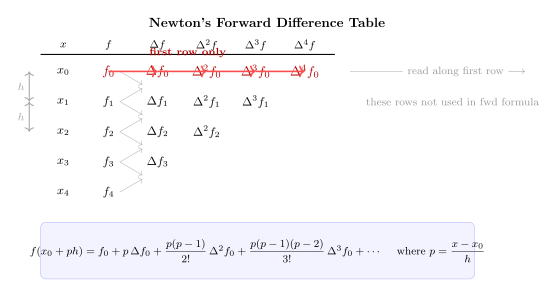
Newton’s forward difference formula. For equally spaced data at with values , define , , etc. Then:
where . Only the entries in the first row of the difference table () are used.
When to use. Newton forward is for near the beginning of the table ( typically). For near the end of the table, use Newton’s backward formula instead.
Degree identification. If for all , the data lies on a polynomial of degree . The formula terminates naturally — include only the terms with nonzero differences.
Question Archetypes
| Archetype | Recognition |
|---|---|
| newton-forward-interpolation | Equally spaced table; estimate at a non-grid point near the start; or find the interpolating polynomial |
newton-forward-interpolation (3 question(s); 2013, 2018, 2024)
Recognition Cues
- “Using Newton’s forward difference formula, find/estimate the value of …”
- Equally spaced -values given; query point near the start of the table.
- 2018 variant: “find the lowest-degree polynomial” — difference table collapses to zero at some order.
- 2013 variant: grouped frequency table; must form cumulative counts first.
Solution Template
- Build the forward difference table. Columns: , , , , , … Fill each column: entry = entry below minus entry above, in the previous column.
- Read the first-row diagonal: Stop at the last nonzero entry.
- Compute : .
- Substitute into Newton’s formula term by term. Compute each binomial coefficient explicitly.
- State the answer. For a polynomial question, substitute and expand in .
Worked Example
2024 Paper 2, 2024-P2-Q8b (15 marks)
Using Newton’s forward difference formula for interpolation, estimate the value of from: : 1, 2, 3, 4, 5, 6; : 0, 1, 8, 27, 64, 125.
Step 1 — Forward difference table (, ):
| 1 | 0 | 1 | 6 | 6 | 0 | 0 |
| 2 | 1 | 7 | 12 | 6 | 0 | |
| 3 | 8 | 19 | 18 | 6 | ||
| 4 | 27 | 37 | 24 | |||
| 5 | 64 | 61 | ||||
| 6 | 125 |
Third differences are constant (= 6); fourth and higher = 0. Data lies on a cubic.
Step 2 — Compute : .
Step 3 — Apply formula (first-row values: , , , , higher = 0):
(Exact check: , so . Formula is exact for cubics.)
2018 Paper 2, 2018-P2-Q5b (10 marks)
Using Newton’s forward difference formula find the lowest-degree polynomial given , , , , .
Forward difference table (, , ):
| 1 | 1 | 8 | 8 | 6 | 0 |
| 2 | 9 | 16 | 14 | 6 | |
| 3 | 25 | 30 | 20 | ||
| 4 | 55 | 50 | |||
| 5 | 105 |
, so the lowest degree is exactly 3. First-row values: , , , .
Expand in : .
Substitute :
Common Traps
- Using the wrong row. The formula uses only the first row of the table ( at ). Entries from other rows give incorrect results.
- Shift offset. The parameter is , not . In 2018, so ; forgetting this and writing produces a polynomial that misses every data point.
- Stopping too early. Include all terms until the differences become zero. Truncating at when gives only quadratic accuracy.
- Cumulative conversion (2013). For a grouped frequency question, interpolate the cumulative function . The count in is , not just .
Marks-Aware Writing
A 10-mark answer must show the full difference table (all columns labelled), the value of , each term of the Newton formula computed separately, and the numerical answer. A 15-mark answer must additionally state the polynomial’s degree from the vanishing differences, expand to standard polynomial form if asked, and include a verification step (substitute a data point back).
Practice Set
- 2013-P2-Q5c (10 m) — — Hint: first build the cumulative frequency table, then apply Newton forward to find ; answer is students.
- 2018-P2-Q5b (10 m) — — Hint: signals a cubic; expand in first, then back-substitute to get the polynomial in .
- 2024-P2-Q8b (15 m) — — Hint: third differences constant, fourth = 0; ; three nonzero terms only.