Number systems
At a Glance
- Frequency: 7 sub-parts across 7 of 13 years (2016, 2018, 2019, 2021, 2022, 2024, 2025)
- Priority tier: T2
- Marks (count): 10 (1), 15 (2), 5 (4)
- Average solve time: ~6 min
- Difficulty mix: easy 7
- Section: B | Dominant type: computation
Why This Chapter Matters
Number-system conversions appear as a guaranteed 5–15 mark gift in Section B, usually Q5(c) or Q6(b). Every question asks for the same four-skill toolkit applied to different numbers. The topic requires zero mathematical insight — only a reliable algorithm executed carefully. A student who internalises the three rules (repeated division, repeated multiplication, bit-grouping) scores full marks in under ten minutes.
Minimum Theory
The positional system. A number written in base uses digits . Its value is the sum of each digit times the appropriate power of : the digit in position (counting from 0 at the units place) contributes . For the fractional part, position contributes . Bases in play: binary (), octal (), hexadecimal (), decimal (). Hex uses letters A–F for digits 10–15.
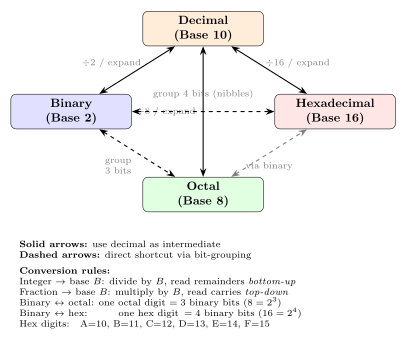
Converting an integer from decimal to base . Divide by repeatedly, recording remainders. Reading remainders from last to first (bottom-to-top) gives the base- digits. For a fraction, multiply by repeatedly and record the integer parts top-to-bottom until the fraction terminates (or to the desired precision).
Binary ↔ octal and binary ↔ hex shortcuts. Since and , one octal digit corresponds to exactly 3 binary digits and one hex digit to exactly 4. To convert, group bits outward from the radix point: integer part right-to-left (padding with leading zeros on the left), fractional part left-to-right (padding with trailing zeros on the right). Then replace each group with its decimal equivalent (0–7 for octal, 0–F for hex).
Question Archetypes
| Archetype | Recognition |
|---|---|
| base-conversion | Any question asking to convert a number between decimal, binary, octal, or hexadecimal |
base-conversion (7 question(s); 2016, 2018, 2019, 2021, 2022, 2024, 2025)
Convert numbers between decimal/binary/octal/hexadecimal
Recognition Cues
The question lists one or more numbers each tagged with a source base and asks for a target base. It may mix several conversion directions in one question (e.g., “(i) decimal→binary, (ii) binary→hex, (iii) hex→decimal”). Marks are typically 5 per sub-part at 15-mark totals, or a single 10-mark combined question.
Solution Template
For decimal → base (integer part): divide by repeatedly; record remainders; read bottom-to-top.
For decimal → base (fraction): multiply by repeatedly; record integer parts; read top-to-bottom.
For base → decimal: write each digit times its power of and sum.
For binary → octal: group bits in 3s from the radix point outward; pad outer ends with zeros.
For binary → hex: group bits in 4s (nibbles) from the radix point outward; pad outer ends with zeros.
For octal/hex → binary: replace each digit with its 3-bit / 4-bit binary equivalent.
Worked Example 1
2016 Paper 2, 2016-P2-Q5d (10 marks)
Convert the decimal numbers 4096, 0.4375, and 2048.0625 to binary and hexadecimal.
4096 to binary and hex. , so in binary it is a 1 followed by twelve 0s: Group in nibbles of 4 from the right: , giving hex digits :
0.4375 to binary and hex. Repeated multiplication by 2:
| step | value | integer carry |
|---|---|---|
| 0 | ||
| 1 | ||
| 1 | ||
| 1 (terminates) |
Reading carries top-to-bottom: . Grouping the four binary fraction digits as one nibble :
2048.0625 to binary and hex. Integer part : . Fraction : multiply by 2 four times to get carries , giving . Combining: Integer part in hex: group . Fraction: :
Worked Example 2
2018 Paper 2, 2018-P2-Q6b (15 marks)
(i) to decimal. (ii) to hexadecimal. (iii) to decimal. (iv) to binary.
(i) Binary → decimal (positional expansion):
(ii) Binary → hex (nibble grouping from radix point): Integer part: pad left to a multiple of 4 bits: . Read as hex: . Fraction: .
(iii) Hex → decimal (positional expansion), with , :
(iv) Decimal → binary (repeated division by 2):
| quotient | rem | quotient | rem | |
|---|---|---|---|---|
| 0 | 1 | |||
| 1 | 0 | |||
| 0 | 1 | |||
| 0 | 1 | |||
| 0 |
Reading bottom-to-top: . Check: ✓.
Worked Example 3
2019 Paper 2, 2019-P2-Q6b (15 marks, selected sub-parts)
(i) to binary. (iii) to hexadecimal. (iv) to decimal.
(i) binary: divide by 2 until zero; remainders read upward: Check: ✓.
(iii) hex: ; ; ; . Bottom-to-top: .
(iv) decimal:
Common Traps
- Nibble/triplet anchoring. Always group bits outward from the radix point: integer part groups from the right (towards the point), fractional part groups from the left. Pad with zeros at the outer ends (leftmost for integer, rightmost for fraction), never in the middle.
- Read remainders upward. In the repeated-division algorithm, remainders are written below each division step; the most-significant bit is the last remainder. Reading them top-down gives the digits in reverse order — a very common mistake.
- Hex digits A–F. Remainders of 10, 11, 12, 13, 14, 15 become A, B, C, D, E, F. In positional expansions, , , etc. — mis-reading these is the chief arithmetic error.
- Fractional conversions may not terminate. If the fraction in the target base is non-terminating, truncate to the required number of places and state this explicitly.
Marks-Aware Writing
For a 5-mark question (typically one or two conversions): show the division table or multiplication table explicitly so the examiner can award method marks; state the final answer clearly in the target base.
For a 10-mark question: two to three conversions, each displayed in full with a check (e.g., expand back to verify). One line of verification at the end distinguishes a complete answer.
For a 15-mark question: four conversions in one question — plan before writing. Integer and fractional parts must be handled separately and reunited across the radix point. Note any non-terminating fractions and state the truncation.
Practice Set
- 2024-P2-Q5c-i (5 m) — — hex → decimal (positional expansion with hex letters)
- 2023-P2-Q5c-i (5 m) — — decimal → binary and hex
- 2023-P2-Q5c-ii (5 m) — — binary ↔ octal via 3-bit grouping