Runge-Kutta methods (RK2/RK4)
At a Glance
- Frequency: 4 sub-parts across 4 of 13 years (2014, 2015, 2019, 2022)
- Priority tier: T3
- Marks (count): 10 (2), 15 (2)
- Average solve time: ~10 min
- Difficulty mix: medium 4
- Section: B | Dominant type: computation
Why This Chapter Matters
RK4 appears in Section B at 10–15 marks in four of the last nine years, always as a pure computation: apply the four-stage formula to advance the ODE solution one or two steps. There is no theory to derive — the formula is the entire job. The skill is working through the arithmetic carefully at 4 decimal places without sign or rounding errors. The 2022 question has two steps (final answer accumulates error over two applications).
Minimum Theory
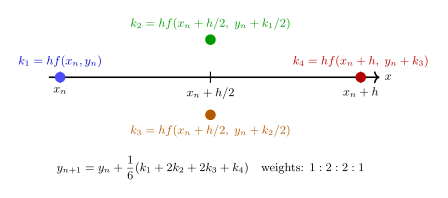
RK4 formula. For dy/dx=f(x,y) with y(x0)=y0 and step size h:
k1=hf(xn,yn),
k2=hf(xn+2h,yn+2k1),
k3=hf(xn+2h,yn+2k2),
k4=hf(xn+h,yn+k3),
yn+1=yn+61(k1+2k2+2k3+k4).
Weights: 1:2:2:1 (sum =6). Node pattern: k1 at (xn,yn); k2,k3 at the midpoint xn+h/2; k4 at the endpoint xn+h.
Key structure: k2 uses k1/2; k3 uses k2/2; k4 uses k3 (full step, not k3/2).
Question Archetypes
| Archetype | Recognition |
|---|
| runge-kutta | ”Using RK4, solve y′=f(x,y), y(x0)=y0, at x=x0+h” (one or two steps) |
runge-kutta (4 question(s); 2014, 2015, 2019, 2022)
Recognition Cues — Explicit ODE y′=f(x,y) with one initial condition; asked to find y at a specific x using “Runge-Kutta method of fourth order.”
Solution Template
- Identify f(x,y), x0, y0, h.
- Compute k1 at (x0,y0).
- Compute k2 at (x0+h/2,y0+k1/2).
- Compute k3 at (x0+h/2,y0+k2/2).
- Compute k4 at (x0+h,y0+k3).
- Update: y1=y0+61(k1+2k2+2k3+k4).
- Repeat for a second step if required, using y1 and x1=x0+h as the new starting point.
Worked Example 1 (one step)
2019 Paper 2, 2019-P2-Q5d (10 marks)
Using RK4, solve dy/dx=(y2−x2)/(y2+x2), y(0)=1, at x=0.2 with h=0.2.
f(x,y)=(y2−x2)/(y2+x2), x0=0, y0=1, h=0.2.
k1=0.2⋅f(0,1)=0.2⋅1=0.2000.
k2=0.2⋅f(0.1,1.1)=0.2⋅(1.21−0.01)/(1.21+0.01)=0.2⋅(1.20/1.22)=0.2⋅0.9836=0.1967.
k3=0.2⋅f(0.1,1.0984)=0.2⋅(1.2064−0.01)/(1.2064+0.01)≈0.2⋅0.9836=0.1967.
k4=0.2⋅f(0.2,1.1967)=0.2⋅(1.4321−0.04)/(1.4321+0.04)=0.2⋅0.9457=0.1891.
y1=1+61(0.2000+2⋅0.1967+2⋅0.1967+0.1891)=1+61(1.1759)≈1.1960.
y(0.2)≈1.1960.
Worked Example 2 (two steps)
2022 Paper 2, 2022-P2-Q8b (15 marks)
Using RK4, solve dy/dx=x+y2, y(0)=1, at x=0.2 with h=0.1.
Step 1 (x=0→0.1):
k1=0.1(0+1)=0.1000. k2=0.1(0.05+1.052)=0.1⋅1.1525=0.1153. k3=0.1(0.05+1.05762)≈0.1⋅1.1686=0.1169. k4=0.1(0.1+1.11692)≈0.1⋅1.3474=0.1347.
y1=1+61(0.1000+0.2306+0.2338+0.1347)=1+61(0.6991)=1+0.1165=1.1165.
Step 2 (x=0.1→0.2):
k1=0.1(0.1+1.11652)=0.1⋅1.3466=0.1347. k2=0.1(0.15+1.18392)≈0.1⋅1.5516=0.1552. k3=0.1(0.15+1.19412)≈0.1⋅1.5759=0.1576. k4=0.1(0.2+1.27412)≈0.1⋅1.8233=0.1823.
y2=1.1165+61(0.1347+0.3104+0.3152+0.1823)=1.1165+61(0.9426)=1.1165+0.1571=1.2736.
y(0.2)≈1.2736.
Common Traps
- k4 uses k3, not k3/2. The endpoint slope uses the full step increment yn+k3, while the midpoint slopes use half increments k1/2 and k2/2.
- Keep ≥4 decimal places throughout. Rounding k2 or k3 to 3 places shifts the final answer in the 4th decimal. Work with 4+ places and round only at the end.
- Weights: 1:2:2:1, not 1:1:1:1. The middle two stages k2,k3 each get weight 2.
- Each ki already includes h. Don’t multiply by h again in the update formula.
Marks-Aware Writing
Show all four k-values explicitly (each as a formula and a decimal). Display the weighted average k1+2k2+2k3+k4, divide by 6, and add to yn. For a two-step question, repeat all four stages for the second step. The examiners give process marks for the correct formula applied correctly — getting a slightly wrong numerical answer because of rounding still earns most marks if the method is shown correctly.
Practice Set
- 2014-P2-Q6c (10 m) — — Hint: one RK4 step with h=0.2 from x=0.6 to x=0.8.
- 2015-P2-Q7b (10 m) — — Hint: one or two RK4 steps on an interval around x=2.