Simpson’s 1/3 and 3/8 rules
At a Glance
- Frequency: 5 sub-parts across 5 of 13 years (2013, 2017, 2018, 2022, 2024)
- Priority tier: T2
- Marks (count): 10 (1), 15 (2), 20 (1), 7.5 (1)
- Average solve time: ~11 min
- Difficulty mix: medium 3, easy 2
- Section: B | Dominant type: computation
Why This Chapter Matters
Simpson’s rules appear in 5 of the last 13 UPSC papers, always in Section B as medium-to-high-mark questions (7.5–20 marks). The two formulas share the same structure — a weighted sum of function values scaled by a step-size factor — and differ only in the number of nodes per panel and the weight pattern. Learning to read the weight pattern correctly (1-4-2-4-2-…-4-1 for the 1/3 rule; 1-3-3-2-3-3-2-…-3-3-1 for the 3/8 rule) eliminates the most common errors. The 2017 derivation question is the only outlier; the Newton forward-difference derivation is fully worked below.
Minimum Theory
Simpson’s 1/3 rule (composite). Subdivide into equal sub-intervals of width where is even. With : Weight pattern: 1, 4, 2, 4, 2, …, 4, 1. Error: for some .
Simpson’s 3/8 rule (composite). Subdivide into equal intervals where is a multiple of 3. With the same notation: Weight pattern: 1, 3, 3, 2, 3, 3, 2, …, 3, 3, 1 (the weight 2 appears at every third interior node, i.e., at the joints between groups). Single-panel formula: ; exact for polynomials of degree . Error: .
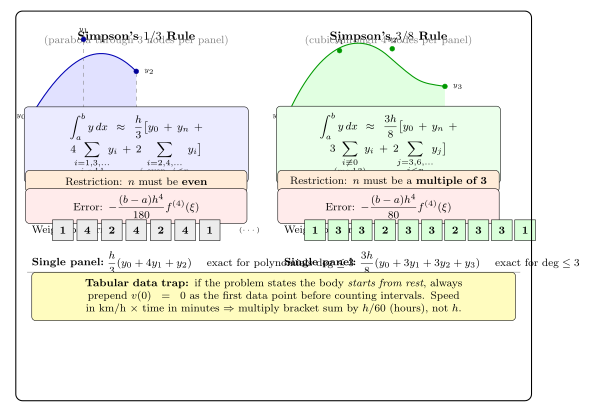
Unit conversion note. When speed is in km/h and time is in minutes, the step size measured in minutes must be converted to hours before using the formula. Write and compute distance for the 1/3 rule. Forgetting this factor of 60 inflates the answer by exactly 60.
“Starts from rest” note. If the problem states a vehicle starts from rest, must be inserted as the first data point even when it is not listed in the table. This extra point shifts all existing indices by one and ensures the total number of intervals is even (for 1/3) or a multiple of 3 (for 3/8).
Question Archetypes
| Archetype | Recognition |
|---|---|
| simpsons-rule | Tabular data or a function given; compute an integral numerically using Simpson’s rule |
| simpsons-derivation | ”Derive the composite Simpson’s 3/8 formula”; state restriction on ; state error bound |
simpsons-rule (4 question(s); 2013, 2018, 2022, 2024)
Apply Simpson’s 1/3 or 3/8 rule to tabular data or a function
Recognition Cues
A table of or values is given, or a function is to be sampled at equally-spaced nodes. The instruction is “using Simpson’s rule” or “apply Simpson’s (or ) rule.” Velocity–time problems typically say “starts from rest” or give data only from , signalling that a row must be prepended.
Solution Template
- Set up the table. List all (or ) values and corresponding (or ) values. If “starts from rest,” insert at the front.
- Check (number of intervals). Count intervals, not points: . Verify is even (1/3 rule) or a multiple of 3 (3/8 rule). State .
- Assign weights. Label each with its weight: endpoints get 1; for 1/3, odd-indexed get 4 and even-indexed interior get 2; for 3/8, indices not divisible by 3 get 3 and interior indices divisible by 3 get 2.
- Compute the bracket sum .
- Apply the prefactor. Distance for 1/3; for 3/8. Apply the unit conversion if needed.
- State the answer to two or three significant figures.
Worked Example 1
2013 Paper 2, 2013-P2-Q7c (15 marks)
A train starts from rest and attains the following speeds (in km/h) at regular intervals of 2 minutes: at min. Estimate the distance travelled in 30 minutes by Simpson’s rule.
Step 1 — Prepend and extend to 30 min. The train starts from rest, so . After min the speed is 0 and stays 0, so the extra 10 minutes contribute nothing.
Step 2 — Table and interval count.
| (min) | (km/h) | weight | |
|---|---|---|---|
| 0 | 0 | 0 | 1 |
| 1 | 2 | 16 | 4 |
| 2 | 4 | 28.8 | 2 |
| 3 | 6 | 40 | 4 |
| 4 | 8 | 46.4 | 2 |
| 5 | 10 | 51.2 | 4 |
| 6 | 12 | 32 | 2 |
| 7 | 14 | 17.6 | 4 |
| 8 | 16 | 8 | 2 |
| 9 | 18 | 3.2 | 4 |
| 10 | 20 | 0 | 1 |
(even, 1/3 rule valid), min.
Step 3 — Bracket sum.
- Endpoints:
- Odd-indexed (×4):
- Even interior (×2):
Step 4 — Convert and apply formula. min hours.
Worked Example 2
2018 Paper 2, 2018-P2-Q5d (10 marks)
Using Simpson’s rule, find the distance (in km) travelled in 20 minutes by a train that starts from rest and reaches the following speeds (km/h): at min; speed at min is km/h.
Step 1 — Prepend .
| (min) | (km/h) | weight | |
|---|---|---|---|
| 0 | 0 | 0 | 1 |
| 1 | 2 | 10 | 4 |
| 2 | 4 | 18 | 2 |
| 3 | 6 | 25 | 4 |
| 4 | 8 | 29 | 2 |
| 5 | 10 | 32 | 4 |
| 6 | 12 | 20 | 2 |
| 7 | 14 | 11 | 4 |
| 8 | 16 | 5 | 2 |
| 9 | 18 | 2 | 4 |
| 10 | 20 | 8.5 | 1 |
(even), min hour.
Step 2 — Bracket sum.
- Endpoints:
- Odd (×4):
- Even interior (×2):
Step 3 — Apply formula.
Worked Example 3
2022 Paper 2, 2022-P2-Q7b (15 marks)
A train starts from rest and the speed (in km/h) is recorded at 2-minute intervals: at min. Estimate the distance in 20 minutes using Simpson’s rule.
The data table is identical to the 2013 problem (same ten speeds). Prepend ; the computation is exactly as in Worked Example 1 above.
Note: The 2013 question asked for distance in 30 minutes, but since for min the answer is the same. The 2022 question asks explicitly for 20 minutes — same answer.
Worked Example 4
2024 Paper 2, 2024-P2-Q7b-i (7.5 marks)
Using Simpson’s rule with , evaluate .
Step 1 — Compute function values. With , the nodes are (7 points, intervals — a multiple of 3, so 3/8 rule is valid).
Let :
| weight | |||
|---|---|---|---|
| 0 | 1 | ||
| 1 | 3 | ||
| 2 | 3 | ||
| 3 | 2 | ||
| 4 | 3 | ||
| 5 | 3 | ||
| 6 | 1 |
Step 2 — Apply by groups of 3.
Group 1 ( to ):
Group 2 ( to ):
Step 3 — Total.
Verification: The exact value is . The 3/8 rule gives the exact answer because is a cubic.
Common Traps
- Omitting . “Starts from rest” always means must be added. Without it, the interval count is odd for the 2013/2018/2022 data, making the 1/3 rule inapplicable.
- Unit conversion. Speed in km/h, time in minutes. The bracket sum carries units of km/h (step count), but the step size must be in hours. Use ; do not apply minutes directly in the formula.
- Weight-2 vs weight-4 confusion (1/3 rule). Odd-indexed interior nodes get weight 4; even-indexed interior nodes get weight 2. A parity error swaps 4 and 2 on every other node, altering the result substantially.
- 3/8 weight pattern. Only nodes at interior positions divisible by 3 (i.e., group joints) get weight 2; all other interior nodes get weight 3. The pattern 1-3-3-2-3-3-2-…-3-3-1 must be memorised exactly.
- n-divisibility check. The 1/3 rule requires even; the 3/8 rule requires . Confirm this before writing the formula. A common mistake is applying 3/8 to an interval count that is even but not a multiple of 3.
simpsons-derivation (1 question(s); 2017)
Derive the composite Simpson’s 3/8 formula; state the restriction on ; state the error bound
Recognition Cues
The question says “derive Simpson’s rule” or “obtain the composite formula and state the restriction on .” It typically asks for the error bound as well. A 20-mark question of this type requires the Newton forward-difference derivation of the single-panel formula, then the composite extension, followed by the error statement.
Solution Template
- Set up a single panel with step . Introduce the forward-difference substitution so , and ranges from 0 to 3.
- Write Newton’s forward interpolation formula truncated to the cubic term (four nodes).
- Integrate term by term from to using the five definite integrals listed in Step 3 of the derivation below.
- Collect and simplify to obtain the single-panel formula .
- Composite extension: Sum such panels; node shared by two panels appears twice and its weight doubles from 1 to 2 (only at the group-joint positions).
- State the restriction: .
- State the error: single-panel ; composite .
Worked Example
2017 Paper 2, 2017-P2-Q7b (20 marks)
Derive the composite Simpson’s rule. State the restriction on and give the error bound.
Part A — Single-panel derivation.
Let four equally-spaced nodes be with corresponding ordinates . Substitute , :
Newton’s forward interpolation formula:
Integrate each term from to :
Computing carefully:
Substituting back:
Now express in terms of the ordinates using , , :
Collect coefficients:
- :
- :
- :
- :
Part B — Composite formula.
Divide into sub-intervals where is a multiple of 3. Group the nodes into consecutive panels, each covering 4 nodes. Summing:
The endpoints and appear once each (weight 1). The panel-joint nodes each appear as the last node of one panel and the first node of the next, so they are counted twice (weight 2). All remaining interior nodes appear in exactly one panel with weight 3.
Part C — Restriction and error bound.
Restriction: must satisfy (a multiple of 3), since the integration panels each require exactly 3 sub-intervals.
Single-panel truncation error (from the omitted term):
Composite error (summing panels, with ):
Common Traps
- Restriction is mod 3, not even. The 3/8 rule needs . Writing ” must be even” (the 1/3 rule requirement) is a mark-losing error.
- Weight-2 placement. Only the panel-joint interior nodes (indices ) carry weight 2. Writing weight 2 at every third interior node starting from index 1 is wrong; it starts from index 3.
- Error denominator. The composite 3/8 error has denominator 80, not 180 (that belongs to the 1/3 rule). Confusing the two denominators costs the error-bound mark.
- Single-panel vs composite error. The single-panel error is ; the composite has (one power of absorbed into ). Quoting the single-panel formula as the composite answer is incorrect.
- Derivation algebra. When collecting coefficients, perform the arithmetic carefully for all four terms. The coefficient of involves three contributions from , , and ; missing any one shifts the result.
Marks-Aware Writing
For a 10-mark or 7.5-mark computation question: Write out the full table with weights shown explicitly; show the three sub-sums (endpoints, odd/3-weights, even-weights/2) separately; write the prefactor and unit-conversion step clearly; box the final answer. Omitting the weight column or the unit step each costs 1–2 marks.
For a 15-mark computation question: Everything above, plus: state explicitly that is even (or a multiple of 3) and name the rule being used; include the unit conversion as a labelled intermediate line (not a silent in-line multiplication). A clearly structured table and correct bracket sum earn the bulk of the marks even if arithmetic slips slightly.
For a 20-mark derivation question: Work all four stages — setup of Newton interpolation, definite integration of each difference-quotient term, collecting coefficients to arrive at the single-panel formula, and the composite extension. State the restriction and the two forms of the error (single-panel and composite). A derivation that only quotes the final formula earns at most 5 of 20 marks. Showing the coefficient computation for explicitly is expected.
Practice Set
- 2014-P2-Q7b (15 m) — — apply Simpson’s 1/3 to a velocity table; check interval parity; practise the unit conversion