Trapezoidal rule (composite; error)
At a Glance
- Frequency: 3 sub-parts across 3 of 13 years (2014, 2024, 2025)
- Priority tier: T3
- Marks (count): 10 (1), 7.5 (1), 15 (1)
- Average solve time: ~9 min
- Difficulty mix: easy 2, medium 1
- Section: B | Dominant type: computation
Why This Chapter Matters
The trapezoidal rule is tested in two modes: straightforward application (2014, 2024) and theoretical derivation of the correction constant and error term (2025). The application questions are among the fastest 10-mark problems in the paper — tabulate f(xi), apply the formula, done. The 2025 derivation question is harder (15 marks) but follows a single pattern: expand both sides in Taylor series about x0, match powers of h, and the surviving term gives the error. Both modes are mechanical once the template is known.
Minimum Theory
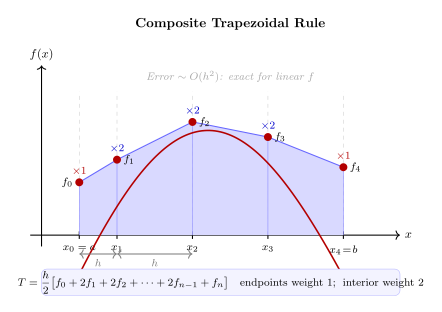
Composite trapezoidal rule. For ∫abf(x)dx with n equal subintervals of width h=(b−a)/n and nodes xi=a+ih:
∫abf(x)dx≈2h[f(x0)+2f(x1)+2f(x2)+⋯+2f(xn−1)+f(xn)]
Weights: 1 for the two endpoints; 2 for each interior node. The total number of function evaluations is n+1.
Truncation error. The composite trapezoidal rule has global error O(h2): specifically ET=−12(b−a)h2f′′(ξ) for some ξ∈(a,b). Halving h reduces the error by a factor of 4.
Corrected trapezoidal rule (2025). Adding derivative correction terms 12h2(f′(a)−f′(b)) raises accuracy to O(h4). This is derived by choosing the constant p in 2h(f0+f1)+ph2(f0′−f1′) to kill the h3 Taylor residual, giving p=121.
Question Archetypes
| Archetype | Recognition |
|---|
| trapezoidal-rule | ”Integrate … using the trapezoidal rule with n subintervals / width h“ |
| quadrature-derivation | ”Find the constant p and error term for the formula ∫=2h(f0+f1)+ph2(f0′−f1′)“ |
trapezoidal-rule (2 question(s); 2014, 2024)
Recognition Cues
- “Use n subintervals to integrate … using the trapezoidal rule.”
- “Integrate f(x) from x=a to x=b using the trapezoidal rule with width h=…”
- A specific h or n is given; the function is evaluated at the grid points.
Solution Template
- Compute h and list nodes. h=(b−a)/n; nodes x0,x1,…,xn.
- Tabulate f(xi). Compute each value, keeping 6 decimal places.
- Apply the formula. Sum = f0+fn+2(f1+f2+⋯+fn−1); multiply by h/2.
- State the result. Optionally compare with the exact value to show O(h2) accuracy.
Worked Example
2014 Paper 2, 2014-P2-Q5c (10 marks)
Use five subintervals to integrate ∫011+x2dx using the trapezoidal rule.
h=(1−0)/5=0.2. Nodes: 0,0.2,0.4,0.6,0.8,1.0.
| i | xi | f(xi)=1/(1+xi2) |
|---|
| 0 | 0.0 | 1.000000 |
| 1 | 0.2 | 0.961538 |
| 2 | 0.4 | 0.862069 |
| 3 | 0.6 | 0.735294 |
| 4 | 0.8 | 0.609756 |
| 5 | 1.0 | 0.500000 |
T=20.2[1.000000+0.500000+2(0.961538+0.862069+0.735294+0.609756)]
=0.1⋅[1.500000+2×3.168657]=0.1×7.837314
∫011+x2dx≈0.7837
(Exact: π/4≈0.7854; error ≈0.0017, consistent with O(h2)=O(0.04).)
2024 Paper 2, 2024-P2-Q7bii (7.5 marks)
Integrate f(x)=5x3−3x2+2x+1 from x=−2 to x=4 using the trapezoidal rule with h=1.
Nodes: −2,−1,0,1,2,3,4 (n=6). Function values: −55,−9,1,5,33,115,281.
T=21[−55+281+2(−9+1+5+33+115)]=21[226+2(145)]=2516
∫−24f(x)dx≈258
(Exact value 246; error 12, expected for a cubic with h=1.)
quadrature-derivation (1 question(s); 2025)
Recognition Cues
- “Find the constant p such that ∫x0x1fdx=2h(f0+f1)+ph2(f0′−f1′) achieves maximum accuracy.”
- “Find the error term. Deduce the composite rule.”
- Taylor expansion matching; the formula has a derivative correction term.
Solution Template
- Expand both sides in powers of h about x0 using f1=f+f′h+2f′′h2+⋯ and f0′=f′, f1′=f′+f′′h+⋯.
- Compute the error E= LHS − RHS term by term.
- Set the h3 coefficient to zero to find p.
- Identify the leading surviving error term (the first non-vanishing power of h).
- Compose over [a,b]: sum N panels; derivative correction telescopes to f′(a)−f′(b).
Worked Example
2025 Paper 2, 2025-P2-Q8b (15 marks)
Find the constant p and error term for ∫x0x1fdx=2h(f0+f1)+ph2(f0′−f1′). Deduce the composite rule on [a,b].
Taylor expansions about x0 (writing f(k)=f(k)(x0)):
LHS=fh+2f′h2+6f′′h3+24f′′′h4+120f(4)h5+⋯
2h(f0+f1)=fh+2f′h2+4f′′h3+12f′′′h4+48f(4)h5+⋯
ph2(f0′−f1′)=−pf′′h3−2pf′′′h4−6pf(4)h5−⋯
Error E= LHS − RHS:
E=(61−41+p)f′′h3+(241−121+2p)f′′′h4+⋯
Set h3 coefficient to zero: 61−41+p=0⇒
p=121
With p=121, the h4 coefficient also vanishes. The first surviving term is:
E=720h5f(4)(ξ),ξ∈(x0,x1)
Composite rule on [a,b] with N panels (h=(b−a)/N):
∫abfdx=h[2f0+f1+f2+⋯+fN−1+2fN]+12h2(f′(a)−f′(b))+720(b−a)h4f(4)(η)
Common Traps
- n subintervals vs. n+1 points. With 5 subintervals there are 6 grid points (x0 through x5). Counting 5 points gives the wrong answer.
- Interior vs. endpoint weights. The two endpoints have weight 1; all interior points have weight 2. Adding an interior point with weight 1 (or vice versa) is a common slip.
- Taylor sign of f0′−f1′. The correction term is ph2(f0′−f1′), not (f1′−f0′). The sign difference swaps the role of p.
- Telescoping in the composite formula. The derivative correction ∑(fi′−fi+1′) telescopes to f′(a)−f′(b) — not N times the single-panel correction.
Marks-Aware Writing
A 10-mark trapezoidal application answer must show: the step size h computed, a table of f(xi) values, the formula with interior/endpoint weights identified, and the numerical result. A 15-mark derivation answer must show: the Taylor expansion of each side to at least h5, the coefficient-matching step, the value of p with clear algebra, the error term with its exponent identified, and the composite rule written out.
Practice Set
- 2014-P2-Q5c (10 m) — — Hint: h=0.2, 6 grid points; interior sum ≈3.169; exact value is π/4.
- 2024-P2-Q7b-ii (7.5 m) — — Hint: cubic function so trapezoidal is not exact; error =258−246=12, consistent with O(h2) error bound.
- 2025-P2-Q8b (15 m) — — Hint: match h3 coefficient to get p=1/12; the h4 term also vanishes automatically; composite rule has a derivative end-correction term.