Frequency: 3 sub-parts across 3 of 13 years (2016, 2017, 2025)
Priority tier: T3
Marks (count): 15 (3)
Average solve time: ~16 min
Difficulty mix: hard 2, medium 1
Section: B | Dominant type: derivation
Why This Chapter Matters
Charpit’s method is the standard tool for nonlinear first-order PDEs in UPSC Paper 2, appearing with a 15-mark allocation in 2016, 2017, and 2025. The technique has a fixed pipeline but demands algebraic skill at two points: identifying the clean first integral from the auxiliary ratios, and executing the final integration of dz=pdx+qdy. The 2016 question (characteristic-strip on a parabola) and the 2025 question (separable structure leading to z3/2) illustrate that the method is versatile — knowing it covers both complete-integral and integral-surface variants.
Minimum Theory
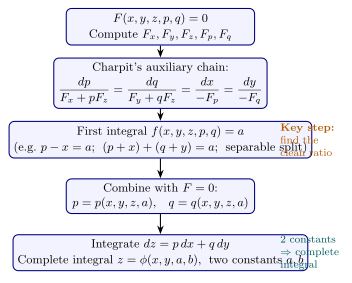
Charpit’s auxiliary equations. For a nonlinear first-order PDE F(x,y,z,p,q)=0 (p=zx,q=zy), Charpit’s method seeks a one-parameter family compatible with F=0. The auxiliary (Charpit) equations are:
Any first integral f(x,y,z,p,q)=a of this system, combined with F=0, gives compatible equations p=p(x,y,z,a), q=q(x,y,z,a). Integration of dz=pdx+qdy then yields the complete integralz=ϕ(x,y,a,b) containing two arbitrary constants a,b.
Finding the first integral. The most productive ratio pairs are those in which the numerators are each other’s negatives after algebra, giving d(combination)=0. Common patterns: dp+dx (yielding p+x=a), d(p+x)+d(q+y)=0 (yielding (p+x)+(q+y)=a), or separable structure F=f(x,p,z)−g(y,q,z) (yielding f=g=a).
Characteristic-strip for complete integral. When the question asks to find the integral surface through an initial curve, the same Charpit equations are used as characteristic-strip equations; p0,q0 on the initial curve are determined by the PDE and the strip condition z˙0=p0x˙0+q0y˙0.
”Determine the characteristics of [PDE] and find the integral surface through [curve]“
charpit-method (2 question(s); 2017, 2025)
Recognition Cues — The question asks for a “complete integral” of a nonlinear first-order PDE. In 2017 the PDE factors via a substitution P=p+x, Q=q+y; in 2025 the PDE separates as zp2−x=zq2−y.
Solution Template
Write F(x,y,z,p,q)=0 and compute Fx,Fy,Fz,Fp,Fq.
Write Charpit’s five-ratio chain.
Identify the first integral: add ratio numerators to form an exact differential; or spot a separable x-only vs.\ y-only structure in F.
Combine the first integral with F=0 to express p and q explicitly in terms of x,y,z,a.
Integrate dz=pdx+qdy (check it is exact: ∂p/∂y=∂q/∂x).
Write the complete integral z=ϕ(x,y,a,b) with two constants; check by substituting back.
From the p- and x-ratios: dp+dx corresponds to numerator (2(q+x))+(−2(q+y))=2(x−y) and from the q- and y-ratios: dq+dy corresponds to 2(p+y)+(−2(p+x))=2(y−x). So d(p+x)+d(q+y)=0, giving
(p+x)+(q+y)=a.
Rewrite the PDE. Set P=p+x, Q=q+y. Then PQ=(p+x)(q+y)=pq+py+xq+xy, so
F=2PQ−2xy+x2+y2=2PQ+(x−y)2=0⟹PQ=−21(x−y)2.
With P+Q=a and PQ=−21(x−y)2, the values P,Q are roots of t2−at−21(x−y)2=0:
P=2a+a2+2(x−y)2,Q=2a−a2+2(x−y)2.
So p=P−x, q=Q−y. Integrate dz=pdx+qdy=(P−x)dx+(Q−y)dy:
dz=2a(dx+dy)−(xdx+ydy)+2a2+2(x−y)2(dx−dy).
Let s=x−y; the radical term is 21a2+2s2ds, integrating to 4sa2+2s2+42a2sinh−1a2s.
Two arbitrary constants a,b confirm this is a complete integral.
2025 Paper 2, 2025-P2-Q7a (15 marks)
Find the complete integral of z(p2−q2)=x−y.
Write F=zp2−zq2−x+y=0. Partials:
Fx=−1,Fy=1,Fz=p2−q2,Fp=2zp,Fq=−2zq.
Separable structure. Rewrite the PDE as
zp2−x=zq2−y.
The left side depends only on (x,p,z) and the right side only on (y,q,z); for this equality to hold for all x,y both sides must be a constant, say a:
zp2−x=a⟹p=zx+a,zq2−y=a⟹q=zy+a.
Check in the PDE: z(p2−q2)=z⋅zx+a−z⋅zy+a=(x+a)−(y+a)=x−y ✓.
Integrate dz=pdx+qdy:
dz=zx+adx+zy+ady⟹zdz=x+adx+y+ady.
Integrating both sides:
32z3/2=32(x+a)3/2+32(y+a)3/2+32b.
z3/2=(x+a)3/2+(y+a)3/2+b
Two arbitrary constants a,b: a genuine complete integral.
Common Traps
The decisive regrouping (2017). Without spotting that F=2(p+x)(q+y)+(x−y)2, the Charpit ratios look intractable. The step d(p+x)+d(q+y)=0 follows from noting that the sum of the dp- and dx-numerators equals the negative of the sum of the dq- and dy-numerators.
The sinh−1 in 2017. The integral ∫a2+2s2ds gives a sinh−1 (equivalently ln) term — this is correct, not an error. The form dz=pdx+qdy is exact (py=qx can be verified), so the line integral is path-independent and the integration is legitimate.
Separable split in 2025. The key insight is that zp2−x is a function of (x,p,z) alone and zq2−y of (y,q,z) alone, so both equal a constant a. Don’t use the full Charpit ratio machinery when this structure is visible — it leads to the same answer faster.
The zdz integration. In 2025, ∫zdz=32z3/2; the final form z3/2 should be left as is — expanding or solving for z obscures the clean two-parameter structure.
Two constants are mandatory. A “complete integral” must contain exactly two independent arbitrary constants. Forgetting b (the constant of integration from dz) gives only a one-parameter family, which is not complete.
characteristic-strip (1 question(s); 2016)
Recognition Cues — “Determine the characteristics of [F=0]” paired with “find the integral surface through [curve]”. The initial curve is given as an equation in x,y,z (here a parabola).
Solution Template
Write F=0; compute Fp,Fq,Fx,Fy,Fz.
The strip equations: x˙=Fp, y˙=Fq, z˙=px˙+qy˙, p˙=−(Fx+pFz), q˙=−(Fy+qFz) (dot =d/ds).
Integrate from initial values (x0,y0,z0,p0,q0).
Find p0,q0 on the initial curve: (a) the PDE, (b) the strip condition z˙0=p0x˙0+q0y˙0.
Substitute; eliminate the two parameters to express z in terms of x,y.
Worked Example
2016 Paper 2, 2016-P2-Q6a (15 marks)
Determine the characteristics of z=p2−q2 and find the integral surface through 4z+x2=0, y=0.
The characteristics are parametric curves (x0+2p0(es−1),y0−2q0(es−1),z0e2s); their projections onto the xy-plane are straight lines with direction (p0,−q0).
Initial data on the parabola4z+x2=0, y=0. Parametrise: x0=t, y0=0, z0=−t2/4.
Strip condition on y=0 (so dy0=0): z˙0=p0x˙0⇒−t/2=p0⋅1, so p0=−t/2.
PDE: p02−q02=z0⇒t2/4−q02=−t2/4⇒q02=t2/2, so q0=t/2.
Integrate and eliminate. With these initial values:
x=t(2−es),y=−2t(es−1),z=−4t2e2s.
From y=−2t(es−1): tes=t+y/2⋅(−1)… simplifying: note x=t(2−es)=2t−tes and y=2t(1−es)=−2(tes−t), so tes=t−y/2 and x=2t−(t−y/2)=t+y/2.
Thus t=x−y/2 and tes=x−y/2−(y/2)=x−2y. Then
z=−4(tes)2=−4(x−2y)2.
z=−41(x−2y)2,i.e.4z+(x−2y)2=0
This is a parabolic cylinder; at y=0, 4z+x2=0 ✓.
Common Traps
Two conditions for p0,q0. Both the PDE and the strip condition are needed. On y=0 the strip condition reduces to p0=dz0/dx0=−t/2; then the PDE gives q02=p02−z0=t2/4+t2/4=t2/2. Forgetting one condition leaves the system underdetermined.
The z˙=2z consistency check. Verify early that p2−q2=(p02−q02)e2s=z0e2s=z — this confirms the z-equation and catches arithmetic errors before the elimination step.
The final surface is a perfect square. The answer −41(x−2y)2 is a parabolic cylinder, not a cone; the (x−2y) combination comes naturally from eliminating t,s.
Marks-Aware Writing
15-mark questions (all three appearances). A full-marks response must show: (1) F and all five partial derivatives written explicitly; (2) the Charpit ratio chain; (3) the first integral or separable split derived with algebra visible; (4) the expressions for p and q substituted into dz=pdx+qdy; (5) the integration (including the sinh−1 in 2017 or the 32z3/2 in 2025); and (6) the complete integral boxed with the statement “two arbitrary constants a,b”.
For the characteristic-strip question (2016), additionally state the nature of the characteristics (“parametric curves …, projecting as straight lines”) before moving to the initial data step.
Practice Set
Year
Paper/Q
Marks
Hint
2025
P2-Q8a
15
Characteristic-strip on p2+q2=2; see P2-PD-03 for the full solution.
We've mapped all 13 years of this exam. Get new chapters, tools, and solutions as we release them — free.