Second-order linear PDEs with constant coefficients (CF, PI)
At a Glance
- Frequency: 12 sub-parts across 12 of 13 years (2013–2025 except 2019)
- Priority tier: T1
- Marks (count): 10 (6), 15 (6)
- Average solve time: ~13 min
- Difficulty mix: medium 7, hard 4, easy 1
- Section: B | Dominant type: computation
Why This Chapter Matters
This atom appears in every year except one since 2013, always worth 10 or 15 marks. The method — factor the operator, write the CF, compute a PI term by term — is completely algorithmic once you know the four PI rules. The only genuine difficulty is detecting resonance (where the naive exponential rule gives 0/0) and applying the x-multiplier correction. Mastering that single trap, plus the shift identity for the xnsin/cos RHS, covers every hard case in the corpus.
Minimum Theory
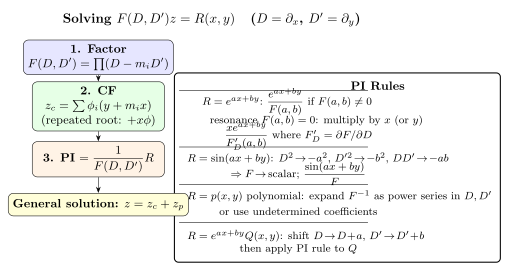
Operator notation and factorisation. Write the PDE as F(D,D′)z=R(x,y) where D=∂/∂x, D′=∂/∂y. The characteristic auxiliary equation sets D=m and D′=1 (or D/D′=m): solving F(m,1)=0 for m gives the slopes of the characteristic families. Each simple linear factor (D−mD′) contributes an arbitrary function ϕ(y+mx) to the complementary function (CF). A repeated factor (D−mD′)k contributes ϕ1(y+mx)+xϕ2(y+mx)+⋯+xk−1ϕk(y+mx).
PI rules (four cases).
| RHS R | Rule | Condition |
|---|
| eax+by | F(a,b)eax+by | F(a,b)=0 |
| eax+by, resonant | FD′(a,b)xeax+by (or y⋅) | F(a,b)=0 for one simple factor |
| sin(ax+by) or cos | Replace D2→−a2, D′2→−b2, DD′→−ab; divide | Non-zero denominator |
| eax+byQ(x,y) | Shift: F(D,D′)[eax+byΦ]=eax+byF(D+a,D′+b)Φ; find Φ | General — used for xnsin |
For a polynomial R: expand 1/F(D,D′) as a formal power series in D/D′ (or D′/D) and apply to R; the series terminates.
Boundary conditions. When boundary curves are given, pin down the arbitrary functions ϕi by substituting the stated conditions into the general solution.
Question Archetypes
Three patterns cover the corpus.
| Archetype | You are seeing this when… |
|---|
| operator-pde | ”solve F(D,D′)z=R(x,y)” — standard CF + PI |
| operator-pde-boundary | solve and fit boundary conditions (surface through given lines) |
| verify-pde-solution | ”verify that u=f(ξ)+g(η) satisfies the PDE” — chain-rule differentiation |
operator-pde (10 question(s); 2013, 2014, 2015, 2016, 2017, 2018, 2020, 2021, 2022, 2025)
Recognition Cues
- “Solve (F(D,D′))z=R(x,y)” with explicit D,D′ notation.
- The RHS is a sum of exponentials, polynomials, trig functions, or products thereof.
- No boundary data given — general solution only.
Solution Template
- Factor. Write F(D,D′)=∏(D−miD′). Find mi by solving F(m,1)=0 (for second-order, a quadratic; for third-order, a cubic — group and factor).
- CF. zc=∑ϕi(y+mix). For a repeated root m: add xϕj(y+mx) for each repetition.
- PI. For each RHS term, apply the appropriate rule. Check for resonance before applying the exponential rule.
- Sum. z=zc+zp.
Worked Example(s)
2014 Paper 2, 2014-P2-Q5a (10 marks)
Solve (2D2−5DD′+2D′2)z=24(y−x).
Factor. (2D−D′)(D−2D′). Roots: m=1/2 (from 2D−D′=0) and m=2 (from D−2D′=0).
CF. zc=ϕ1(y+21x)+ϕ2(y+2x), equivalently f(2y+x)+g(y+2x).
PI. RHS =24(y−x), degree 1. Try cubic ansatz zp=Ax3+Bx2y; matching coefficients:
(2D2−5DD′+2D′2)(Ax3+Bx2y)=12Ax+2By−10Bx. Set =(24y−24x): B=12, A=3.
z=f(2y+x)+g(y+2x)+3x3+6x2y.
2015 Paper 2, 2015-P2-Q5b (10 marks)
Solve (D2+DD′−2D′2)u=ex+y.
Factor. (D−D′)(D+2D′). Roots m=1 and m=−2.
CF. uc=ϕ1(y+x)+ϕ2(y−2x).
PI. F(1,1)=1+1−2=0: resonance with the factor (D−D′).
Apply (D+2D′)−1 first (non-resonant, value 1+2=3): gives ex+y/3.
Then (D−D′)−1(ex+y/3): solve (D−D′)u=ex+y via characteristics — u=xex+y (integration along x+y=const). Divide by 3:
up=3xex+y.
u=ϕ1(y+x)+ϕ2(y−2x)+3xex+y.
2017 Paper 2, 2017-P2-Q5a (10 marks)
Solve (D2−2DD′+D′2)z=ex+2y+x3+sin2x.
Factor. (D−D′)2: repeated root m=1.
CF. zc=ϕ1(y+x)+xϕ2(y+x).
PI for ex+2y. F(1,2)=(1−2)2=1=0: PI =ex+2y/1=ex+2y.
PI for x3. Only D,D2 act (since D′x3=0): 1/D2⋅x3=x5/20.
PI for sin2x. D2→−4, DD′→0, D′2→0: F→−4, PI =−sin2x/4.
z=ϕ1(y+x)+xϕ2(y+x)+ex+2y+20x5−4sin2x.
2016 Paper 2, 2016-P2-Q7a (15 marks)
Solve (D3−2D2D′−DD′2+2D′3)z=ex+y.
Factor. Auxiliary m3−2m2−m+2=(m−2)(m−1)(m+1): roots m=2,1,−1.
CF. zc=ϕ1(y+2x)+ϕ2(y+x)+ϕ3(y−x).
PI. F(1,1)=(1−2)(1−1)(1+1)=0: resonance on (D−D′). Non-vanishing factors at (1,1): (1−2)(1+1)=−2.
zp=−2xex+y=−2xex+y.
z=ϕ1(y+2x)+ϕ2(y+x)+ϕ3(y−x)−2xex+y.
2018 Paper 2, 2018-P2-Q7a (15 marks)
Solve (2D2−5DD′+2D′2)z=5sin(2x+y)+24(y−x)+e3x+4y.
Factor. (D−2D′)(2D−D′); CF =ϕ1(y+2x)+ϕ2(2y+x).
PI for 5sin(2x+y). D2→−4, DD′→−2, D′2→−1: F=2(−4)−5(−2)+2(−1)=0. Resonance! The factor (D−2D′) annihilates sin(2x+y) (since 2x+y matches the slope m=2). Trial z=x(Pcos(2x+y)+Qsin(2x+y)); matching gives PI =−35xcos(2x+y).
PI for 24(y−x). Polynomial ansatz (cubic): PI =712x2y−712xy2=712xy(x−y).
PI for e3x+4y. F(3,4)=−10=0: PI =−101e3x+4y.
z=ϕ1(y+2x)+ϕ2(2y+x)−35xcos(2x+y)+712xy(x−y)−101e3x+4y.
2013/2022 Paper 2, 2013-P2-Q6a and 2022-P2-Q7a (15 marks each)
Solve (D2+DD′−6D′2)z=x2sin(x+y).
Sources:,
Factor. (D+3D′)(D−2D′); CF =f(y−3x)+g(y+2x).
PI. RHS is x2⋅sin(x+y) — use the shift identity. Replace sin(x+y)=Im(ei(x+y)) and find PI of x2ei(x+y). The shifted operator F(D+i,D′+i) has non-zero constant term F(i,i)=i2+i2−6i2=4=0, so no resonance. Expand (4+L)−1 with L=3iD−11iD′+…:
Φ=[4+L]−1x2=41[x2−46ix+2+16−18]=4x2−83ix−3213.
Take imaginary part after multiplying by ei(x+y):
zp=(4x2−3213)sin(x+y)−83xcos(x+y).
z=f(y−3x)+g(y+2x)+(4x2−3213)sin(x+y)−83xcos(x+y).
2020 Paper 2, 2020-P2-Q5d (10 marks)
Solve (D3−2D2D′−DD′2+2D′3)z=e2x+y+sin(x−2y).
Factor. (D−D′)(D+D′)(D−2D′); CF =ϕ1(y+x)+ϕ2(y−x)+ϕ3(y+2x).
PI for e2x+y. F(2,1)=0 (since D−2D′ vanishes at m=2, b/a=1/2). Non-vanishing factors: (2−1)(2+1)=3. PI =xe2x+y/3.
PI for sin(x−2y). Replace D2→−1, D′2→−4, DD′→2 (since a=1,b=−2, ab=−2). Cubic operator reduces to 3D−6D′: 3D−6D′1sin(x−2y)=−151cos(x−2y).
z=ϕ1(y+x)+ϕ2(y−x)+ϕ3(y+2x)+3xe2x+y−15cos(x−2y).
2025 Paper 2, 2025-P2-Q5a (10 marks)
Solve (D2+DD′−2D′2)z=ysinx.
Factor. (D−D′)(D+2D′); CF =f(y+x)+g(y−2x).
PI. RHS =ysinx. Trial: zp=y(asinx+bcosx)+(csinx+dcosx). Apply the operator: only D2 and DD′ act non-trivially. Matching coefficients of ysinx, ycosx, sinx, cosx:
a=−1, b=0, c=0, d=−1.
z=f(y+x)+g(y−2x)−ysinx−cosx.
2021 Paper 2, 2021-P2-Q7a (15 marks)
Solve (D2−D′2−3D+3D′)z=xy+ex+2y.
Factor. D2−D′2−3D+3D′=(D−D′)(D+D′)−3(D−D′)=(D−D′)(D+D′−3).
CF. From (D−D′): ϕ1(y+x). From (D+D′−3): e3xϕ2(y−x) (verify: D+D′−3 kills e3xf(y−x) since D+D′ kills functions of y−x and 3e3x cancels).
PI for ex+2y. F(1,2)=(1−2)(1+2−3)=(−1)(0)=0: resonance on (D+D′−3). Apply (D−D′)−1 first (value −1): gives −ex+2y. Then (D+D′−3)−1ex+2y=xex+2y. So PI =−xex+2y.
PI for xy. Use (u,v)=(x+y,x−y) substitution to make the operator separable; result is a degree-3 polynomial in (x,y) (full form in the source).
z=ϕ1(y+x)+e3xϕ2(y−x)+(poly PI)−xex+2y.
Common Traps
- Resonance detection is step zero. Before applying eax+by/F(a,b), always check whether F(a,b)=0. If it does, identify which factor vanishes and apply the x-multiplier rule only to that factor, dividing by the remaining factors evaluated at (a,b).
- Repeated-root CF requires xϕ2. For (D−D′)2, the CF is ϕ1(y+x)+xϕ2(y+x) — a common error is to write only ϕ1.
- Trig PI with odd-degree operators (2020-Q5d): first reduce all D2→−a2, D′2→−b2, DD′→−ab, which simplifies the cubic operator to a first-degree expression; then invert that.
- Shift identity for xnsin/cos (2013, 2022): write sin(ax+by)=Im(ei(ax+by)); shift the operator by (a,b) using F(D+a,D′+b); the constant term is F(ia,ib), which must be non-zero (no resonance after the shift); the polynomial expansion terminates because D3x2=0.
- D′ kills functions of x only: when the RHS is xn (no y), every D′ term in the operator annihilates it, and only powers of D act.
operator-pde-boundary (1 question(s); 2023)
Recognition Cues
- “Find the surface satisfying [PDE] and passing through [two lines or curves].”
- General solution has arbitrary functions ϕi; boundary conditions pin them down.
Solution Template
- Solve the homogeneous PDE to get the general solution z=f(ξ1)+xg(ξ1) (or sum of fi(ξi)).
- Apply first BC (simpler curve, often x=0 or z=0): determines one arbitrary function.
- Apply second BC (substitute into the remaining general solution): get an equation for the second arbitrary function; solve by substitution.
- Write the explicit surface.
Worked Example(s)
2023 Paper 2, 2023-P2-Q6a (15 marks)
Find the surface through z=x=0 and z−1=x−y=0 satisfying zxx−4zxy+4zyy=0.
Factor. (D−2D′)2: repeated root m=2. General solution: z=f(y+2x)+xg(y+2x).
BC 1 (x=0, z=0): f(y)=0 for all y, so f≡0. Now z=xg(y+2x).
BC 2 (x=y, z=1): xg(3x)=1, so g(3x)=1/x. Set u=3x: g(u)=3/u.
z=x⋅y+2x3=2x+y3x.
Verify: zxx−4zxy+4zyy=0 ✓; z∣x=0=0 ✓; z∣y=x=3x/3x=1 ✓.
Common Traps
- For repeated root (D−mD′)2: the second piece uses x⋅g(y+mx), not y⋅g. Using y would give a different (incorrect) surface.
- When inverting g(3x)=1/x: write u=3x and express g as a function of a single argument u; g(u)=3/u (not 3/x, which would still depend on the original variable).
verify-pde-solution (1 question(s); 2024)
Recognition Cues
- “Show that u=f(ξ)+g(η) satisfies [wave/Laplace/heat equation] when [condition on parameters].”
- No solving required — only differentiation via the chain rule.
Solution Template
- Compute uxx, uyy, utt (or whatever derivatives the PDE involves) using ξx,ξy,ξt,ηx,ηy,ηt.
- Substitute into the PDE; collect terms in f′′(ξ)+g′′(η).
- The PDE holds iff the coefficient of f′′+g′′ satisfies the stated algebraic condition.
Worked Example(s)
2024 Paper 2, 2024-P2-Q5a (10 marks)
Show u=f(x−kt+iαy)+g(x−kt−iαy) satisfies uxx+uyy=utt/c2 when α2=1−k2/c2.
With ξ=x−kt+iαy and η=x−kt−iαy:
uxx=f′′+g′′; uyy=(iα)2f′′+(−iα)2g′′=−α2(f′′+g′′); utt=k2(f′′+g′′).
uxx+uyy=(1−α2)(f′′+g′′),c2utt=c2k2(f′′+g′′).
Equating: 1−α2=k2/c2, i.e. α2=1−k2/c2. ■
Common Traps
- (iα)2=−α2, not +α2 or −iα2. Track i2=−1 carefully.
Marks-Aware Writing
10-mark questions (compulsory Q5 slot): Show factorisation (one line), write CF (one line), compute PI with the specific rule named, write the general solution. For resonance: one sentence (”F(a,b)=0, so multiply by x”), then the corrected PI.
15-mark questions (Q6–Q8 slot): Show factorisation with the auxiliary equation, verify the factorisation. Write CF with correct argument form. For multi-term RHS: handle each PI term in a labelled sub-step. Verify the PI by substituting back (one line, or quote sympy if time is short). Box the general solution.
For the shift-identity questions (2013, 2022): explicitly write F(D+i,D′+i), simplify, identify the constant term F(i,i)=0, expand the geometric series, and extract the real/imaginary part.
Practice Set
| Year | Paper/Q | Marks | Archetype | One-line hint |
|---|
| 2025 | P2-Q5a | 10 | operator-pde | RHS ysinx; undetermined coefficients y(asinx+bcosx)+(csinx+dcosx) |
| 2024 | P2-Q5a | 10 | verify-pde-solution | Chain rule: (iα)2=−α2; collect f′′+g′′; match coefficients |
| 2023 | P2-Q6a | 15 | operator-pde-boundary | Repeated root (D−2D′)2; f≡0 from x=0 BC; g(u)=3/u from x=y BC |
| 2022 | P2-Q7a | 15 | operator-pde | Same operator/RHS as 2013; shift identity; F(i,i)=4; Im part gives the PI |
| 2021 | P2-Q7a | 15 | operator-pde | Factor (D−D′)(D+D′−3); CF includes e3xϕ2(y−x); double resonance for ex+2y |
| 2020 | P2-Q5d | 10 | operator-pde | Three roots; F(2,1)=0 (resonance); trig PI via D2→−1, D′2→−4, DD′→2 |
| 2018 | P2-Q7a | 15 | operator-pde | Three PIs; trig is resonant (F=0); x-multiply; polynomial is cubic; exponential F(3,4)=−10 |
| 2017 | P2-Q5a | 10 | operator-pde | Repeated root (D−D′)2; three separate PIs; ex+2y non-resonant (F(1,2)=1) |
| 2016 | P2-Q7a | 15 | operator-pde | Third-order cubic; m=2,1,−1; resonance at m=1 for ex+y; PI =−xex+y/2 |
| 2015 | P2-Q5b | 10 | operator-pde | Factor (D−D′)(D+2D′); F(1,1)=0 resonance; apply non-resonant factor first |
| 2014 | P2-Q5a | 10 | operator-pde | Factor (2D−D′)(D−2D′); polynomial PI cubic ansatz; matching gives zp=3x3+6x2y |
| 2013 | P2-Q6a | 15 | operator-pde | x2sin(x+y); shift identity; F(i,i)=4; Im of ei(x+y)Φ with series |