Wave equation
At a Glance
- Frequency: 7 sub-parts across 6 of 13 years (2013, 2014, 2017, 2020, 2021, 2023)
- Priority tier: T2
- Marks (count): 15 (2), 20 (5)
- Average solve time: ~15 min
- Difficulty mix: medium 5, hard 2
- Section: B | Dominant type: computation
Why This Chapter Matters
The wave equation appears in 6 of the last 11 years and is essentially always a 15- or 20-mark question — the highest mark range in Paper 2’s PDE cluster. Every question uses the same algorithm: separate variables, quantise the spatial modes using the fixed-end boundary conditions, apply the two initial conditions to determine the Fourier coefficients, and write the series. The variation between questions lies entirely in the initial conditions (zero vs. non-zero displacement, zero vs. non-zero velocity, polynomial vs. trigonometric IC), which determines which coefficients survive and how much integration is required. Mastering the algorithm once covers all seven appearances.
Minimum Theory
Wave equation. The transverse displacement u(x,t) of a tightly stretched string of length L satisfies
utt=c2uxx,0<x<L,t>0,
with c2=T/μ (tension/mass-per-unit-length). Boundary conditions u(0,t)=u(L,t)=0 (fixed ends). Initial conditions: u(x,0)=f(x) (initial shape) and ut(x,0)=g(x) (initial velocity).
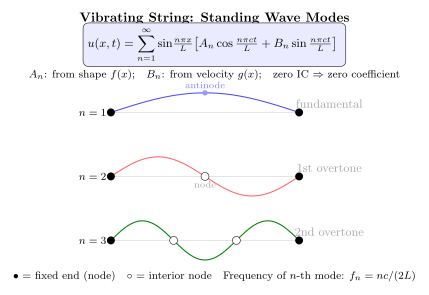
Separation of variables. Set u=X(x)T(t). The BCs force X(0)=X(L)=0 and the separation constant must be negative (call it −λ2) to get oscillatory solutions. The normalised modes are Xn(x)=sin(nπx/L), n=1,2,…, with corresponding time factors Tn(t)=Ancos(nπct/L)+Bnsin(nπct/L). General solution:
u(x,t)=∑n=1∞sinLnπx[AncosLnπct+BnsinLnπct].
IC rule. Apply u(x,0)=f(x): An=L2∫0Lf(x)sinLnπxdx.
Apply ut(x,0)=g(x): LnπcBn=L2∫0Lg(x)sinLnπxdx, i.e. Bn=nπc2∫0Lg(x)sinLnπxdx.
Zero IC simplifications: If f(x)=0 then An=0 for all n (pure sin in time). If g(x)=0 then Bn=0 (pure cos in time). If f is already one eigenmode asin(n0πx/L), no series is needed — only An0=a survives.
IBP for polynomial ICs. For f(x)=x(L−x) on (0,L): ∫0Lx(L−x)sin(nπx/L)dx=n3π32L3[1−(−1)n], so only odd n contribute (1/n3 decay). For g(x)=λx(L−x): the Bn coefficient is n4π4c8λL3 for odd n. For f(x)=x on (0,L): An=nπ2L(−1)n+1 (slow 1/n decay, alternating). For constant g=1: Bn=n2π2c4L for odd n only.
Triangular IC. For a string plucked at x=a to height h: bn=π2n2a(L−a)2hL2sinLnπa. Harmonics for which sin(nπa/L)=0 are absent (nodes at the pluck point).
Question Archetypes
All wave-equation questions in the corpus share the same archetype.
| Archetype | You are seeing this when… |
|---|
| vibrating-string | a string of length L with fixed ends and given initial displacement/velocity; find u(x,t) |
vibrating-string (7 question(s); 2013, 2014, 2014, 2017, 2020, 2021, 2023)
Recognition Cues
- “A tightly stretched string of length L with both ends fixed; find the displacement at any time.”
- One or both initial conditions given: initial shape f(x) and/or initial velocity g(x).
- Variants: a single eigenmode IC (no series needed); triangular (plucked) IC; polynomial IC (requires IBP twice).
Solution Template
- Write the general sine-series solution u=∑n≥1sin(nπx/L)[Ancosωnt+Bnsinωnt] where ωn=nπc/L.
- Set t=0: ∑Ansin(nπx/L)=f(x). Compute An by Fourier projection or by inspection if f is already a finite sum of modes.
- Differentiate in t and set t=0: ∑Bnωnsin(nπx/L)=g(x). Compute Bn=ωnL2∫0Lgsin(nπx/L)dx.
- For polynomial ICs: use two IBPs (bracket terms vanish at fixed ends); collect odd/even n cases.
- Write the final boxed series. Note which harmonics vanish (e.g. n divisible by 3 if plucked at L/3).
Worked Example(s)
2013 Paper 2, 2013-P2-Q6c (20 marks)
String length l, fixed ends, released from rest; initial velocity λx(l−x).
f(x)=0 → all An=0. Apply g(x)=λx(l−x):
Bn⋅lnπc=l2λ∫0lx(l−x)sinlnπxdx=l2λ⋅n3π32l3⋅[1−(−1)n].
For even n: Bn=0. For odd n: Bn=n4π4c8λl3.
u(x,t)=π4c8λl3n odd∑n41sinlnπxsinlnπct.
The 1/n4 decay signals a quadratic IC; the odd-harmonics-only pattern follows from x(l−x) being even about l/2.
2014 Paper 2, 2014-P2-Q7a (15 marks)
String length π, c=1; zero velocity; initial shape k(sinx−sin2x).
g(x)=0 → all Bn=0. The IC f(x)=ksinx−ksin2x is already a finite sum of eigenmodes (L=π, so basis is sinnx): by inspection A1=k, A2=−k, all others zero.
u(x,t)=ksinxcost−ksin2xcos2t.
No Fourier integral required; the solution is a finite sum and stays finite for all t.
2014 Paper 2, 2014-P2-Q8a (15 marks)
utt=uxx on (0,1); u(x,0)=0; ut(x,0)=x2.
L=c=1. An=0. Compute Bn from x2 via two IBPs (using ∫x2sin(nπx)dx=−x2cos(nπx)/(nπ)+2xsin(nπx)/(nπ)2+2cos(nπx)/(nπ)3):
- Odd n: Bn=(nπ)42[(nπ)2−4].
- Even n: Bn=−(nπ)22.
u(x,t)=n=1∑∞Bnsin(nπt)sin(nπx),
with the Bn as above. Unlike the x(l−x) case, both odd and even harmonics contribute (because x2 lacks the midpoint symmetry).
2017 Paper 2, 2017-P2-Q8a (20 marks)
(i) Derive the general solution by separation of variables. (ii) Boundary conditions y(0,t)=y(l,t)=0, yt(x,0)=0, y(x,0)=asin(πx/l).
Part (i). Set y=X(x)G(t); show the separation constant must be negative −k2; write y=(Acoskx+Bsinkx)(Ccosckt+Esinckt). State why +k2 (exponential in x) is rejected. The appropriate solution is the oscillatory form with negative constant.
Part (ii). BCs: A=0, k=nπ/l. IC yt=0: En=0. IC y(x,0)=asin(πx/l) is already the n=1 mode: C1=a, all others zero.
y(x,t)=asinlπxcoslπct.
The initial shape is a single eigenmode so no Fourier series arises — only the fundamental survives.
2020 Paper 2, 2020-P2-Q8a (20 marks)
String length l, plucked at x=l/3 to height h, released from rest.
g(x)=0 → Bn=0. The initial shape is the triangular function:
f(x)={3hx/l,3h(l−x)/(2l),0≤x≤l/3,l/3≤x≤l.
Fourier sine coefficients (integrate piecewise + IBP on each segment):
bn=π2n29hsin3nπ.
Since sin(nπ/3)=0 for n=3,6,9,…, every third harmonic vanishes (nodes at the pluck point).
y(x,t)=π29hn=1∑∞n21sin3nπsinlnπxcoslnπct.
2021 Paper 2, 2021-P2-Q6a (20 marks)
a2uxx=utt on (0,L); u(x,0)=x(L−x)/4; ut(x,0)=0.
Bn=0 (zero velocity). Compute An from x(L−x)/4; using the standard integral ∫0Lx(L−x)sin(nπx/L)dx=2L3[1−(−1)n]/(n3π3), only odd n contribute:
An=L2⋅41⋅n3π34L3=n3π32L2(n odd).
u(x,t)=n odd∑n3π32L2sinLnπxcosLanπt.
Same integral structure as 2013-P2-Q6c (quadratic IC, odd harmonics, 1/n3 decay from shape — noting here it’s displacement, not velocity, so decay is 1/n3 not 1/n4).
2023 Paper 2, 2023-P2-Q7c (20 marks)
a2uxx=utt on (0,L); u(x,0)=x; ut(x,0)=1.
Both ICs non-zero; both An and Bn survive.
An: Fourier sine series of x on (0,L): An=nπ2L(−1)n+1 (slow 1/n decay, alternating sign — because f(L)=L=0).
Bn: Fourier sine series of constant 1: LnπaBn=nπ2[1−(−1)n], giving Bn=n2π2a4L for odd n, 0 for even.
u=n=1∑∞nπ2L(−1)n+1sinLnπxcosLnπat+n odd∑n2π2a4LsinLnπxsinLnπat.
Common Traps
- Sign of separation constant. For a vibrating string the separation constant must be −k2<0; choosing +k2 gives exponentials in x that cannot satisfy the fixed-end BCs non-trivially. State the reason.
- Which IC kills which coefficient. Zero initial displacement → An=0, pure sinct in time. Zero initial velocity → Bn=0, pure cosct in time. Mixing these up is the most common source of errors.
- The factor L/(nπc) from the Bn formula. Bnωn= (Fourier coefficient of g) but ωn=nπc/L, so Bn=(L/(nπc))×(Fourier coefficient). Forgetting this factor is frequent.
- Triangular IC (2020). The two-segment integral requires careful setup of limits and slopes; the result bn=π2n29hsin(nπ/3) can be verified at n=3: sin(π)=0 ✓ (no third harmonic when plucked at L/3).
- The x(L−x) integral. Commit this to memory: ∫0Lx(L−x)sin(nπx/L)dx=n3π32L3[1−(−1)n]. It appears in 2013, 2021 (and analogously in heat-equation chapters). Odd n only.
Marks-Aware Writing
15-mark questions (2014-Q7a, 2014-Q8a): Four steps — write the general solution, apply the zero-velocity or zero-displacement IC (one sentence), compute the Fourier coefficient integral (show the IBP setup), write the final series. For Q7a: identify that the IC is already a finite sum; no integral needed (2 marks saved).
20-mark questions (2013, 2017, 2020, 2021, 2023): The mark scheme expects all five components: PDE + general solution derivation (step 1), BC application (step 2), first IC (step 3), second IC (step 4), assembled answer (step 5). For the 2017 two-part question, Part (i) derivation is worth ~8 marks on its own; state the rejection of the positive constant explicitly.
Practice Set
| Year | Paper/Q | Marks | One-line hint |
|---|
| 2024 | P2-Q5a | 10 | Not a BVP — verify directly: compute uxx,uyy,utt via chain rule; show uxx+uyy=utt/c2 iff α2=1−k2/c2 (the condition given) |