Absolute and conditional convergence
At a Glance
- Frequency: 4 sub-parts across 4 of 13 years (2015, 2016, 2018, 2025)
- Priority tier: T3
- Marks (count): 10 (3), 15 (1)
- Average solve time: ~7 min
- Difficulty mix: easy 3, medium 1
- Section: A | Dominant type: computation
Why This Chapter Matters
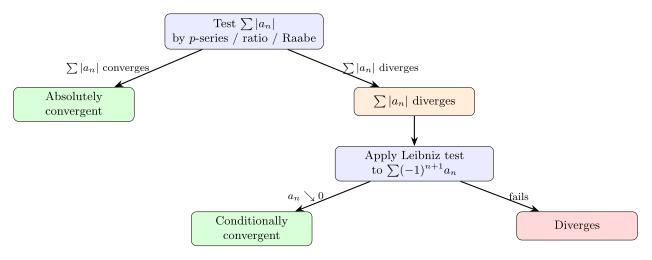
Alternating-series questions appear in Section A compulsory (Q1) almost every year, always for 10 marks. The question always asks: does the series converge? Is the convergence absolute or conditional? The answer is always: yes (Leibniz); conditional (absolute series diverges by comparison with for ). The 2016 question requires proving Leibniz and the harmonic divergence from scratch — that proof is worth knowing in full. The 2022 and 2023 questions add the ratio test and Raabe’s test for the absolute part.
Minimum Theory
Absolute convergence. is absolutely convergent if converges. Absolute convergence implies convergence.
Conditional convergence. converges but diverges.
Leibniz alternating series test. If , is decreasing, and , then converges.
Proof sketch: Even partial sums are non-decreasing and bounded above by ; odd partial sums satisfy ; both converge to the same limit.
Convergence tests for :
| Test | When to use |
|---|---|
| -series comparison: | converges; diverges |
| Ratio test | Terms involve factorials, powers, or |
| Raabe’s test | Ratio test gives limit exactly 1 |
Raabe’s test. If , then the series converges absolutely if and diverges if .
Question Archetypes
| Archetype | Recognition |
|---|---|
| conditional-convergence | Alternating series ; apply Leibniz + comparison test on $\sum |
| ratio-test | Power-series type; ratio ; classify by vs 1 |
| ratio-raabe-test | Ratio test inconclusive at boundary; Raabe test resolves |
conditional-convergence (3 question(s); 2015, 2016, 2018)
Recognition Cues — Alternating series where involves or ; asked for “absolute and conditional” convergence or “range of .”
Solution Template
- Verify Leibniz conditions: , decreasing (compute for large ), .
- Conclude convergence by Leibniz.
- Test by limit comparison with .
- Classify: converges absolutely iff ; conditionally iff .
Worked Example 1
2015 Paper 2, 2015-P2-Q1c (10 marks)
Test convergence and absolute convergence of .
Set . Leibniz: ; has for , so is decreasing; . All conditions hold — series converges.
For absolute convergence: . Limit comparison with : . Since diverges (), so does . Not absolutely convergent — conditionally convergent.
Worked Example 2
2018 Paper 2, 2018-P2-Q1d (10 marks)
, . Find: (i) range of for absolute convergence; (ii) range of for conditional convergence.
Leibniz: , decreasing ( increasing), for all . Series converges for all .
Absolute series: . Limit comparison with gives ratio , same convergence behaviour. Converges iff .
Worked Example 3
2016 Paper 2, 2016-P2-Q2a (15 marks)
Show is conditionally convergent. Prove any theorems used.
Convergence (Leibniz test + proof): , strictly decreasing, . Leibniz proof: even partial sums are non-decreasing (each bracket ) and bounded above by ; odd sums since . Both subsequences converge to the same limit. ✓
Divergence of : is the harmonic series minus its first term. Proof of harmonic divergence: group in blocks ; the -th block ( terms starting from ) sums to . Infinitely many blocks each contribute , so partial sums . ✓
Hence conditionally convergent.
Common Traps
- Verify all three Leibniz conditions. Monotonicity is the one most often skipped. Use or explicit comparison .
- doesn’t imply convergence. The harmonic series has but diverges. Leibniz additionally requires the alternating sign and monotonicity.
- Limit comparison: the ratio must be in . If or , the standard limit comparison fails; use the direct comparison instead.
ratio-test (1 question(s); 2022)
Worked Example
2022 Paper 2, 2022-P2-Q4b (15 marks)
Test for .
as . Ratio test: converges if , diverges if .
At : (Stirling: ). Since diverges (p-series, ), diverges also at .
ratio-raabe-test (1 question(s); 2023)
Worked Example
2023 Paper 2, 2023-P2-Q1c (10 marks)
Test for .
Ratio . Converges for , diverges for , inconclusive at .
Raabe at : . Converges at .
Marks-Aware Writing
For 10-mark convergence questions: three explicit steps — Leibniz conditions stated and verified; conclude convergence; limit-comparison with for the absolute series. Box the final classification.
For the 15-mark question (2016) requiring proofs: write the full Leibniz proof (even partial sums non-decreasing and bounded; odd sums sandwich) AND the dyadic-blocking proof of harmonic divergence. These proofs together are 8–10 marks; missing either means half-marks at most.
Practice Set
- 2025-P2-Q1c (10 m) — — Hint: Leibniz; absolute series is the harmonic series, , diverges.