Fundamental theorems of integral calculus
At a Glance
- Frequency: 2 sub-parts across 2 of 13 years (2017, 2020)
- Priority tier: T3
- Marks (count): 15 (2)
- Average solve time: ~12 min
- Difficulty mix: medium 2
- Section: A | Dominant type: computation
Why This Chapter Matters
The two fundamental theorems of calculus are not just background — UPSC asks directly about their hypotheses. The 2017 question makes you diagnose exactly where FTC1 applies and where it fails (at the jump discontinuities of the floor function). The 2020 question uses the “King’s rule” reflection symmetry that collapses a hard integral into an easy one — a trick that appears repeatedly across years and papers. Both problems reward knowing the precise statement of a theorem over mechanical computation.
Minimum Theory
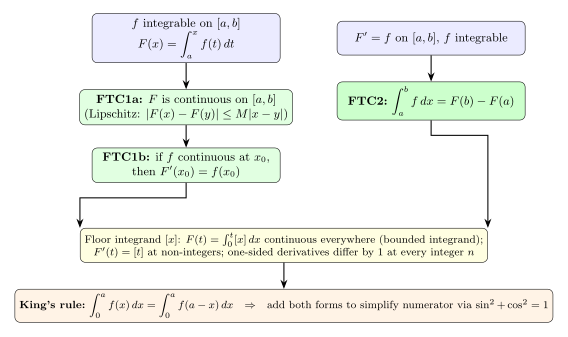
FTC1 (integral-function differentiability). If is Riemann integrable on and , then is continuous on . Moreover, at every point where is continuous, is differentiable and .
FTC2. If is differentiable on with Riemann integrable on , then .
Continuity of the integral function. If is bounded on , then is Lipschitz (and hence continuous) on regardless of any discontinuities of . Differentiability requires the integrand to be continuous at the point in question.
Symmetry (King’s rule). On : . This follows by the substitution . Applying it and adding the two forms often collapses a complicated numerator into or another simple expression.
Question Archetypes
| Archetype | Recognition |
|---|---|
| integral-function-smoothness | ”; find where is differentiable / continuous” |
| symmetry-integral | ”Show ”; numerator contains or in denominator with |
integral-function-smoothness (1 question(s); 2017)
Recognition Cues — The function is defined by where has known discontinuities (typically a piecewise or floor function). The question asks exactly where is differentiable and/or continuous but not differentiable. Apply FTC1: continuity is free (bounded integrand), differentiability requires continuity of at the point.
Solution Template
- Identify discontinuities of . Pinpoint every point where the integrand is discontinuous.
- Prove is continuous everywhere. Use the Lipschitz bound: .
- Non-integer : apply FTC1. At any where is continuous, .
- Integer : compute one-sided derivatives. In a left neighbourhood of , the integrand has value ; in a right neighbourhood, value . The one-sided derivatives are and ; they differ, so is not differentiable at .
- State answers clearly. Differentiable set; continuous-but-not-differentiable set.
Worked Example
2017 Paper 2, 2017-P2-Q2a (15 marks)
Let , where denotes the largest integer . (i) Determine all real numbers at which is differentiable. (ii) Determine all real numbers at which is continuous but not differentiable.
Step 1 — is continuous everywhere.
The floor function is bounded on every bounded interval. For any ,
So is continuous on all of .
Step 2 — Differentiability at non-integer .
If , then lies in some open interval where is constant, hence continuous. By FTC1, .
Step 3 — One-sided derivatives at integers.
At an integer , compute:
Since , the derivative does not exist at any integer. This includes : .
Answers:
Common Traps
- is not special. Students often state that is differentiable at because . But the one-sided derivatives and differ, so fails to be differentiable there.
- Continuity does not fail. The integral of any bounded function is Lipschitz-continuous. Saying is discontinuous at integers is wrong; only differentiability fails.
- The slope jump is exactly 1 at every integer. The floor function increases by at each integer, giving a slope mismatch of regardless of which integer you check.
symmetry-integral (1 question(s); 2020)
Recognition Cues — A definite integral over where the integrand involves a sum in the denominator. The standard move is to apply the King substitution and add the two forms. After the substitution, the numerator often simplifies via .
Solution Template
- Name the integral . Write .
- Apply King’s rule. Set ; use the identities , to simplify .
- Identify (if it holds). Check that the substitution just swaps in the integrand.
- Add . The combined numerator usually becomes (or another simple form), leaving a tractable integral.
- Evaluate the resulting integral. Rewrite the denominator as and integrate using .
- Simplify. Use and to obtain the exact value.
Worked Example
2020 Paper 2, 2020-P2-Q4b (15 marks)
Show that .
Let .
Step 1 — King’s rule. Substitute :
Since the denominator is unchanged and the numerator swaps , we get .
Step 2 — Add.
Step 3 — Evaluate .
Write , so
Substitute , limits to :
Step 4 — Simplify. Using and :
Therefore .
Step 5 — Finish.
Common Traps
- Skipping the King step. Trying to evaluate by Weierstrass substitution or partial fractions is extremely messy. The reflection is the only clean entry point.
- Forgetting . The final simplification depends on knowing or quickly deriving this half-angle value. Derive it with the half-angle formula: (rationalise ). Under exam pressure, verify numerically: . ✓
- Arithmetic on . Note ; these are the same. Write whichever form matches the target expression.
Marks-Aware Writing
A 15-mark answer for the FTC question requires: (1) an explicit Lipschitz/uniform continuity argument to establish global continuity, (2) FTC1 cited for non-integers with written clearly, (3) both one-sided limits computed at a general integer with the difference shown. Omitting the continuity proof or treating carelessly each costs marks.
For the symmetry integral: (1) define and and show by King’s rule, (2) add and simplify to get , (3) evaluate via and the antiderivative, (4) compute and and carry through the logarithm identity. All four steps must appear for full marks.
Practice Set
- 2013-P2-Q1c (10 m) — — Hint: likely another FTC / continuity-of-integral question; establish where the integrand is continuous first.
- 2014-P2-Q2b (15 m) — — Hint: may involve a symmetry substitution or integral-function differentiability; identify the technique from the structure of the integrand.