Maxima and minima of multi-variable functions (analytic criteria)
At a Glance
- Frequency: 4 sub-parts across 4 of 13 years (2014, 2016, 2021, 2023)
- Priority tier: T3
- Marks (count): 15 (4)
- Average solve time: ~10 min
- Difficulty mix: medium 3, hard 1
- Section: A | Dominant type: computation
Why This Chapter Matters
Multi-variable Lagrange multiplier questions appear in Section A at 15 marks and are among the highest-value non-compulsory questions. All three Lagrange archetypes (one constraint, two constraints, distance to surface) follow the same procedure: write the Lagrange system, exploit symmetry to reduce it, solve for the coordinates, and evaluate the objective. The key skill is recognising when the system admits a symmetric solution (, etc.) to avoid solving a general cubic.
Minimum Theory
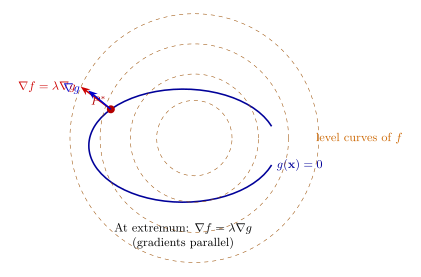
Lagrange multipliers (one constraint). Minimise/maximise subject to . At a constrained extremum: . This gives equations (the gradient equations plus the constraint).
Lagrange multipliers (two constraints). Subject to and : at a constrained extremum, . The equations are usually solved by exploiting symmetry.
Hessian test (unconstrained). At a critical point of : . See P2-RA-20 for details.
Distance to surface. Minimise (squared distance) subject to the surface equation . The Lagrange equations factor as (or similar), giving the critical point in terms of ; substituting into determines .
Question Archetypes
| Archetype | Recognition |
|---|---|
| lagrange-extrema | Minimise/maximise subject to one constraint |
| lagrange-distance | Extremise distance from a point to a surface |
| lagrange-two-constraint | Extremise subject to two constraints; secular equation |
| hessian-extrema | Unconstrained; find critical points and classify |
lagrange-extrema (1 question(s); 2014)
Worked Example
2014 Paper 2, 2014-P2-Q4b (15 marks)
Find the minimum of subject to by Lagrange multipliers.
Lagrange system: , , . Multiply each by , , respectively: , , . Hence , so (from , either all positive or two negative).
Minimum value: , attained at (and other sign patterns).
(AM-GM alternative: with equality iff .)
lagrange-distance (1 question(s); 2023)
Worked Example
2023 Paper 2, 2023-P2-Q2b (15 marks)
Find min/max distances from to sphere using Lagrange multipliers.
Minimise subject to .
: , , .
Since : , , .
Substituting into : , so .
Two critical points: (near side) and (far side).
Since : distances are (min, near) and (max, far).
hessian-extrema (1 question(s); 2016)
Worked Example
2016 Paper 2, 2016-P2-Q3b (15 marks)
Find relative extrema of .
, . Adding: . Substituting: .
Critical points: , , .
, , .
At : , → local min, .
At : — inconclusive. Line slices: (rises); for small (falls). Saddle point.
lagrange-two-constraint (1 question(s); 2023, 2025)
Recognition Cues — Maximise subject to TWO constraints; often involves an ellipsoid and a plane; solved by a secular equation.
Worked Example (2025)
2025 Paper 2, 2025-P2-Q3b (15 marks)
Maximise subject to ().
By Lagrange: , etc. Multiply the three equations by , , : . So (from the constraint). Max volume .
Common Traps
- in distance problems. The Lagrange equations give ; dividing requires , which must be stated.
- Symmetry gives , not . The sign pattern matters for whether the critical value is a min or a max.
- requires line slices. Never conclude “saddle” or “extremum” when without additional work.
- AM-GM as a shortcut. For symmetric objectives like subject to , AM-GM provides both the answer and a cleaner proof than the Lagrange computation.
Marks-Aware Writing
All four historical questions are 15 marks. The examiner awards marks for: (a) writing the Lagrange system explicitly, (b) the algebraic step reducing to the symmetric case, (c) applying the constraint to find the coordinates, and (d) evaluating the objective and stating min/max. Steps (b) and (c) together account for about 8 marks — the algebra must be shown.
For the distance problem: computing geometrically and subtracting/adding the radius is a useful check, but the Lagrange algebra must still be shown in full.
Practice Set
- 2022-P2-Q3b (15 m) — — Hint: two-constraint Lagrange; secular equation (quadratic in ); stationary values are the eigenvalues of the associated matrix restricted to the constraint surface.