Maxima and minima of single-variable functions
At a Glance
- Frequency: 4 sub-parts across 4 of 13 years (2013, 2015, 2021, 2022)
- Priority tier: T3
- Marks (count): 10 (2), 15 (2)
- Average solve time: ~8 min
- Difficulty mix: easy 2, medium 2
- Section: A | Dominant type: computation
Why This Chapter Matters
These questions appear in Section A and test two flavours: (a) Hessian-based extrema of two-variable functions (find critical points, classify via ), and (b) extrema of one-variable functions on a closed interval. The Hessian test sometimes produces a degenerate case () that requires direct line-slice analysis — this is the key difficulty. The closed-interval case is purely algorithmic.
Minimum Theory
Critical points. Set (for 1D) or (for 2D) and solve.
Second derivative test (1D). At a critical point : if , local min; if , local max; if , inconclusive (use higher derivatives or direct comparison).
Closed interval (1D). On : evaluate at all critical points inside and at the endpoints , . The largest value is the absolute max, the smallest is the absolute min.
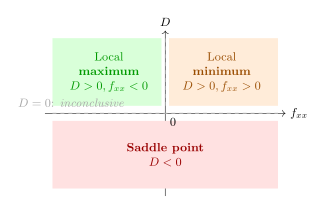
Second derivative test (2D). At a critical point of :
- , : local minimum.
- , : local maximum.
- : saddle point.
- : inconclusive — examine along line slices through the critical point.
Degenerate case . Evaluate along two lines through the critical point. If exceeds the critical value along one line and falls below it along another, the point is a saddle.
Question Archetypes
| Archetype | Recognition |
|---|---|
| hessian-extrema | Find and classify all critical points of using the Hessian test |
| extrema-on-interval | Find absolute max/min of on a closed interval |
hessian-extrema (3 question(s); 2013, 2015, 2022)
Recognition Cues — “Find max/min values of ”; no constraint given (unconstrained); function is polynomial or similar.
Solution Template
- Compute , ; solve and simultaneously.
- For each critical point compute , , , and .
- Classify each point; for use line slices.
- State the extreme values (and note whether a global max/min exists).
Worked Example
2013 Paper 2, 2013-P2-Q3c (10 marks)
Find max/min of .
Step 1. , . Substitute: . Critical points: and .
Step 2. , , .
At : → saddle.
At : , , → local min, .
Step 3. No global max (as , via the term).
Degenerate case example (2016): For , the critical point yields . Slices: (rises), for small (falls) — saddle.
Common Traps
- is inconclusive; don’t guess. Showing one line where increases and one where it decreases is the required argument.
- Global vs local. The presence of odd-degree terms (like ) means is unbounded; no global max or min may exist even if local extrema do.
extrema-on-interval (1 question(s); 2021)
Worked Example
2021 Paper 2, 2021-P2-Q2a (15 marks)
Find max and min of on .
. Discriminant: , roots at and — both outside . So on (check: ) — is strictly increasing.
Absolute max at : . Absolute min at : .
Common Traps
- Check critical points are inside the interval. When no critical points lie inside , the function is monotone on and the extrema are at the endpoints.
- Don’t confuse the discriminant sign. means two real roots; the roots are near and , both outside .
Marks-Aware Writing
For the Hessian test: write , explicitly; show the system solution step; build a table of at each critical point; classify each in words. For , exhibit two specific line slices. Marking: roughly 2 marks per critical point’s classification, plus 2 marks for the final statement.
For extrema on interval: critical points from ; check each is in the interval (state this); evaluate at the critical points and endpoints; state the max/min with their locations. On a 15-mark question, more detail is expected — show the discriminant calculation, check sign of on the interval.
Practice Set
- 2022 question (see atom_stats) — additional Hessian computation on a quartic.
- 2015 Paper 2 Hessian question — check
analysis/solutions/for details.