Partial derivatives; equality of mixed partials (Schwarz)
At a Glance
Frequency: 2 sub-parts across 2 of 13 years (2014, 2020)
Priority tier: T3
Marks (count): 15 (1), 20 (1)
Average solve time: ~14 min
Difficulty mix: medium 2
Section: A | Dominant type: proof
Why This Chapter Matters
Two of the most mark-dense questions in recent Paper 2 Real Analysis sit here: a 15-marker on piecewise mixed partials (2014) and a 20-marker on Euler’s theorem for homogeneous functions (2020). Both are conceptually sharp — one tests whether you can compute fxy=fyx via limits and diagnose the discontinuity, the other tests whether you know to apply Euler’s theorem to tanu rather than u itself. These patterns are well-established exam favourites and reward specific preparation.
Minimum Theory
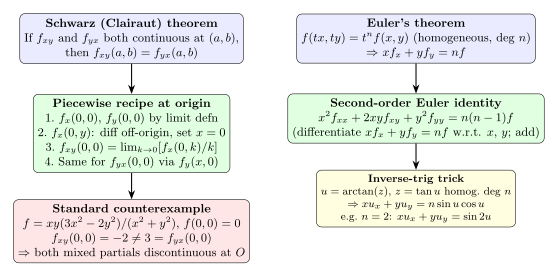
Schwarz (Clairaut) theorem. If fxy and fyx both exist and are continuous at a point (a,b), then fxy(a,b)=fyx(a,b). The converse fails: if the mixed partials are unequal at (a,b), at least one must be discontinuous there.
Mixed partials at a singular point (piecewise function). When f is given by a formula for (x,y)=(0,0) and a separate value at (0,0), the standard recipe is: (1) compute fx(0,y) and fy(x,0) by differentiating the off-origin formula and setting the remaining variable to 0; (2) compute fxy(0,0) as limk→0[fx(0,k)−fx(0,0)]/k, and fyx(0,0) similarly. Never use the product/quotient rule directly at (0,0) for a piecewise function.
Euler’s theorem for homogeneous functions. If f(x,y) is homogeneous of degree n (i.e., f(tx,ty)=tnf(x,y)), then xfx+yfy=nf. The second-order extension: differentiating the first-order relation with respect to x and y separately and combining (multiply ∂/∂x relation by x, ∂/∂y relation by y, add) gives x2fxx+2xyfxy+y2fyy=n(n−1)f.
Question Archetypes
Archetype
Recognition
mixed-partials
Piecewise f with formula for (x,y)=(0,0), value 0 at origin; compute fxy and fyx at (0,0) and discuss continuity
euler-theorem
u=arctan(g(x,y)) or u=sin−1(⋅) where tanu or sinu is homogeneous; prove a second-order PDE identity
euler-theorem (1 question(s); 2020)
Recognition Cues — The function u involves an inverse trig (arctan, arcsin) of a rational function. The question asks you to prove an identity of the form x2uxx+2xyuxy+y2uyy=(something in u). The key is that u itself is not homogeneous, but tanu (or sinu) is — verify this by checking the scaling degrees.
Solution Template
Let z=tanu (or sinu, etc.). Write out z explicitly as a ratio of polynomials.
Verify homogeneity of z. Replace (x,y) with (tx,ty) and read off the degree n (typically n = numerator degree minus denominator degree).
Apply first-order Euler: xzx+yzy=nz. Convert to u using zx=sec2u⋅ux (or zx=cosu⋅ux for z=sinu).
Simplify to get xux+yuy=g(u) for a simple trig expression g.
Differentiate the first-order relation. Apply ∂/∂x to both sides, multiply by x; apply ∂/∂y, multiply by y; add.
Use xux+yuy=g(u) to simplify. This yields x2uxx+2xyuxy+y2uyy=g(u)(g′(u)−1).
Substitute and simplify with trig identities to reach the target form.
Worked Example
2020 Paper 2, 2020-P2-Q3c (20 marks)
If u=tan−1x−yx3+y3, x=y, show that x2uxx+2xyuxy+y2uyy=(1−4sin2u)sin2u.
Step 7 — Evaluate.g=sin2u, g′=2cos2u. So g′(u)−1=2cos2u−1=2(1−2sin2u)−1=1−4sin2u. Therefore:
x2uxx+2xyuxy+y2uyy=sin2u⋅(1−4sin2u).
x2uxx+2xyuxy+y2uyy=(1−4sin2u)sin2u.
Common Traps
Applying Euler to u directly. The function u=arctan(…) is not homogeneous. Always check: does u(tx,ty)=tnu(x,y)? It doesn’t. Apply Euler to z=tanu.
Wrong degree. The degree of z=(x3+y3)/(x−y) is 3−1=2, not 3. Count numerator minus denominator degrees.
Missing the g(u) substitution in the second-order step. After differentiating, both sides should simplify using equation (1). The intermediate expression g(u)(g′(u)−1) must be written before simplifying with 2cos2u−1=1−4sin2u.
mixed-partials (1 question(s); 2014)
Recognition Cues — A function defined piecewise: one formula for (x,y)=(0,0), typically f=xy⋅h(x,y)/(x2+y2) for some polynomial h, and f(0,0)=0. The question asks for fxy(0,0) and fyx(0,0) and discusses their continuity. The factor xy in the numerator is the key shortcut: f and its first partials vanish on the coordinate axes.
Solution Template
Use the xy factor. Note f(h,0)=0 for all h and f(0,k)=0 for all k (from the explicit formula).
Compute fx(0,0) and fy(0,0) by limit definition. Both are 0 (from step 1).
Compute fx(0,y) for y=0. Differentiate the off-origin formula with respect to x, then set x=0.
Compute fxy(0,0) by limit definition:fxy(0,0)=limk→0[fx(0,k)−fx(0,0)]/k.
Compute fy(x,0) for x=0. Differentiate with respect to y, set y=0.
Compute fyx(0,0) similarly.
Compare fxy and fyx. If they differ, cite Schwarz: at least one mixed partial is discontinuous at (0,0). Show the discontinuity using different approach paths.
Worked Example
2014 Paper 2, 2014-P2-Q3b (15 marks)
Obtain ∂x∂y∂2f(0,0) and ∂y∂x∂2f(0,0) for
f(x,y)=⎩⎨⎧x2+y2xy(3x2−2y2),0,(x,y)=(0,0)(x,y)=(0,0).
Also discuss the continuity of fxy and fyx at (0,0).
Step 1 — First partials at origin. Since f(h,0)=0 for all h and f(0,k)=0 for all k (the formula gives xy(…)/(x2+y2) which vanishes on the axes):
fx(0,0)=limh→0hf(h,0)−0=0,fy(0,0)=0.
Step 2 — fx(0,y) for y=0. Differentiate the off-origin formula with respect to x and evaluate at x=0:
Step 6 — Continuity discussion. Since fxy(0,0)=fyx(0,0), Schwarz’s theorem requires at least one to be discontinuous at (0,0). In fact, both are.
Away from (0,0), f∈C∞ so fxy=fyx; call this common function g(x,y).
Along y=0: fy(x,0)=3x, so ∂xfy(x,0)=3→3 as x→0.
Along x=0: fx(0,y)=−2y, so ∂yfx(0,y)=−2→−2 as y→0.
The limits of g along these two paths are 3 and −2 respectively, hence different. Therefore lim(x,y)→(0,0)g(x,y) does not exist, and both fxy and fyx are discontinuous at (0,0).
Both fxy and fyx are discontinuous at (0,0).
Common Traps
Using the smooth formula at the origin. The product/quotient rule applied to the off-origin formula is invalid at (0,0) for a piecewise function. Always use the limit definition there.
fxy=fyx is the signal, not the explanation. The unequal values are a consequence of discontinuity; the discontinuity must still be demonstrated by showing path-dependent limits.
Missing the xy factor shortcut. If the numerator contains xy as a factor, then f vanishes on both axes, so fx(0,0)=0 and fy(0,0)=0 with no computation needed. Recognising this saves 2–3 minutes.
Wrong cancellation in fx(0,y). In the formula for fx at x=0: the term 9x2−2y2→−2y2 and the second term vanishes; after dividing by y2 from the denominator, fx(0,y)=−2y. Be careful not to drop the sign.
Marks-Aware Writing
A 15-mark answer for the mixed-partials question requires all of: (1) compute first partials at origin by limit definition (no points for using the formula), (2) compute fx(0,y) by differentiating off-origin and setting x=0, (3) compute fxy(0,0) as a limit, (4) same for fyx(0,0) via fy(x,0), (5) state the values, (6) discuss continuity with path-dependent limits. Omitting any of steps 1–5 costs 2–3 marks each.
A 20-mark Euler answer requires: (1) identify the homogeneous function z=tanu and verify degree, (2) state and apply first-order Euler to get xux+yuy=sin2u, (3) differentiate this relation twice and add, (4) substitute g(u)(g′(u)−1), (5) trig simplification of 2cos2u−1=1−4sin2u. All five algebraic steps must be visible for full marks.
Practice Set
2022-P2-Q3b (20 m) — — Hint: likely Euler’s theorem on another homogeneous or inverse-trig function; identify the substitution z=sinu or z=tanu first.
2021-P2-Q3b (20 m) — — Hint: second-order Euler identity; verify degree of the homogeneous function before applying.
2016-P2-Q3b (15 m) — — Hint: mixed-partials or Schwarz counterexample; use limit definition at the origin for the piecewise formula.
We've mapped all 13 years of this exam. Get new chapters, tools, and solutions as we release them — free.