Riemann integral
At a Glance
- Frequency: 10 sub-parts across 9 of 13 years (2013, 2014, 2015, 2018, 2021, 2022, 2023, 2024, 2025)
- Priority tier: T1
- Marks (count): 10 (4), 15 (6)
- Average solve time: ~8 min
- Difficulty mix: medium 6, easy 4
- Section: A | Dominant type: proof
Why This Chapter Matters
The Riemann integral appears in 9 of the last 13 years, split evenly between 10- and 15-mark questions — almost all in Section A. Unlike the rest of calculus which tests computation, this atom tests reasoning: can you prove a function is integrable, can you recognise when it is not, and can you evaluate an integral from the definition? Four recurring proof templates (Darboux criterion, Lebesgue criterion, Darboux theorem, oscillation squeeze) cover every question that has ever appeared.
Minimum Theory
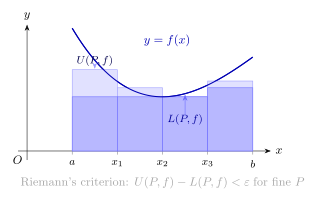
Darboux sums. For bounded on and partition , define and . The upper and lower Darboux sums are Always . Define (upper integral) and (lower integral). Always .
Riemann integrability criteria:
- (Riemann’s criterion) is Riemann integrable iff for every there exists a partition with .
- (Lebesgue’s criterion) A bounded function on is Riemann integrable iff its set of discontinuities has Lebesgue measure zero. In practice: finitely many, or countably many, discontinuities ⇒ integrable.
Key theorem classes:
- Continuous on Riemann integrable (by uniform continuity via Heine-Cantor).
- Monotone on Riemann integrable (telescoping Darboux sums).
- Bounded with at most countably many discontinuities Riemann integrable.
Antiderivatives (Darboux’s theorem). If on then must have the intermediate value property — no jump discontinuities. Therefore a function with a jump discontinuity is Riemann integrable but does not have an antiderivative. These are separate properties.
Question Archetypes
Seven patterns cover all Riemann integral questions.
| Archetype | You are seeing this when… |
|---|---|
| integrability-from-definition | prove integrability and compute from Darboux sums directly |
| integrability-class-proof | prove that monotone or continuous functions are integrable |
| integrability-criterion | decide integrability and antiderivative existence for a piecewise function |
| step-function-integral | function has finitely/countably many discontinuities; decide integrability and compute |
| ftc-evaluation | evaluate by spotting an antiderivative (FTC), handling a singular endpoint |
| integral-bounds | prove upper and lower bounds without computing the integral |
| non-integrable-example | show upper and lower integrals differ (Dirichlet-type) |
| oscillation-proof | pure definition proof about oscillation |
integrability-from-definition (1 question; 2022)
Recognition Cues
- “Show that is Riemann integrable on and ”
- Explicit Darboux sums required; often or similar power on .
Solution Template
- Set up the uniform partition with .
- Compute and (for increasing : , ).
- Use standard sum formulas (, etc.).
- Take ; show both limits equal the same value.
Worked Example(s)
2022 Paper 2, 2022-P2-Q2a (15 marks)
Show is Riemann integrable on and .
Partition. Equal partition : , . Since increasing: , .
Both limits equal , so is Riemann integrable and .
Common Traps
- Use (index starts at 0) for the lower sum, and for the upper sum. Don’t mix.
- The dominant term in both is ; the lower-order terms vanish as .
integrability-class-proof (2 question(s); 2021, 2025)
Recognition Cues
- “Prove that every monotone/continuous function on is Riemann integrable.”
Solution Template (monotone):
- State Riemann’s criterion.
- Choose the equal partition with .
- For increasing : . For decreasing: same formula with .
- Choose ; then .
Solution Template (continuous):
- Invoke Heine-Cantor: on compact , continuous uniformly continuous.
- Given , find so .
- Choose partition with mesh ; then each oscillation .
- .
Worked Example(s)
2021 Paper 2, 2021-P2-Q1c (10 marks)
Prove: monotone on is Riemann integrable.
WLOG increasing. For equal partition (mesh ): on each , and , so This is for . Riemann’s criterion is satisfied.
2025 Paper 2, 2025-P2-Q4b (15 marks)
Prove every continuous function on is Riemann integrable.
Bounded: continuous on compact bounded (extreme value theorem), so Darboux sums are finite.
Uniform continuity (Heine-Cantor): since is continuous on the compact set , it is uniformly continuous: for any , such that .
Choose a fine partition: take any partition with mesh . On each subinterval (length ), attains its max at and min at , and , so .
Riemann’s criterion is satisfied.
The key: uniform (not pointwise) continuity is needed — it gives a single controlling all oscillations simultaneously. Compactness of is what guarantees the upgrade from continuous to uniformly continuous.
Common Traps
- For the monotone proof: the telescoping is the entire mechanism — state it explicitly.
- For the continuous proof: do not use pointwise continuity (each would depend on the point, not simultaneously valid). State “uniformly continuous by Heine-Cantor” and then apply.
- Both proofs apply to monotone-decreasing by the same argument (swap and , get ).
integrability-criterion (1 question; 2013)
Recognition Cues
- “Is Riemann integrable? Does there exist a function with ?” — two separate questions.
- is piecewise-defined with a jump at an interior point.
Solution Template
- Integrability: check boundedness; identify the set of discontinuities; apply Lebesgue’s criterion (finite or countable measure zero integrable).
- Antiderivative: if has a jump discontinuity, cite Darboux’s theorem — derivatives must have the intermediate value property, so cannot be a derivative.
Worked Example(s)
2013 Paper 2, 2013-P2-Q1c (10 marks)
for , for . Riemann integrable on ? Antiderivative exists?
Integrability. is bounded (values in ). The single discontinuity at (jump: ) has measure zero. By Lebesgue’s criterion: yes, is Riemann integrable.
Antiderivative. has a jump at : , . Any value is not attained by on . By Darboux’s theorem, a derivative cannot have a jump discontinuity. Therefore no antiderivative with exists on .
Common Traps
- Riemann integrability and existence of an antiderivative are independent concepts. A function can be integrable without having an antiderivative (as here), and vice versa. Do not conflate them.
- The FTC has two distinct parts: (1) if is continuous, then is an antiderivative; (2) if is Riemann integrable, then . Neither implies an antiderivative exists for a discontinuous function.
step-function-integral (2 question(s); 2013, 2015)
Recognition Cues
- is piecewise constant (floor function, on intervals of length , etc.).
- “Is Riemann integrable? Compute .”
Solution Template
- Integrability: identify the discontinuity set (integer points for floor function, for the step function); state it is finite or countable (measure zero); conclude integrable by Lebesgue.
- Compute: on each constant piece, contribution value length. Sum up (possibly as an infinite series for the countable case).
- For infinite series: use partial fractions and telescoping.
Worked Example(s)
2013 Paper 2, 2013-P2-Q3d (10 marks)
on . Integrable? Compute.
Step function: on , on , on , . Discontinuities at — finite set, measure zero. Integrable.
(The single point contributes zero.)
2015 Paper 2, 2015-P2-Q2b (15 marks)
on , . Integrable on ? Find .
Bounded (). Discontinuities at — countable, measure zero. Integrable.
Length of is . Sum:
Partial fractions: . Sum telescopes + Basel:
Common Traps
- For the floor function: on — so , not . Verify the value on each subinterval.
- The endpoint where contributes , but a single point has measure zero and contributes zero to the integral — don’t add a term for it.
- For the countable-discontinuity example (2015): the series needs partial fractions. The final answer involves (Basel’s sum).
- Length — easy to miscompute as .
ftc-evaluation (1 question; 2014)
Recognition Cues
- An engineered combination like — looks hard but is the derivative of .
- The function is defined piecewise at a singular endpoint ().
Solution Template
- Spot the antiderivative by reverse product rule: .
- Show extends continuously to (squeeze: ).
- Show is bounded on with a single discontinuity at .
- Apply FTC on and let .
Worked Example(s)
2014 Paper 2, 2014-P2-Q2b (15 marks)
for , . Show .
Antiderivative: for .
Let , . Continuous on since .
is bounded () with one discontinuity at . On , FTC gives .
Let : .
Common Traps
- alone and alone have no elementary antiderivatives — the combination is engineered. Don’t try to integrate them separately.
- is continuous at (extends by ) but not differentiable at . FTC still applies via the -limit form.
integral-bounds (1 question; 2018)
Recognition Cues
- “Prove ” — without computing the integral.
- Bound the integrand between constants , then multiply by the interval length.
Solution Template
- Identify a monotonicity or range property of on .
- Bound: for all .
- Integrate: .
- Use strict inequalities if is non-constant (the integral is strictly between the bounds).
Worked Example(s)
2018 Paper 2, 2018-P2-Q1b (10 marks)
Prove .
Monotonicity. has on (since there). So is strictly decreasing, hence is strictly increasing.
Bounds. On : (min at : ; max at : ).
Integrate over length :
Common Traps
- Reciprocating reverses the inequality: decreasing increasing, so min of is at the left endpoint .
- The upper bound is actually sharper than ; state the chain to be rigorous.
- State that is non-constant, hence the bounds are strict (not just ).
non-integrable-example (1 question; 2024)
Recognition Cues
- takes one formula on rationals, another on irrationals.
- “Find upper and lower Riemann integrals; show is not Riemann integrable.”
Solution Template
- On any subinterval, rationals and irrationals are both dense, so (rational branch value) and (irrational branch value) — at any point.
- Upper integral (rational branch); lower integral (irrational branch).
- These differ not Riemann integrable.
Worked Example(s)
2024 Paper 2, 2024-P2-Q4b (15 marks)
on rationals, on irrationals. Find and ; show not Riemann integrable.
Comparison. For : since .
Sup/inf on any : both branches are dense, so (rational branch, max at left since decreasing) and (irrational branch, min at right).
Upper integral (quarter-circle area).
Lower integral .
Common Traps
- The comparison needs justification: iff iff ✓.
- The upper integral being (quarter-circle area) and lower being (triangle area) — don’t swap them.
- Density of both rationals and irrationals is the load-bearing fact — state it explicitly.
oscillation-proof (1 question; 2023)
Recognition Cues
- “Prove: oscillation of on equals .”
- Pure definition-squeezing: two-sided inequality on sup.
Worked Example(s)
2023 Paper 2, 2023-P2-Q4a (15 marks)
Prove: .
Let . Two-sided bound:
: for any , (since ). So is an upper bound and .
: fix . By definition of and , with and with . Then . Since is arbitrary, .
Hence .
Common Traps
- and are not necessarily attained (no continuity assumed). The -argument is essential; writing “there exist with and ” is illegitimate in general.
- Handle the trivial case (constant function, oscillation ) explicitly.
Marks-Aware Writing
10-mark questions (2013-Q1c, 2013-Q3d, 2018, 2021): State the relevant criterion (Lebesgue or Riemann), apply it in two lines, conclude. For the antiderivative question: state Darboux’s theorem, identify the jump, conclude no antiderivative. For monotone integrability: equal partition + telescoping argument takes 4–5 lines.
15-mark questions (2014, 2015, 2022, 2023, 2024, 2025): Full proof with all steps shown. For Darboux sums (2022): write and with sum formulas, take limits, state conclusion. For continuous (2025): state Heine-Cantor, write the oscillation bound, bound . For oscillation (2023): two-sided inequality with the -argument for the lower bound.
Practice Set
| Year | Paper/Q | Marks | Archetype | One-line hint |
|---|---|---|---|---|
| 2025 | P2-Q4b | 15 | integrability-class-proof | Heine-Cantor: uniform continuity; oscillation ; sum |
| 2024 | P2-Q4b | 15 | non-integrable-example | Density: , ; upper , lower ; differ |
| 2023 | P2-Q4a | 15 | oscillation-proof | trivial; via -characterisation of |
| 2022 | P2-Q2a | 15 | integrability-from-definition | Lower sum with ; upper with ; both |
| 2021 | P2-Q1c | 10 | integrability-class-proof | Equal partition; ; choose large |
| 2018 | P2-Q1b | 10 | integral-bounds | decreasing; ; multiply by |
| 2015 | P2-Q2b | 15 | step-function-integral | Countable discont.; interval length ; series = |
| 2014 | P2-Q2b | 15 | ftc-evaluation | Antiderivative ; extend by ; FTC on , limit |
| 2013 | P2-Q3d | 10 | step-function-integral | takes values on three unit intervals; integral |
| 2013 | P2-Q1c | 10 | integrability-criterion | Jump at 0 integrable (Lebesgue) but no antiderivative (Darboux) |