Sequences
At a Glance
- Frequency: 2 sub-parts across 2 of 13 years (2016, 2017)
- Priority tier: T3
- Marks (count): 10 (2)
- Average solve time: ~10 min
- Difficulty mix: easy 1, medium 1
- Section: A | Dominant type: proof
Why This Chapter Matters
Both appearances are in Section A Q1 (compulsory, 10 marks), so these questions are answered under time pressure with no choice. The 2017 question is a clean drill of the Monotone Convergence Theorem on a single recursive sequence — the most tested technique for sequences in UPSC. The 2016 question is harder: two coupled mean-recursion sequences that require induction on a four-term chain and then a limit-equalisation argument. Mastering both templates gives reliable 10-mark scores on any recursive-sequence question.
Minimum Theory
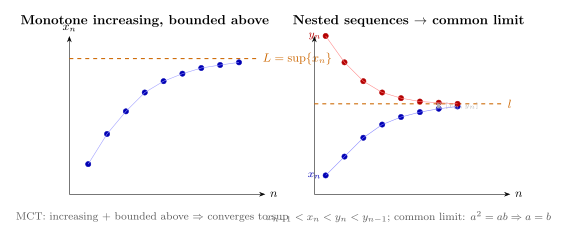
Monotone Convergence Theorem (MCT). A sequence of real numbers converges if it is (i) monotone (increasing or decreasing) and (ii) bounded (above if increasing, below if decreasing). An increasing bounded sequence converges to its supremum; a decreasing bounded sequence converges to its infimum.
Standard proof skeleton for a recursive sequence . (1) Prove lies in some interval by induction (boundedness). (2) Prove has constant sign by induction (monotonicity). (3) Apply MCT to get limit . (4) Pass to the limit in (using continuity of ) and solve for . (5) Discard any extraneous root using the bounds from step (1).
Nested sequences and mean inequalities. For positive , and . Coupled recursions built on GM and HM produce interlaced, monotone sequences that converge to a common limit, identified by passing to the limit in the product relation.
Question Archetypes
| Archetype | Recognition |
|---|---|
| monotone-convergence | single recursive sequence ; prove convergence |
| nested-sequences | two coupled sequences defined by mean recursions; prove nesting and common limit |
monotone-convergence (1 question; 2017)
Recognition Cues — A single recursion of the form with an explicit starting value. The question says “show convergent” without naming the limit — you must prove it exists first. Any explicit root or bound in (e.g., , a fixed point near ) is a hint for the boundedness argument.
Solution Template
- Positivity / well-definedness: show (or stays in the natural domain) by induction.
- Find the fixed points satisfying ; these suggest the natural bound.
- Boundedness by induction: show (the admissible fixed point) for all .
- Monotonicity: compare to (or use directly), factor, and use the bound from step 3 to determine the sign.
- Apply MCT: bounded monotone sequence convergent; let .
- Find : pass to the limit in , solve, discard inadmissible roots by the positivity / sign constraints.
Worked Example
2017 Paper 2, 2017-P2-Q1a (10 marks)
Let and , . Show that the sequence is convergent.
Step 1 — Positivity. . If then , so . By induction for all .
Step 2 — Bounded above by . Claim for all . Base: . Inductive step: if then
Step 3 — Strictly increasing. For , compare squares:
Since , we have and , so the product is negative and
Step 4 — Apply MCT and find the limit. is increasing and bounded above by , so by the Monotone Convergence Theorem it converges to some . Since , we have . Taking limits in :
So or . Since , discard .
Common Traps
- Establish convergence via MCT before solving . Writing the fixed-point equation first and then claiming “so the limit is ” earns no marks — the limit exists only because the sequence is bounded and monotone.
- The spurious root is discarded because ; state this explicitly.
- The cleanest monotonicity argument uses , which reuses the bound established in the previous step.
nested-sequences (1 question; 2016)
Recognition Cues — Two sequences defined by coupled mean-type recursions (e.g., GM and HM of the previous pair). The question asks to prove a four-term chain inequality and then deduce a common limit. The key inequalities are GM or HM strictly between the two terms.
Solution Template
- Establish positivity of all terms by induction.
- State the inductive hypothesis . Prove the base case.
- In the inductive step, prove the four sub-inequalities (i) , (ii) , (iii) ; establish the hinge early as it is reused in both (ii) and (iii).
- Apply MCT: increasing and bounded above (by ); decreasing and bounded below (by ). Both converge.
- Equate the limits: pass to the limit in the product relation (e.g., ) to get ; cancel to obtain .
- Locate the common limit using the strict bounds .
Worked Example
2016 Paper 2, 2016-P2-Q1c (10 marks)
Two sequences and are defined inductively: , , , and for . Prove and deduce both sequences converge to the same limit with .
Step 1 — Positivity. . If then and is a positive average of positives, so . By induction all terms are positive.
Step 2 — Inductive proof of the chain; hypothesis .
Base : . Assume with both positive.
(i) . since .
(Hinge) . , i.e., .
(ii) . From the hinge, , so
(iii) (proves ). is the harmonic mean of and ; since (hinge), the HM lies strictly between them:
Step 3 — Convergence.
is strictly increasing and bounded above by (since ). By MCT, . is strictly decreasing and bounded below by . By MCT, .
Step 4 — Common limit.
Pass to the limit in :
Since , cancel : . Call the common value .
Step 5 — Locate .
strictly increases from , so . strictly decreases from , so .
Common Traps
- The hinge inequality (from ) is used in both step (ii) and step (iii); establish it once and refer back.
- To show , use the product relation (clean), not the harmonic relation (messy). The cancellation requires , which follows from .
- The outer bounds must be strict: not , justified because the very first step already moves both sequences inward.
Marks-Aware Writing
10-mark answer (monotone-convergence): Include all four steps — positivity (brief), boundedness (induction), monotonicity (sign of ), apply MCT then solve , discard . Each step needs one or two lines of algebra.
10-mark answer (nested-sequences): The induction is the bulk. Set up the hypothesis clearly, prove the base case, then in the inductive step establish the hinge before attempting (ii) or (iii). The limit argument (equating via the product relation) is the second major piece and must use MCT by name.
Practice Set
- 2017-P2-Q1a (10 m) — — Hint: find the fixed point first as your bound; then show the sequence is increasing via .
- 2016-P2-Q1c (10 m) — — Hint: the hinge is the first thing to establish in the inductive step; use the product relation (not the harmonic one) to equate limits.