Frequency: 2 sub-parts across 2 of 13 years (2022, 2023)
Priority tier: T3
Marks (count): 10 (1), 15 (1)
Average solve time: ~7 min
Difficulty mix: medium 2
Section: A | Dominant type: proof
Why This Chapter Matters
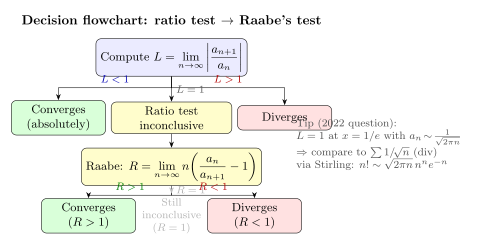
Both questions involve the ratio test applied to series with parameters (x>0), where the ratio test is conclusive everywhere except at a single boundary value where Raabe’s test is needed. Mastering the two-layer decision tree (ratio test → if L=1, apply Raabe) is the key skill. The 2022 question reaches its boundary via Stirling’s approximation; the 2023 question uses Raabe’s test directly. Together they cover every exam scenario for this atom.
Minimum Theory
Ratio test. For a positive-term series ∑an, let L=limn→∞∣an+1/an∣. If L<1: convergent. If L>1: divergent. If L=1: inconclusive — use a finer test.
Raabe’s test. When the ratio test gives L=1, compute R=limn→∞n(an+1an−1). If R>1: convergent. If R<1: divergent. If R=1: still inconclusive.
Stirling’s approximation.n!∼2πnnne−n as n→∞. Useful when the ratio test gives L=1 and the general term an involves nn/n! — Stirling shows an∼1/2πn, then compare to ∑1/n (divergent by p-series with p=1/2<1).
Standard limit.limn→∞(1+1/n)n=e. This appears whenever the ratio an+1/an contains a factor (1+1/n)n — the limit delivers e and determines the radius of convergence.
Question Archetypes
Archetype
Recognition
ratio-test
series ∑an(x) with parameter x>0; ratio test gives L=f(x), determine convergence/divergence
ratio-raabe-test
ratio test gives L=1 at a boundary value of x; use Raabe’s test to classify the boundary
ratio-test (1 question; 2022)
Recognition Cues — The series has general term involving nnxn/n! or similar combinations where (1+1/n)n emerges in the ratio. The boundary x=1/e (radius of convergence) is a Stirling borderline — the general term at the boundary is ∼1/n, signalling divergence.
Solution Template
Identify an and compute an+1/an algebraically.
Simplify to isolate the factor (1+1/n)n→e.
Take liman+1/an=xe (or similar); apply ratio test: converges if xe<1, diverges if xe>1.
At the boundary x=1/e (ratio →1): substitute x=1/e into an, apply Stirling to get an∼1/2πn. Compare to ∑1/n (divergent); conclude divergent at x=1/e.
State the full conclusion.
Worked Example
2022 Paper 2, 2022-P2-Q4b (15 marks)
Test for convergence or divergence of x+2!22x2+3!33x3+⋯+n!nnxn+⋯ (x>0).
At x=1/e: an=n!⋅ennn. By Stirling, n!∼2πn⋅nne−n, so
an∼2πn⋅nne−n⋅ennn=2πn1.
The series ∑1/n diverges (p-series, p=1/2<1). By limit comparison, the series diverges at x=1/e.
Series converges for x<1/e; diverges for x≥1/e.
Common Traps
In simplifying an+1/an: the factor (n+1)n+1 splits as (n+1)⋅(n+1)n; the extra (n+1) cancels with the (n+1)! denominator, leaving (n+1)n/nn=(1+1/n)n→e.
The radius of convergence is 1/e, not 1/e2 or 1/n. State the limit precisely.
At the boundary x=1/e, Stirling is the cleanest tool; the series diverges here too.
ratio-raabe-test (1 question; 2023)
Recognition Cues — The series involves double-factorial products (2n−1)!!/(2n)!! and a parameter x>0. The ratio test gives L=x2, which equals 1 at x=1. Raabe’s test is then applied directly using the expansion of an/an+1.
Solution Template
Write out an and compute an+1/an by pairing the double-factorial ratios carefully.
Take L=liman+1/an. Apply the ratio test for L=1.
At the boundary (L=1): compute an/an+1 and expand as 1+c/n+O(1/n2).
Apply Raabe’s test: R=limn(an/an+1−1). If R>1: converges.
State the full conclusion.
Worked Example
2023 Paper 2, 2023-P2-Q1c (10 marks)
Test the convergence of n=1∑∞2⋅4⋅6⋯(2n)1⋅3⋅5⋯(2n−1)⋅2n+1x2n+1, x>0.
The ratio an+1/an contains two factors involving (2n+1): one from (2n+1)!!/(2n−1)!! and one from the explicit 1/(2n+1). Combine them carefully.
Skipping Raabe at x=1 is the most common error — the ratio test gives L=1 exactly at x=1 and is inconclusive; the series converges there, but this requires Raabe.
Raabe is applied to an/an+1 (not an+1/an); the formula is R=limn(an/an+1−1).
Marks-Aware Writing
15-mark answer (ratio-test): Four steps — compute ratio, take the limit (invoking (1+1/n)n→e), apply ratio test with all three cases, handle boundary via Stirling. The boundary analysis (Step 4) is essential and carries marks.
10-mark answer (ratio-raabe-test): Two steps — ratio test with explicit limit L=x2, Raabe computation at x=1 with R=3/2>1. Show the algebra for the ratio an/an+1 in Raabe clearly.
Practice Set
2022-P2-Q4b (15 m) — — Hint: after the ratio test gives xe, apply Stirling at x=1/e to see an∼1/n.
2023-P2-Q1c (10 m) — — Hint: ratio test gives L=x2; at x=1, apply Raabe to an/an+1=(2n+2)(2n+3)/(2n+1)2.
We've mapped all 13 years of this exam. Get new chapters, tools, and solutions as we release them — free.