CSAT Solved Papers/ 2021/Q10
2021 CSAT — Q10
A Statement followed by Conclusion-I and Conclusion-II is given below. You have to take the Statement to be true even if it seems to be at variance from the commonly known facts. Read all Conclusions and then decide which of the given Conclusion(s) logically follows/follow from the Statement, disregarding the commonly known facts :
Statement : Some radios are mobiles. All mobiles are computers. Some computers are watches.
Conclusion-I : Certainly some radios are watches.
Conclusion-II : Certainly some mobiles are watches.
Which one of the following is correct?
Thinking pathway
Locate. This is a pure-logic question (no passage) — the premise set is the anchor, and a conclusion follows only if the premises make it impossible to be false. Render the chain as sets: Radios overlap Mobiles; Mobiles ⊆ Computers; some Computers are Watches.
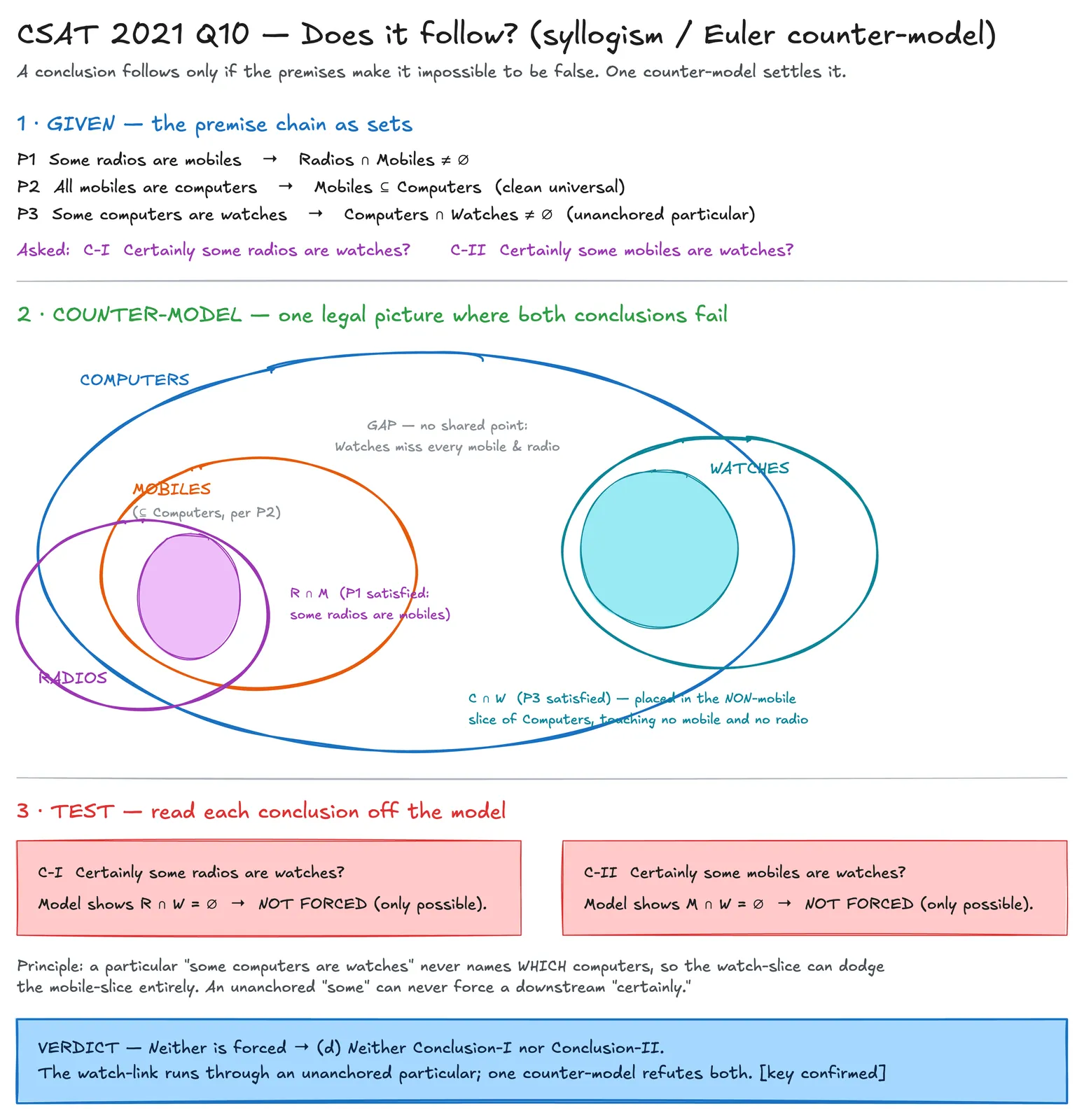
Test (does-it-follow — chase the watch-link). Both conclusions need a guaranteed bridge to Watches. The only watch-information is the particular “some computers are watches” — it places at least one watch among computers, but says nothing about which computers. The watch-computers can be a slice of the computer set that contains no mobile (and hence no radio). Build that counter-model: watches sit in the non-mobile part of Computers. Every premise holds; yet no mobile is a watch and no radio is a watch.
- C-I “certainly some radios are watches” — refuted by the counter-model. Not forced.
- C-II “certainly some mobiles are watches” — refuted by the same counter-model. Not forced.
Eliminate by anatomy. (a)/(b)/(c) each assert a watch-link that is possible but not necessary — it sounds reasonable but is unsupported, in deductive dress: a “some… are” premise treated as if it pinned down exactly which members overlap. A particular premise that doesn’t name its members can never force a downstream “certainly.” Key: (d).
Evidence in the text
Premises: Radios ∩ Mobiles ≠ ∅; Mobiles ⊆ Computers; Computers ∩ Watches ≠ ∅. The only watch-link is a PARTICULAR “some computers are watches” — it need not touch any mobile or radio. Counter-model: let the watch-computers be entirely separate computers from the mobiles. Then no mobile and no radio is a watch, yet every premise holds. So C-I (“certainly some radios are watches”) and C-II (“certainly some mobiles are watches”) are each only POSSIBLE, never forced → (d).
Worked rationale
Premises: Radios ∩ Mobiles ≠ ∅; Mobiles ⊆ Computers; Computers ∩ Watches ≠ ∅.
The watches enter only through “some computers are watches.” Nothing ties those particular watch-bearing computers to the mobiles or the radios.
- C-I Some radios are watches — counter-model: watch-computers lie outside the mobile (hence outside the radio∩mobile) region. Premises hold; no radio is a watch. Does not follow.
- C-II Some mobiles are watches — same counter-model: no mobile is a watch. Does not follow.
Neither conclusion is entailed.
Answer: (d) Neither Conclusion-I nor Conclusion-II.
Visual solution
The same solve, worked by hand — read it, then trace it.
Why the other options miss
- A sounds reasonable, but unsupported: treats “some computers are watches” as if some of those computers must be radios; a counter-model breaks it.
- B sounds reasonable, but unsupported: assumes the watch-computers must include mobiles because all mobiles are computers — but “some computers are watches” needn’t be the mobile ones.
- C compounds the error by forcing both watch-links from a single uncommitted particular.
Specialist insight
The deciding principle: a particular premise (“some X are Y”) that does not specify which X never forces a “certainly” about a different category. “All mobiles are computers” is a clean universal, so it tempts you to feel the watches must reach the mobiles — but the watches are attached to computers in general, and the mobiles are only a sub-slice of computers; the watch-slice and the mobile-slice can be disjoint. On any syllogism, when the bridge to the asked term runs through an unanchored “some,” the honest verdict is “does not follow.” (d).
"Some computers are watches" never says which computers, so it can dodge every mobile and radio — neither "certainly" is forced, so (d).