CSAT Solved Papers/ 2021/Q15
2021 CSAT — Q15
A Statement followed by Conclusion-I and Conclusion-II is given below. You have to take the Statement to be true even if it seems to be at variance from the commonly known facts. Read all Conclusions and then decide which of the given Conclusion(s) logically follows/follow from the Statement, disregarding the commonly known facts :
Statement : Some cats are almirahs. Some almirahs are chairs. All chairs are tables.
Conclusion-I : Certainly some almirahs are tables.
Conclusion-II : Some cats may not be chairs.
Which one of the following is correct?
Thinking pathway
Locate. This is a pure-logic question (no passage) — the premise set is the anchor. Render it: Cats overlap Almirahs; Almirahs overlap Chairs; All Chairs are Tables (Chairs ⊆ Tables).
Test (does-it-follow, per conclusion).
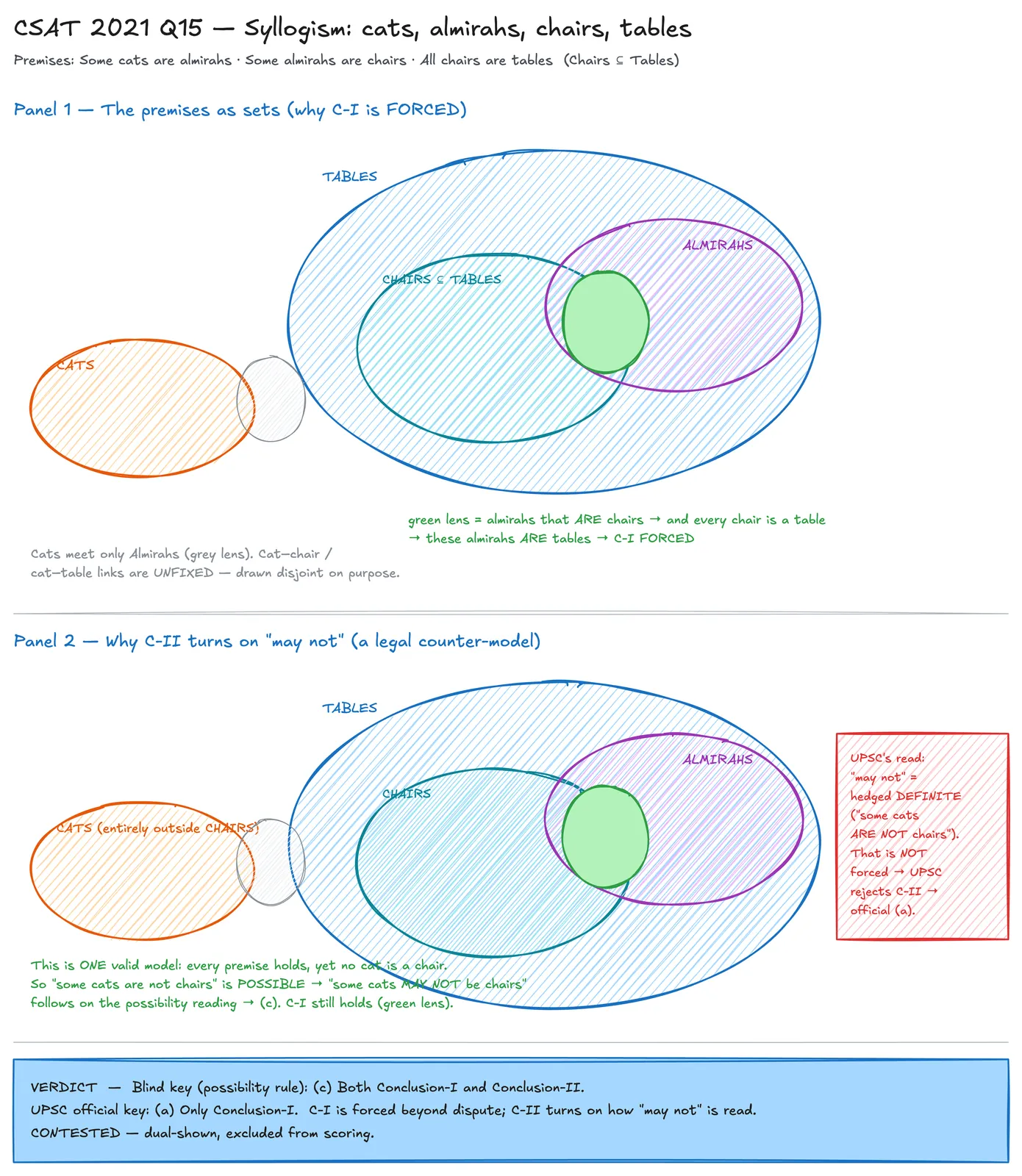
- C-I “Certainly some almirahs are tables” — the overlap “some almirahs are chairs” gives at least one almirah-chair; every chair is a table; so that almirah is a table. Forced — follows.
- C-II “Some cats may not be chairs” — this is a possibility statement. The cat–chair link runs only through two unanchored “some” overlaps (cats∩almirahs, almirahs∩chairs), so nothing fixes whether any cat is a chair. Because “some cats are not chairs” is possible (a counter-model where no cat is a chair satisfies every premise), the possibility-conclusion rule licenses “some cats may not be chairs.” Follows (possibility read).
Eliminate by anatomy. (d) wrongly drops the forced C-I. (b) wrongly drops C-I. The live contest is (c) vs (a), and it is purely a reading convention for “may not” (possibility-operator vs hedged-definite) — see the contest box below. Blind key on the possibility rule: (c).
Evidence in the text
Premises: Cats ∩ Almirahs ≠ ∅; Almirahs ∩ Chairs ≠ ∅; Chairs ⊆ Tables. C-I “Certainly some almirahs are tables” is FORCED: the almirahs that are chairs are tables (Chairs ⊆ Tables), so some almirahs are tables. C-II “Some cats may not be chairs” is a POSSIBILITY claim; the cat–chair relation is wholly undetermined (two unanchored “some” links), so “some cats are not chairs” is possible → under the standard possibility-conclusion rule, C-II also follows → blind (c). Contest: UPSC’s official key is (a) Only Conclusion-I — it rejects C-II, reading “may not” as a definite “are not” (which is indeed not forced). Both keys turn on the convention for reading “may not”; dual-shown, excluded from scoring.
Worked rationale
Premises: Cats ∩ Almirahs ≠ ∅; Almirahs ∩ Chairs ≠ ∅; Chairs ⊆ Tables.
- C-I — an almirah that is a chair is a table (chairs are tables), so some almirahs are tables. Definitely follows.
- C-II — “some cats may not be chairs” asserts only the possibility that some cats fall outside chairs. Since the cat–chair relation is undetermined, that possibility genuinely exists; a possibility conclusion follows when it is not impossible. Follows on the possibility convention.
Blind answer: (c) Both — under the rule that a “may/may not” conclusion follows whenever the relation is undetermined.
Visual solution
The same solve, worked by hand — read it, then trace it.
Why the other options miss
- B sounds reasonable, but unsupported: drops the genuinely forced C-I.
- D drops the forced C-I; clearly wrong on both conventions.
Specialist insight
The honest crux is a notation convention, not a reasoning slip. C-I is forced beyond dispute. C-II hangs entirely on how “may not” is read: as a possibility operator (“it is possible that some cats are not chairs” — true, since the relation is open) it follows, giving (c); as a hedged definite (“some cats are not chairs” with a softening “may”) it does not follow, giving (a). UPSC’s key takes the second reading. Because a defensible deduction supports each key depending on a convention the stem does not pin down, we dual-show both keys and exclude the item from scoring rather than bend the deduction to the official letter. This is precisely the free-CR fuzziness the founder spot-check exists to arbitrate.
C-I is forced; C-II turns on whether "may not" is a possibility-operator (follows → (c), our read) or a hedged "are not" (does not follow → (a), UPSC) — convention-dependent, so contested and unscored.