CSAT Solved Papers/ 2021/Q47
2021 CSAT — Q47
Consider two Statements and a Question:
Statement-1: The last day of the month is a Wednesday.
Statement-2: The third Saturday of the month was the seventeenth day.
Question: What day is the fourteenth of the given month?
Which one of the following is correct in respect of the Statements and the Question?
Worked rationale
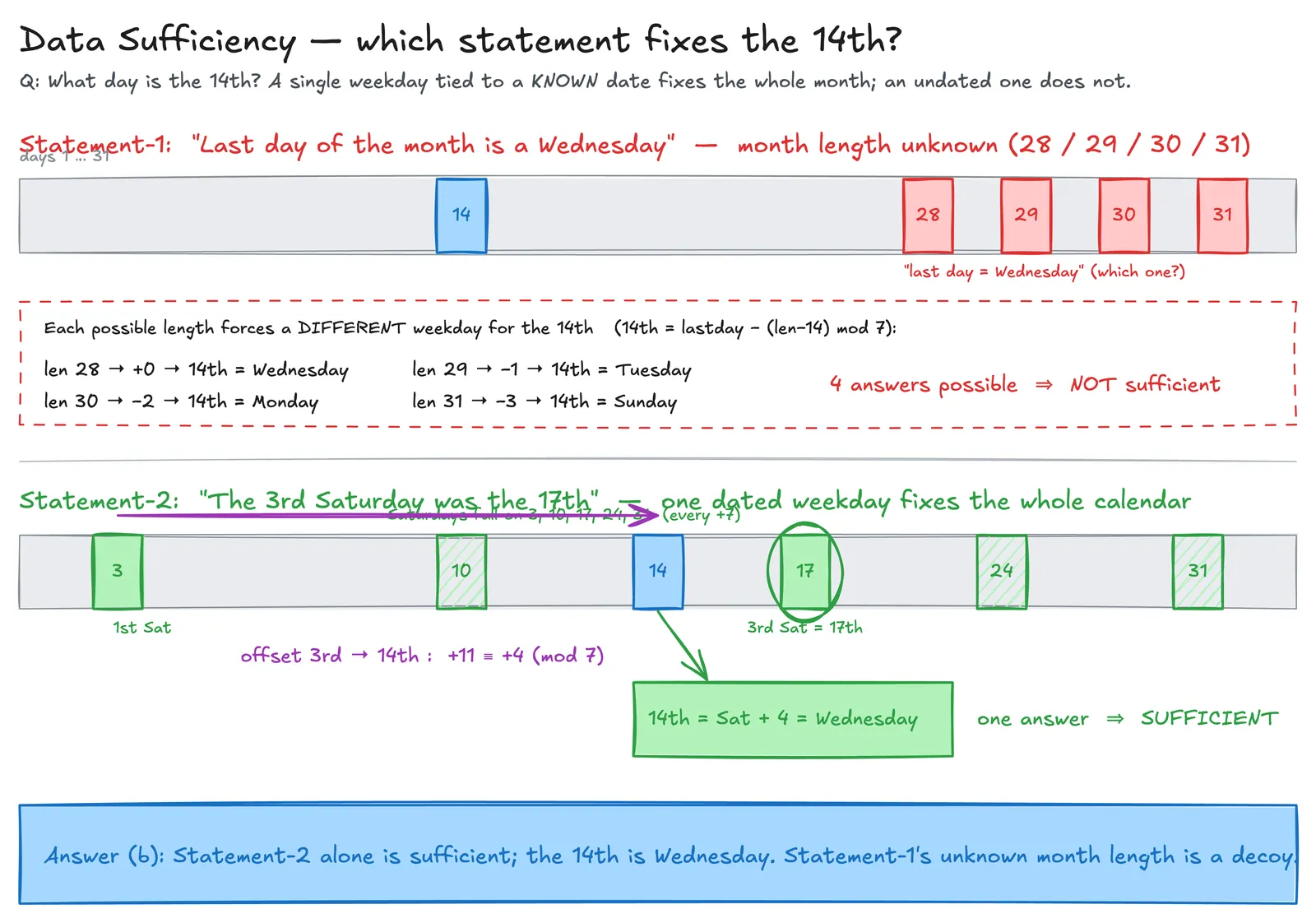
Statement-1 alone: “Last day is Wednesday” — but the month length is unknown ( or days), so the last date could be the th–st. Without knowing how many days the month has, the th cannot be pinned to a weekday. Not sufficient.
Statement-2 alone: the rd Saturday is the th, so Saturdays fall on rd, th, th, th, st. From “the rd is a Saturday,” the th is days later; , so the th is . Determines the day. Sufficient.
Answer: (b) Statement-2 alone is sufficient.
Visual solution
The same solve, worked by hand — read it, then trace it.
Why the other options miss
- A a convention slip: assumes a fixed month length, treating “last day Wednesday” as if it fixed every earlier date.
- C thought both were needed when S2 alone suffices: thinks S2 needs S1’s anchor, missing that “rd Saturday th” alone fixes the whole calendar of weekdays.
- D misreads the clue: fails to convert “rd Saturday” into the first Saturday (rd), which is what makes S2 self-contained.
Specialist insight
A single dated weekday fixes the whole month’s days-of-week; an undated one (S1’s “last day,” with unknown length) does not. From S2, back out the first Saturday (rd), then the th is a fixed offset away (), landing on Wednesday. The trap is S1 looking decisive — but “last day” is anchored to an unknown date, so it’s a decoy. In day-of-week DS, always ask: is the given weekday tied to a known date?
S2 fixes the rd as Saturday th Sat Wednesday; S1's unknown month length is a decoy (b).