CSAT Solved Papers/ 2021/Q49
2021 CSAT — Q49
Consider two Statements and four Conclusions given below. You have to take the Statements to be true even if they seem to be at variance from the commonly known facts. Read all Conclusions and then decide which of the given Conclusion(s) logically follows/follow from the Statements, disregarding the commonly known facts :
Statement-1 : Some greens are blues.
Statement-2 : Some blues are blacks.
Conclusion-1 : Some greens are blacks.
Conclusion-2 : No green is black.
Conclusion-3 : All greens are blacks.
Conclusion-4 : All blacks are greens.
Which one of the following is correct?
Thinking pathway
Locate. This is a pure-logic question (no passage): the given premise set is the anchor, and a conclusion follows only if the premises make it impossible to be false. Render: Greens overlap Blues (some), Blues overlap Blacks (some). Both links are particular, and they share only the middle term Blues.
Test (does-it-follow — build counter-models). The green-black relation is entirely open because two unanchored “some” overlaps cannot pin it down.
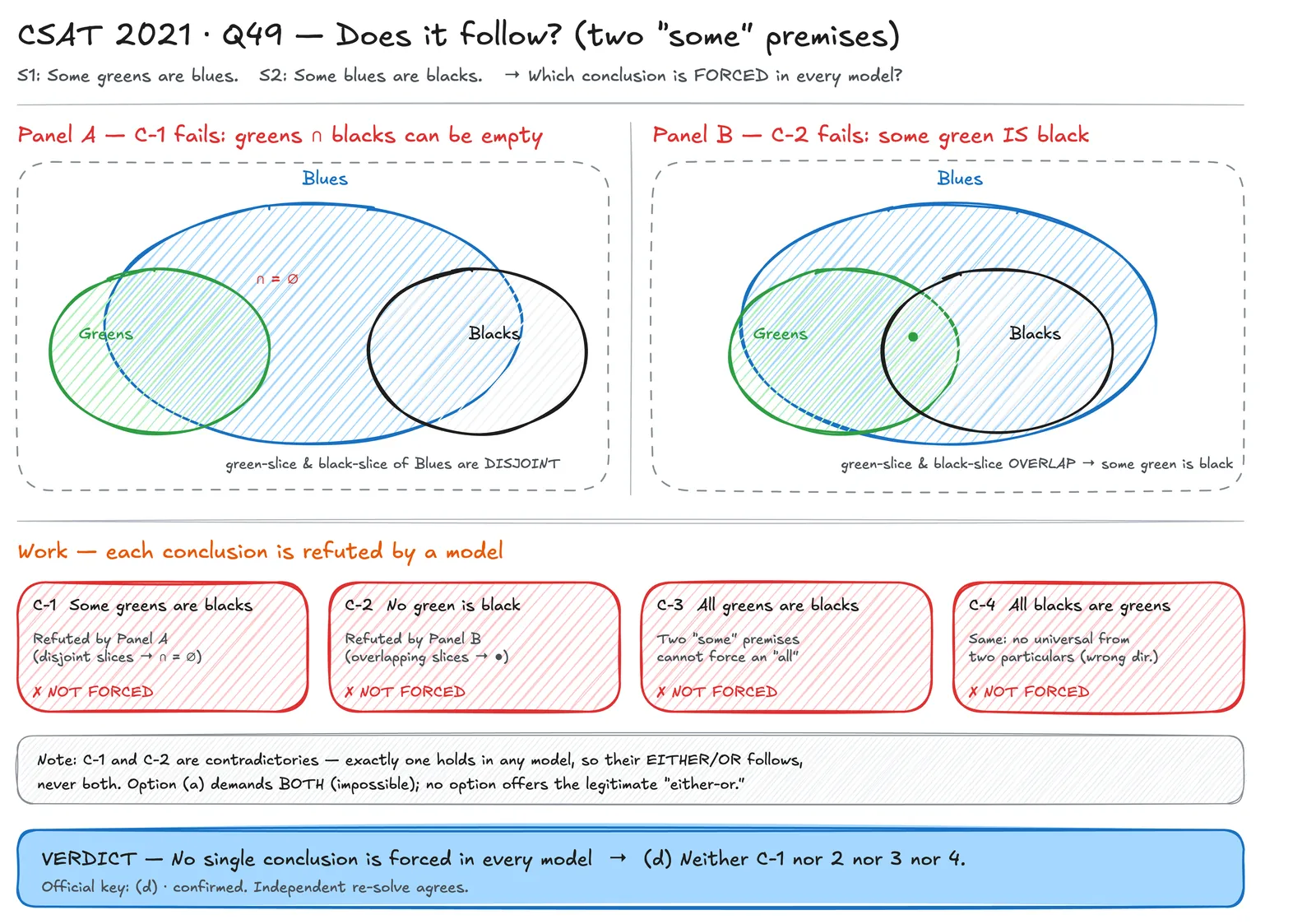
- C-1 “some greens are blacks” — counter-model: let the green-blues and the black-blues be separate parts of Blues; then no green is black. Not forced.
- C-2 “no green is black” — counter-model: let those parts overlap; then some green is black. Not forced.
- C-3 “all greens are blacks” — two particulars never force a universal. Not forced.
- C-4 “all blacks are greens” — likewise unforced (and the link is the wrong direction anyway). Not forced.
Eliminate by anatomy. (a) pairs C-1 and C-2 — but they are contradictory (some-are vs none-are), so they cannot both follow; this is the trap of mistaking a complementary either/or for a conjunction — it sounds reasonable, but is unsupported. (b)/(c) assert universals (C-3, C-4) that two particulars cannot yield. Since no single conclusion holds in every model, the answer is (d) none follows.
Evidence in the text
Premises: Greens ∩ Blues ≠ ∅; Blues ∩ Blacks ≠ ∅. The green–black link runs through TWO unanchored “some” overlaps, so it is wholly undetermined. C-1 “some greens are blacks” — counter-model: the green-blues and the black-blues are disjoint slices of Blues, so no green is black → not forced. C-2 “no green is black” — counter-model: those slices overlap, so some green is black → not forced. C-3 “all greens are blacks” and C-4 “all blacks are greens” — neither is forced by two particulars. NO single conclusion holds in every model → (d). (C-1 and C-2 are a complementary either/or pair, but option (a) asserts BOTH, which is impossible; no option offers the legitimate “either-or,” so none individually follows.)
Worked rationale
Premises: Greens ∩ Blues ≠ ∅; Blues ∩ Blacks ≠ ∅.
- C-1 — counter-model with disjoint blue-slices refutes necessity. Does not follow.
- C-2 — counter-model with overlapping blue-slices refutes necessity. Does not follow.
- C-3 / C-4 — universals unforced by two “some” premises. Do not follow.
C-1 and C-2 form a complementary pair (exactly one is true in any given model), so their either/or would follow — but no option offers “either C-1 or C-2,” and (a) wrongly asserts both at once. With no single conclusion necessary, the verdict is none.
Answer: (d) Neither Conclusion 1 nor 2 nor 3 nor 4.
Visual solution
The same solve, worked by hand — read it, then trace it.
Why the other options miss
- A sounds reasonable, but unsupported: C-1 and C-2 are contradictories, so both cannot hold; this option misreads a complementary either/or as a conjunction. The single deadliest trap.
- B sounds reasonable, but unsupported: pairs a non-forced negative (C-2) with an impossible universal (C-3).
- C sounds reasonable, but unsupported: two universals neither of which a pair of particulars can force.
Specialist insight
Two traps live here. First, the complementary-pair trap: C-1 (“some are”) and C-2 (“none are”) are exact opposites, so in any single model exactly one is true — which tempts a student to tick “C-1 and C-2.” But “exactly one of them is true” is not “both follow”; their either/or follows, their conjunction never can. Since no option offers the either/or and (a) demands both, (a) is wrong. Second, the universal trap: two “some” premises can never deliver an “all.” With every individual conclusion refutable by a counter-model, the disciplined verdict is “none follows.” (d).
C-1 and C-2 are contradictories (their either/or follows, never both), and two "some" premises force no universal — so no single conclusion follows: (d).