CSAT Solved Papers/ 2021/Q64
2021 CSAT — Q64
On a chess board, in how many different ways can consecutive squares be chosen on the diagonals along a straight path?
Worked rationale
This item has a contested official key — both readings are documented; it is excluded from readiness scoring.
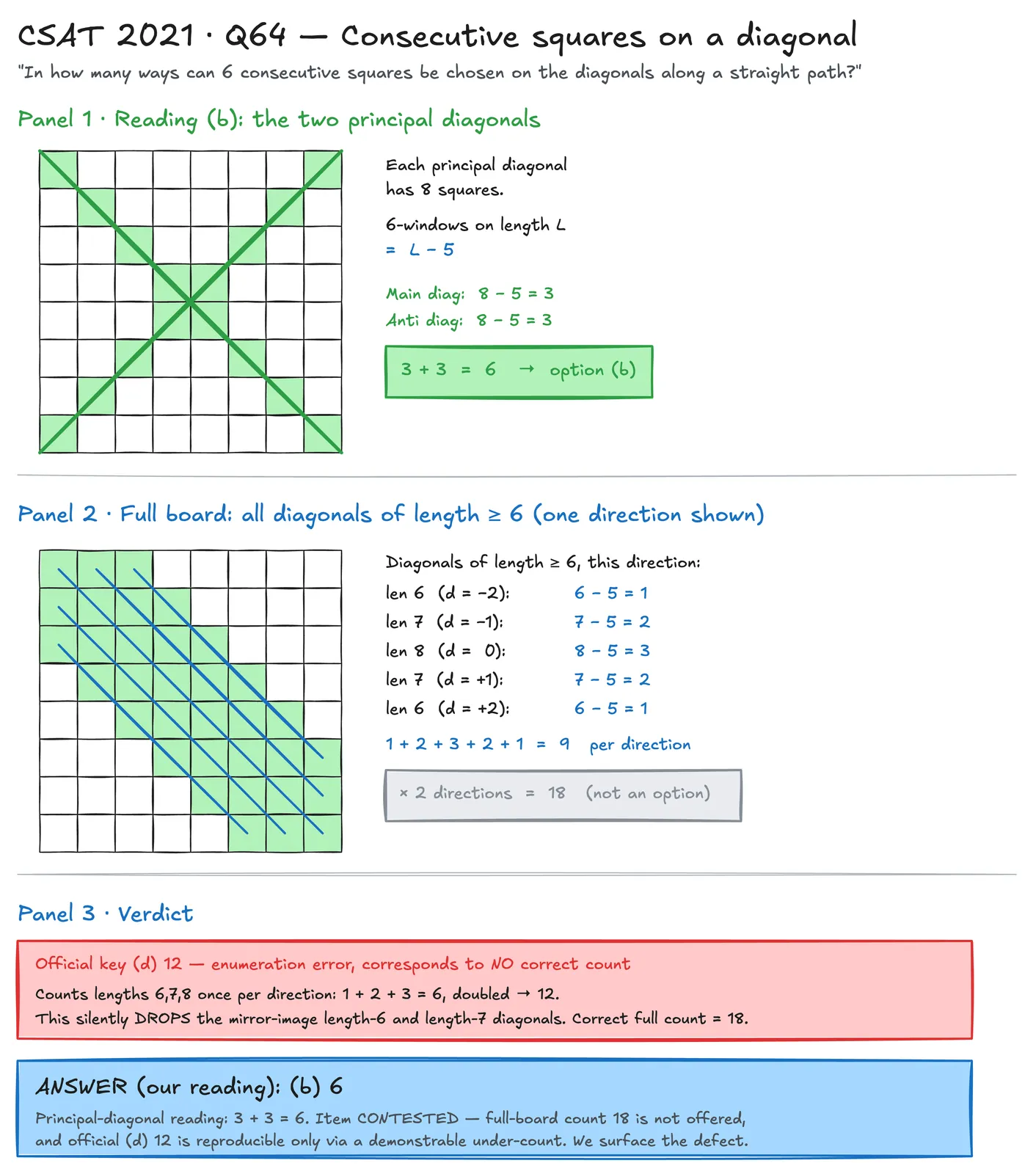
A run of consecutive squares must lie on a diagonal of length . On an board, the diagonals in one direction have lengths ; those of length are the lengths (five diagonals per direction). The number of -windows on a diagonal of length is , so per direction:
and over both diagonal directions the full count is — which is not among the options.
Restricted reading (the two principal/main diagonals only): each main diagonal has squares, giving windows; the two main diagonals give . This is the only clean reading that lands on an offered option.
Where the official comes from (and why it is wrong): index the -diagonals by , length . Those of length are (len ), (len , two of them), (len , two of them). Windows: per direction, . The figure is reproducible only by counting each length once per direction — i.e. taking just the three diagonals from one corner up to the main diagonal, , and doubling to — which silently drops the symmetric length- and length- diagonals on the far side of the main diagonal. That is an enumeration error, not a reading: corresponds to no correct geometric count.
- Our blind-solve under the natural “the diagonals” the two principal diagonals reading gives (b) 6.
- The published UPSC key is (d) 12, reproducible only via the under-count above; the rigorous full-board count is 18 (not offered), and the clean principal-diagonal count is 6.
Because the rigorous full enumeration () is not an option and the official key () is reachable only through a demonstrable under-count, this item is marked contested; correct_key records the most defensible option-yielding reading ().
Answer (our reading): (b) 6 — contested vs official (d) 12.
Visual solution
The same solve, worked by hand — read it, then trace it.
Why the other options miss
- A counted too few: counts windows on only one principal diagonal, or stops one short.
- C off by one: takes squares windows on a diagonal instead of .
Specialist insight
The correct method is a window count: a length- diagonal holds runs of . The ambiguity that makes this contested is the phrase “the diagonals” — read as all diagonals (both directions) it is ; read as the two principal diagonals it is ; neither equals the official . Under the clock and negative marking, an item whose rigorous count () isn’t even offered is a flag to mark and move on, not to force-fit. We surface the defect rather than bend the math.
Length- diagonal gives windows; full board (no option), principal diagonals — official is irreproducible contested.