CSAT Solved Papers/ 2022/Q37
2022 CSAT — Q37
Consider the Question and two Statements given below in respect of three cities and in a State:
Question: How far is city from city ?
Statement-1: City is km from city .
Statement-2: City is km from city .
Which one of the following is correct in respect of the Question and the Statements?
Worked rationale
We want .
Statement-1 alone (): says nothing about . Insufficient.
Statement-2 alone (): says nothing about . Insufficient.
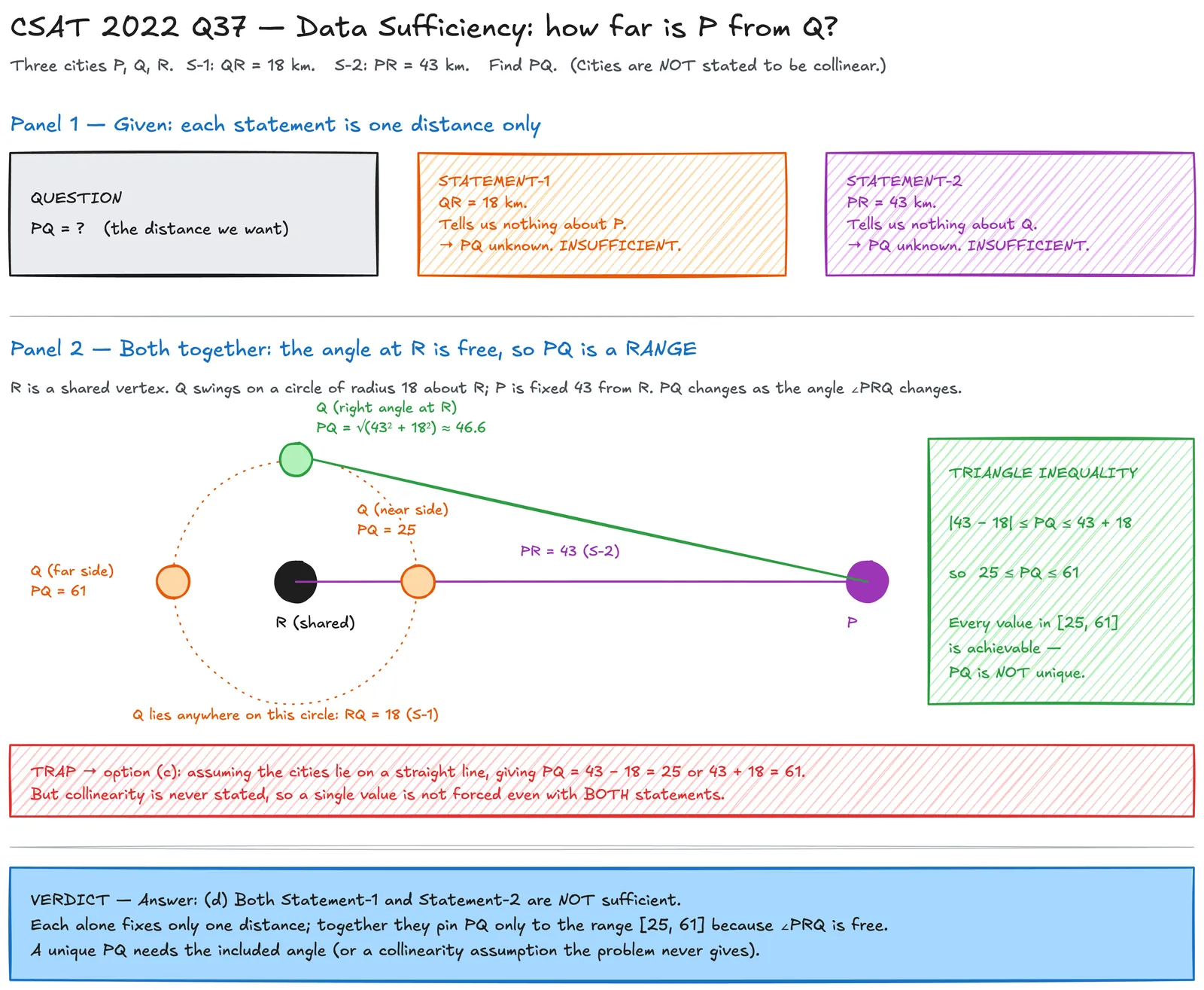
Both together (, ): the three cities need not be collinear. By the triangle inequality, can be anything in the range
so is not uniquely determined — e.g. collinear with in a line gives or , while a right angle at gives . The answer is not fixed even jointly.
Answer: (d) Both Statement-1 and Statement-2 are not sufficient.
Visual solution
The same solve, worked by hand — read it, then trace it.
Why the other options miss
- A thought it was enough when it wasn’t: thinks one distance from locates relative to .
- B thought it was enough when it wasn’t: the same overreach using alone.
- C thought it was enough when it wasn’t: assumes the cities are collinear (so or ), forcing a value the problem never guarantees.
Specialist insight
The engineered trap is assuming collinearity. Two side-lengths of a triangle fix the third only when the included angle is known; here is a shared vertex but the angle is free, so ranges over . On distance DS, always ask “are these points forced onto a line?” — if not, two radii from a common point leave the third distance open.
leave (angle at free) — not unique (d).