CSAT Solved Papers/ 2022/Q38
2022 CSAT — Q38
Two Statements followed by four Conclusions are given below. You have to take the Statements to be true even if they seem to be at variance from the commonly known facts. Read all the Conclusions and then decide which of the given Conclusions logically follows/follow from the Statements, disregarding the commonly known facts :
Statement-1 : All pens are books.
Statement-2 : No chair is a pen.
Conclusion-I : All chairs are books.
Conclusion-II : Some chairs are pens.
Conclusion-III : All books are chairs.
Conclusion-IV : No chair is a book.
Which one of the following is correct?
Thinking pathway
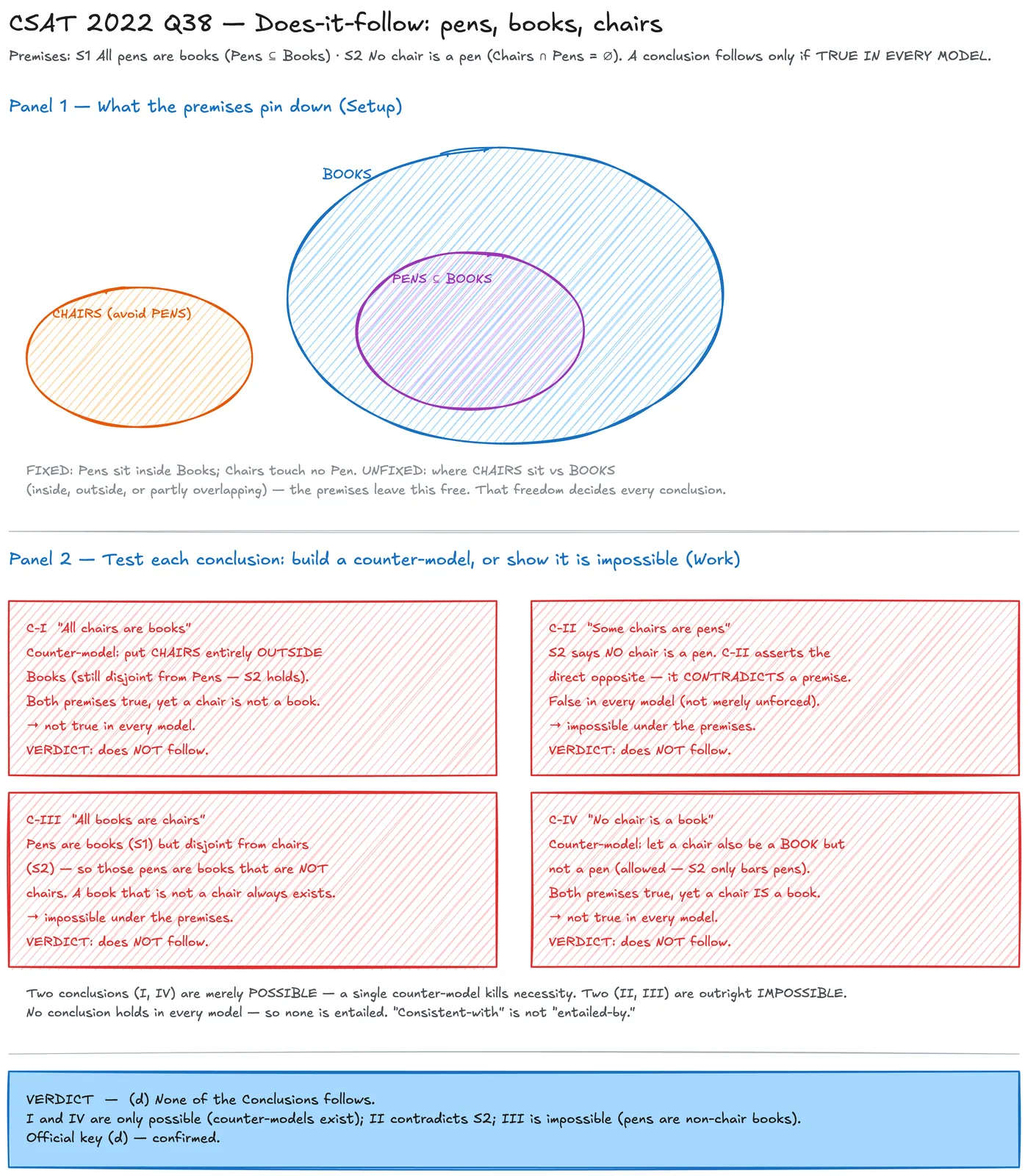
Locate. This is a pure-logic question (no passage): the given premise set is the anchor, and a conclusion follows only if the premises make it impossible to be false. Render the premises as set relations: S1 “All pens are books” → Pens ⊆ Books. S2 “No chair is a pen” → Chairs and Pens are disjoint.
Test (does-it-follow, conclusion by conclusion). The premises pin down only that Pens sit inside Books and that Chairs touch no Pen. Books may extend well beyond Pens, and Chairs may sit anywhere that avoids Pens — inside Books, outside Books, overlapping Books partly.
- C-I “All chairs are books” — a counter-model exists (chairs entirely outside Books, still disjoint from Pens). Not forced.
- C-II “Some chairs are pens” — contradicts S2 outright. Cannot follow.
- C-III “All books are chairs” — nothing makes every book a chair (Pens are books but disjoint from chairs, so some books are not chairs). Not forced — in fact false in every model.
- C-IV “No chair is a book” — a counter-model exists (a chair that is a book but not a pen, consistent with both premises). Not forced.
Eliminate by anatomy. (a)/(b)/(c) each assert a conclusion that is either contradicted (II, III) or merely possible (I, IV) rather than necessary — the deductive-logic version of “sounds reasonable, but unsupported”: “could be true” mistaken for “must be true.” Since no conclusion is forced by the premises, the answer is (d) None of the Conclusions follows.
Evidence in the text
Premises: Pens ⊆ Books, and Chairs ∩ Pens = ∅. C-I (All chairs are books): not forced — chairs may lie outside Books entirely. C-II (Some chairs are pens): directly CONTRADICTS S2 (“No chair is a pen”). C-III (All books are chairs): not forced — Books ⊇ Pens says nothing that makes every book a chair. C-IV (No chair is a book): not forced — a chair avoids Pens but may still be a Book. Each conclusion is either possible-but-not-necessary or outright contradicted; none is FORCED → (d).
Worked rationale
Premises: Pens ⊆ Books; Chairs ∩ Pens = ∅.
- C-I All chairs are books — Build a model: let some chairs lie outside Books. Both premises still hold (those chairs are not pens). So C-I is not necessary. Does not follow.
- C-II Some chairs are pens — S2 says no chair is a pen; C-II directly violates it. Does not follow.
- C-III All books are chairs — Pens are books and are disjoint from chairs, so those books are not chairs; C-III is impossible. Does not follow.
- C-IV No chair is a book — Build a model: a chair that is a book but not a pen — consistent with both premises. So C-IV is not necessary. Does not follow.
Every conclusion is either contradicted or only optionally true; none is entailed.
Answer: (d) None of the Conclusions follows.
Visual solution
The same solve, worked by hand — read it, then trace it.
Why the other options miss
- A sounds reasonable, but unsupported: “all chairs are books” is possible but a counter-model (chairs outside Books, still non-pens) refutes necessity.
- B cause and effect reversed: asserts “some chairs are pens,” the direct negation of S2; tempting only if S2 is misread.
- C sounds reasonable, but unsupported: III is impossible (pens are non-chair books) and IV is merely possible — neither is forced; pairing them compounds the error.
Specialist insight
The whole item turns on the gap between consistent-with and entailed-by. C-I and C-IV are each satisfiable in some arrangement of the sets — but a valid conclusion must hold in every arrangement the premises allow, and a single counter-model kills it. C-II and C-III fail harder (contradiction / impossibility). The disciplined move on “two-statement, four-conclusion” syllogisms: for each conclusion try to build a counter-model that keeps the premises true; if you can, it does not follow. Here every conclusion either has a counter-model or is impossible, so the answer is the “none follows” option. (d).
"All chairs are books" and "No chair is a book" are each merely *possible*, not forced, and the other two are contradicted — a valid conclusion must hold in every model, so (d).