CSAT Solved Papers/ 2022/Q77
2022 CSAT — Q77
There are cups placed on a table arranged in equal number of rows and columns out of which cups contain coffee and cups contain tea. In how many ways can they be arranged so that each row should contain at least one cup of coffee?
Worked rationale
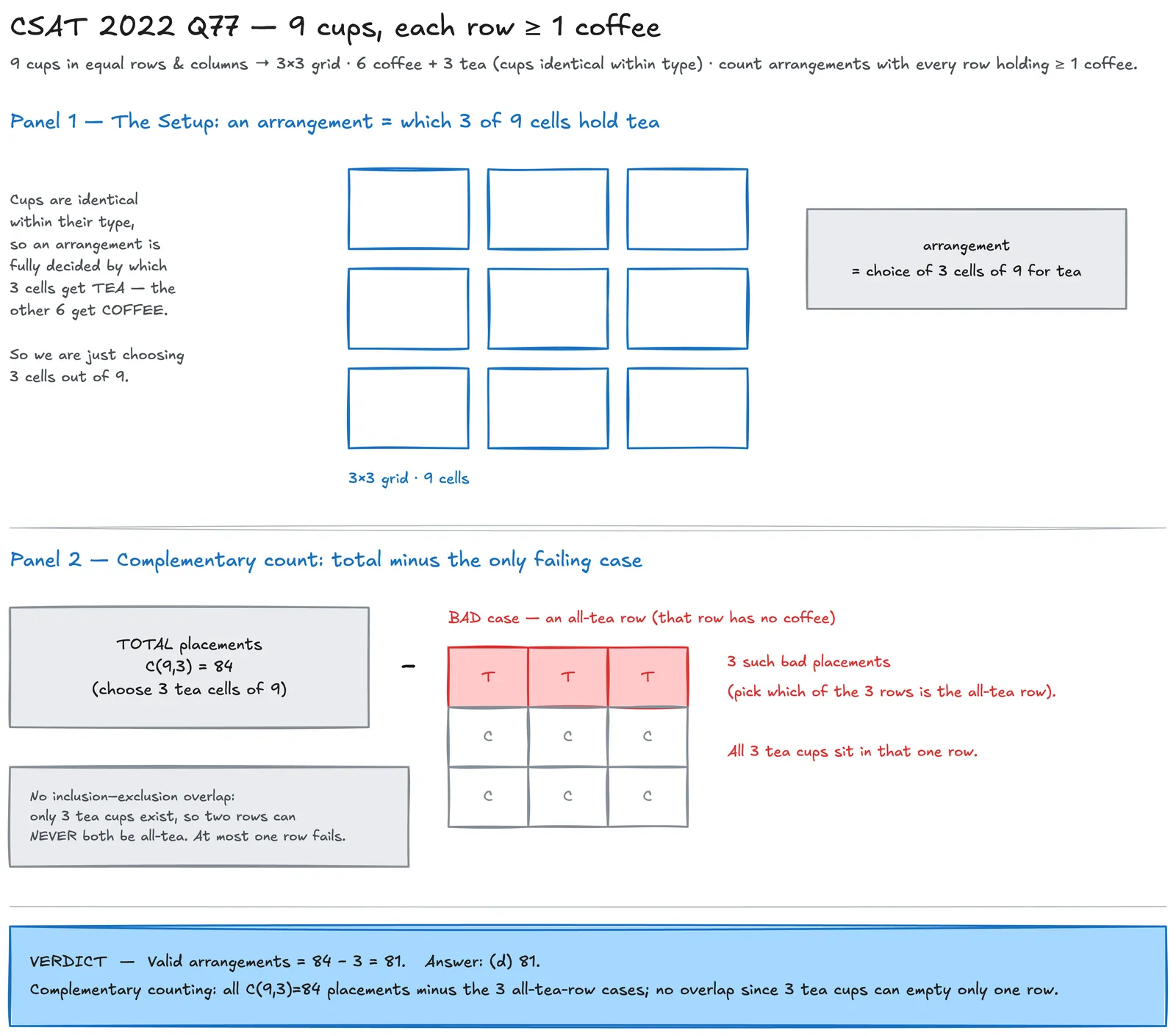
“Equal rows and columns” with cups means a grid. Identical cups, so an arrangement is just a choice of which of the cells hold tea (the rest hold coffee).
Total placements of the tea cups: .
Complementary count — subtract those failing “every row has at least one coffee.” A row fails only if all of its cells are tea (no coffee). Since there are exactly tea cups, a failing row uses all of them, so at most one row can fail, and the number of such bad placements is
Valid arrangements:
Answer: (d) 81.
Visual solution
The same solve, worked by hand — read it, then trace it.
Why the other options miss
- A over-restricted the rows: forces something like one tea per row, drastically undercounting.
- B wrong model: counts (one tea slot per row, chosen independently), which is not the setup here.
- C subtracted too much: removes column-failures as well (or applies a doubled correction to ), over-deducting.
Specialist insight
Complementary counting is the clean route: total minus the only way a row can lack coffee — all three tea cups falling in one row ( placements). No inclusion–exclusion overlap arises because three tea cups cannot empty two rows of coffee. .
minus the all-tea-row placements (d).