CSAT Solved Papers/ 2023/Q20
2023 CSAT — Q20
working independently can do a piece of work in and days respectively. alone works on Monday, alone works on Tuesday, alone works on Wednesday; alone, again works on Thursday and so on. Consider the following statements:
-
The work will be finished on Thursday.
-
The work will be finished in days.
Which of the above statements is/are correct?
Worked rationale
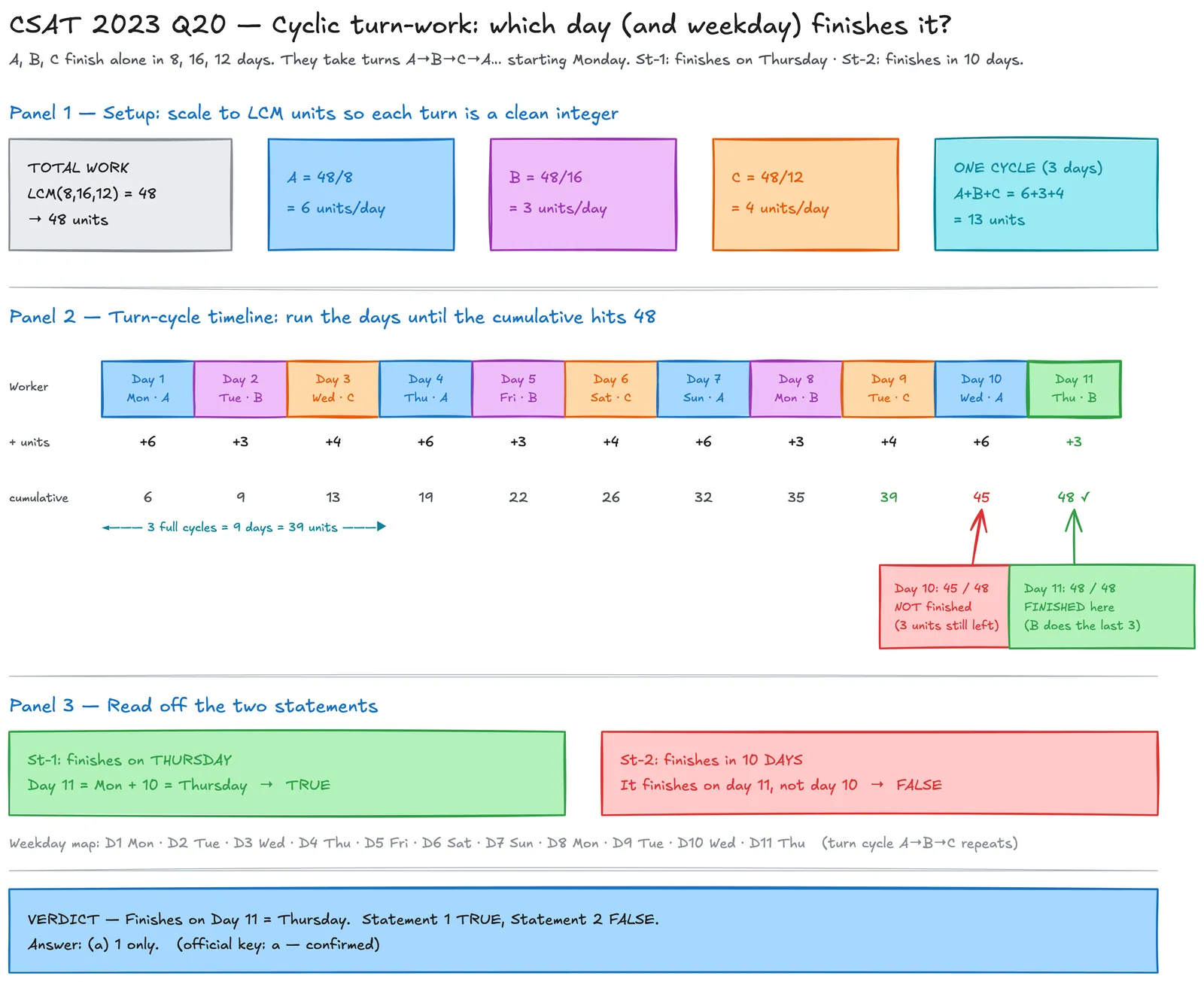
Use a common denominator so each turn adds an integer of “work units.” LCM, so total work units and the daily outputs are
The turn order cycles One full cycle (3 days) does units.
- After cycles ( days): units. Remaining .
- Day (‘s turn): units. Remaining .
- Day (‘s turn): does units . Work completes on day .
Now the weekday of day : day Monday, so day Monday Thursday (Mon, Tue, Wed, Thu, Fri, Sat, Sun, Mon, Tue, Wed, Thu).
- Statement 1 (finished on Thursday): day is Thursday. True.
- Statement 2 (finished in days): it finishes on day , not day . False.
Answer: (a) 1 only.
Visual solution
The same solve, worked by hand — read it, then trace it.
Why the other options miss
- B stops one day early: stops at day (where units), declaring completion a day early and mismatching the weekday.
- C gets the Thursday finish but also asserts ” days,” not noticing the remaining units force an th day.
- D mis-tracks the cycle (e.g. wrong daily units or a bad cycle sum), landing on a different day and rejecting both.
Specialist insight
Scaling to LCM units (, with daily outputs ) turns fractions into clean integer bookkeeping — essential under the clock. The decisive subtlety is who works the finishing day: after days () and day (, ), the last units fall to on day , so it is not a -day job, but day is a Thursday. The two statements are deliberately split — one true (weekday), one false (day-count) — punishing anyone who conflates “Thursday” with ” days.”
In LCM units (/day, cycle ): by day , by day (), last on day () Thursday St-1 true, St-2 false (a).