CSAT Solved Papers/ 2023/Q30
2023 CSAT — Q30
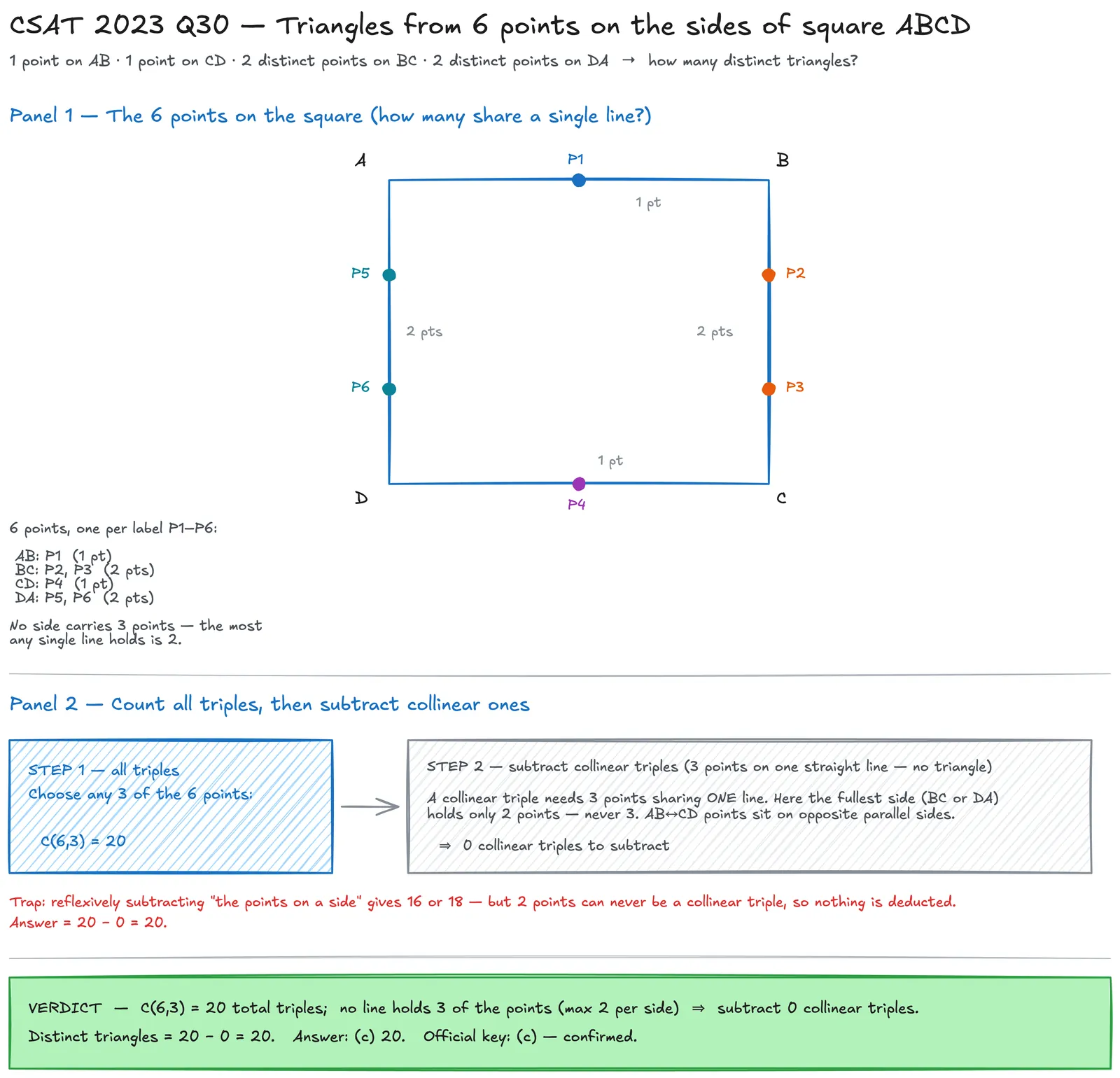
is a square. One point on each of and ; and two distinct points on each of and are chosen. How many distinct triangles can be drawn using any three points as vertices out of these six points?
Worked rationale
Count all triples of the points, then subtract triples that are collinear (which fail to form a triangle).
Total triples:
Now check collinearity. The six points are distributed:
- side : point,
- side : point,
- side : points,
- side : points.
Three points are collinear only if they lie on one straight line. The most a single side holds is points (on or ) — never . No other line through three of these points exists (a point on and a point on lie on opposite, parallel sides and are not collinear with a third). So there are zero collinear triples to remove.
Answer: (c) 20.
Visual solution
The same solve, worked by hand — read it, then trace it.
Why the other options miss
- A subtracted phantom collinear triples: removes “collinear” triples, imagining a side holds points — cutting triangles that are in fact valid.
- B two more phantom subtractions: removes collinear triples (one per -point side), though a side with only points can form no collinear triple at all.
- D over-counted the selections: treats the choices as ordered, or adds cross-side line combinations, pushing the total past .
Specialist insight
The triangle count is minus collinear triples — but a line needs three points to be collinear, and here no side carries more than . So the subtraction is zero and the answer is simply . The trap is reflexively subtracting “the points on a side,” forgetting that points can never be a collinear triple. Always verify how many points lie on the same line before deducting.
; no line holds of the points (max per side), so subtract nothing (c) .