CSAT Solved Papers/ 2023/Q38
2023 CSAT — Q38
Consider the following statements:
-
is older than .
-
and are of the same age.
-
is the youngest.
-
is younger than .
-
is older than .
How many statements given above are required to determine the oldest person/persons?
Worked rationale
Build the order chain and check which statements are load-bearing for naming the oldest.
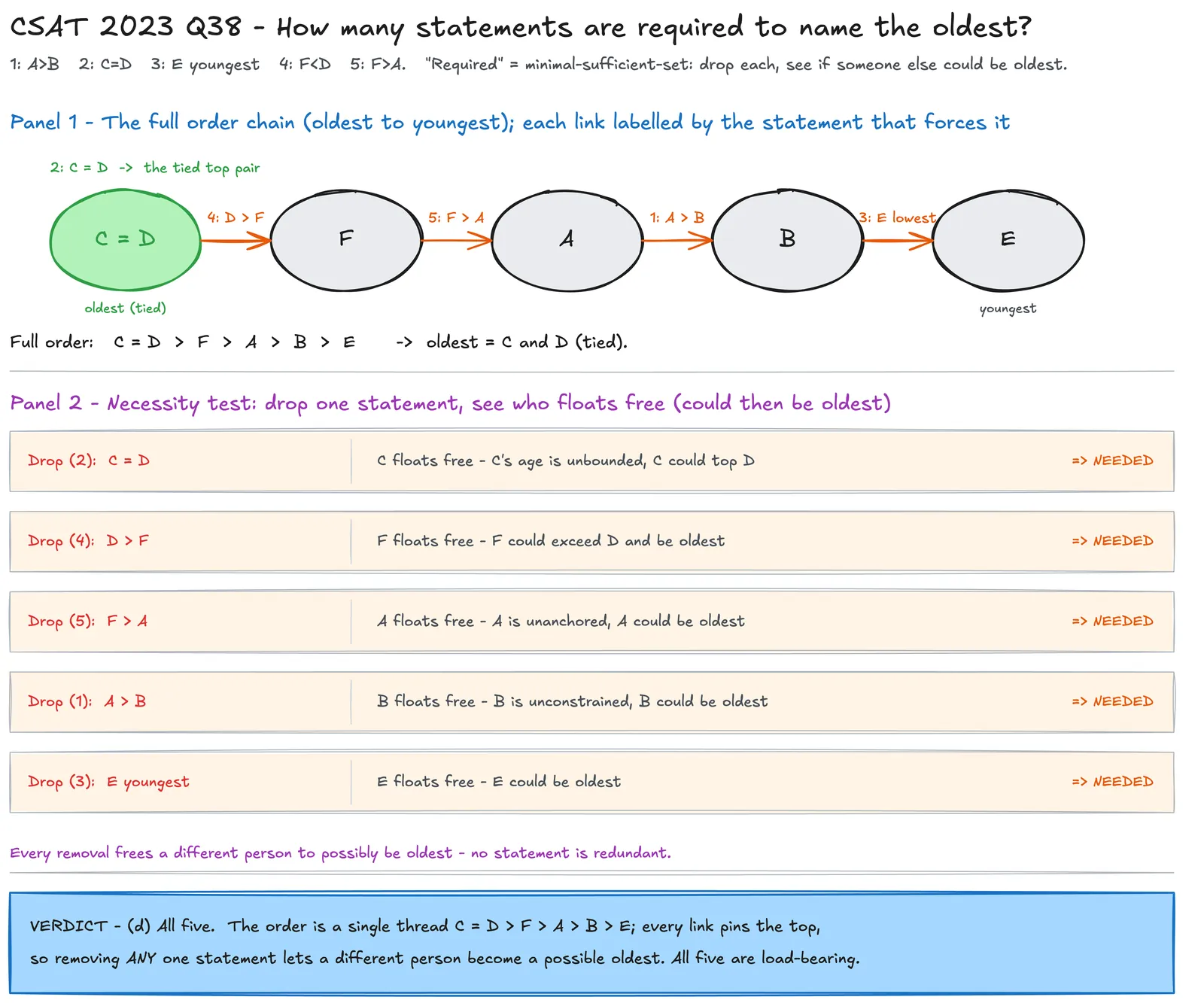
From (5) , (1) : . From (4) : . From (2) : so sit at the top. From (3) is youngest. Full order:
The oldest are and (tied). Now test necessity — drop each statement and ask “can someone else be oldest?”:
- Drop (2): ‘s age is unknown can’t say are both oldest. Needed.
- Drop (4): vs unknown could top . Needed.
- Drop (5): vs the rest is unanchored could be oldest. Needed.
- Drop (1): is unconstrained could be oldest. Needed.
- Drop (3): is unconstrained could be oldest. Needed.
Every statement removes a candidate that could otherwise top the list. All five are required.
Answer: (d) All five.
Visual solution
The same solve, worked by hand — read it, then trace it.
Why the other options miss
- A missed a case: uses just (4)+(2) to crown , ignoring that are then unbounded and could exceed .
- B solved the wrong question: stops once a top pair appears, not testing whether the unmentioned people are ruled out.
- C counted one too few: drops one statement (commonly (1), thinking “obviously” young) without checking that nothing else then bounds .
Specialist insight
“How many statements are required” is a minimal-sufficient-set test, not “can I find the oldest.” The disciplined check is to remove each statement and ask whether some person becomes a possible oldest. Here the chain is a single thread in which every link is needed to pin the top — drop any one and a different person could rise. Recognising that all five are independently load-bearing is the whole item.
Order is ; removing *any* statement frees a person to possibly be oldest, so all five are required (d).