2023 CSAT — Q4
Raj has ten pairs of red, nine pairs of white and eight pairs of black shoes in a box. If he randomly picks shoes one by one (without replacement) from the box to get a red pair of shoes to wear, what is the maximum number of attempts he has to make?
Worked rationale
“Maximum number of attempts” means the worst case — the unluckiest possible draw before a wearable red pair (one left-foot red and one right-foot red) is forced.
Count the shoes:
- Red: pairs shoes ( left right).
- White: pairs shoes.
- Black: pairs shoes.
The adversary delays a red pair as long as possible:
- Draw all non-red shoes first: shoes — still no red.
- Then draw all red shoes of one foot (say all left-reds): shoes — now he holds left-red shoes but still no matched pair.
- The very next shoe — the — must be a right-red (the only shoes left are red right-foot), which completes a red pair.
So the worst case is attempts.
Answer: (d) 45.
Visual solution
The same solve, worked by hand — read it, then trace it.
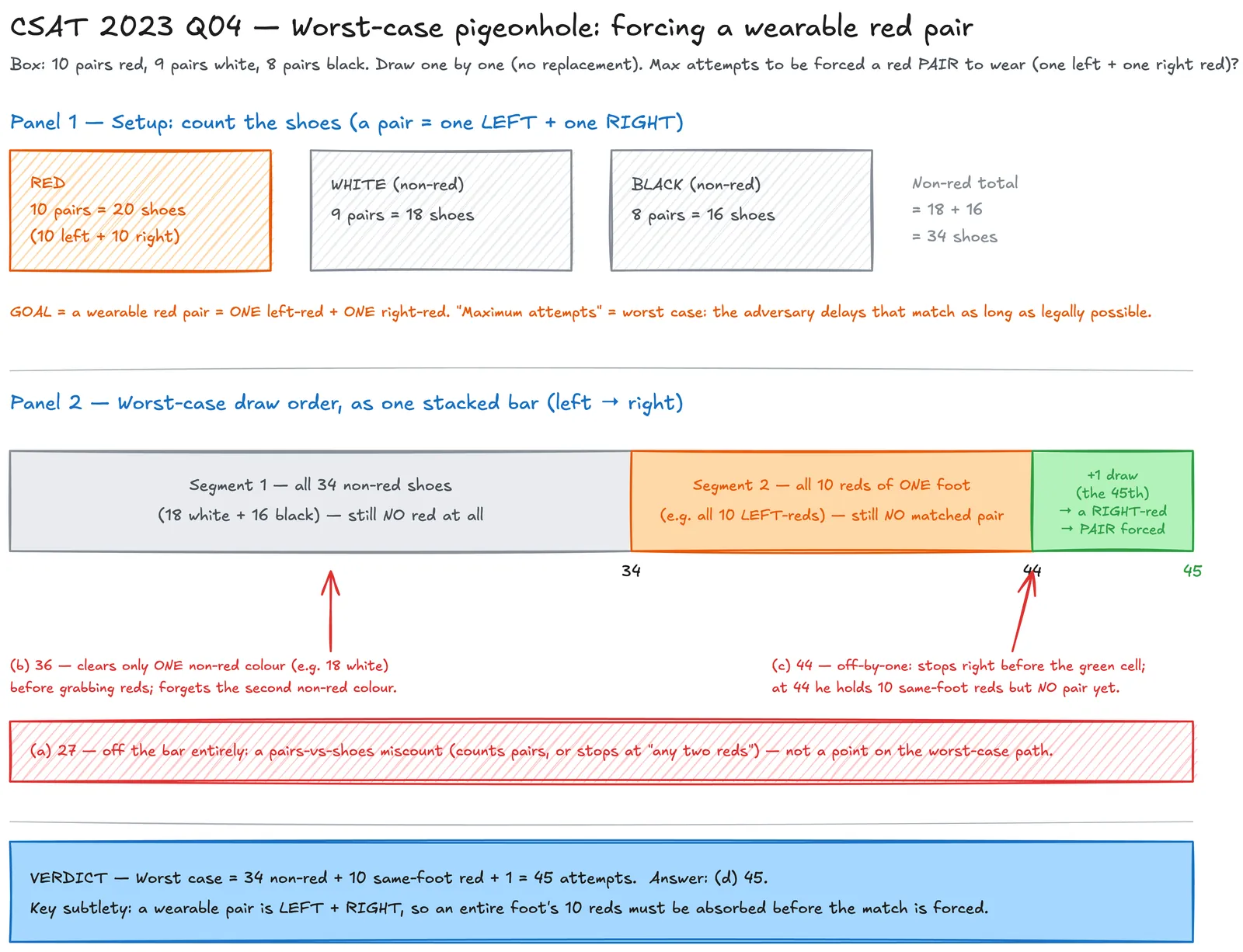
Why the other options miss
- A counted pairs, not shoes: works in pairs rather than individual shoes, or stops at “any two red” rather than a matched left+right pair.
- B cleared only one non-red colour: exhausts just one colour of the non-reds before grabbing reds, forgetting the second non-red colour must also be cleared in the worst case.
- C stopped one shoe early: at he holds same-foot reds but no matched pair yet; the pair is forced only on the very next draw.
Specialist insight
The decisive subtlety is that a “red pair to wear” is a matched pair (one left, one right), not just two red shoes. That is why drawing all reds of a single foot ( shoes) does not yet give a pair — the worst case must absorb an entire foot’s worth of reds before the match is forced. Treating “red pair” as “any two reds” gives and loses the mark. Worst-case pigeonhole: clear every way to avoid the goal, then add one.
A wearable pair is left right, so the worst case is all non-reds all reds of one foot , not .