CSAT Solved Papers/ 2023/Q79
2023 CSAT — Q79
A cuboid of dimensions is painted red, green and blue colour on each pair of opposite faces of dimensions , , respectively. Then the cuboid is cut and separated into various cubes each of side length . Which of the following statements is/are correct?
-
There are exactly small cubes with no paint on any face.
-
There are exactly small cubes with exactly two faces, one painted with blue and the other with green.
Which of the statements given above is/are correct?
Worked rationale
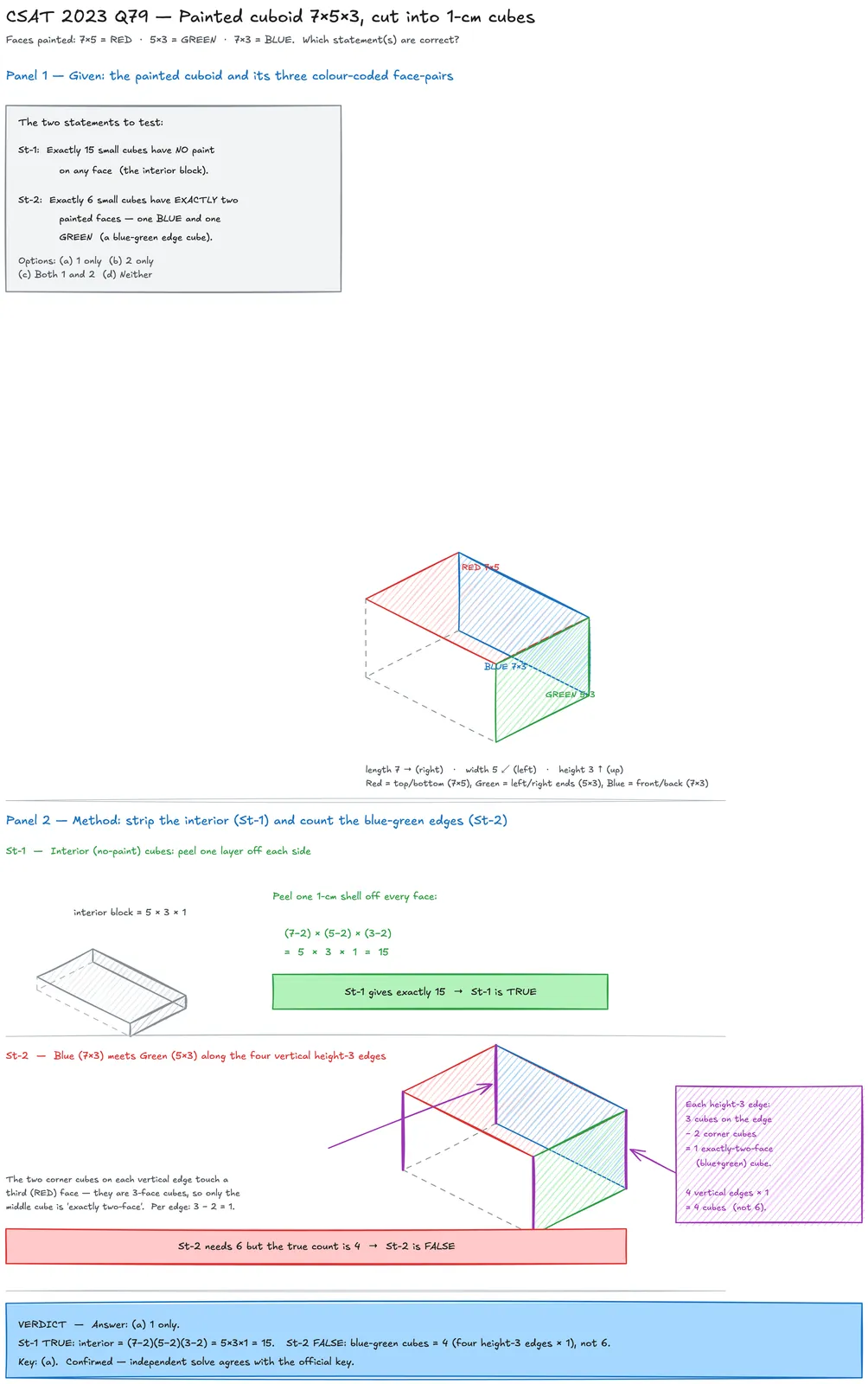
The cuboid is , cut into -cm cubes. Colours: faces red, faces green, faces blue.
Statement 1 (no paint interior): strip one layer off each dimension:
Statement 2 (exactly two faces, one blue and one green): such cubes sit on an edge where a blue () face meets a green () face. Those two face-types share the vertical edges of length — there are such edges. On each, the cubes with exactly two painted faces number (the two ends are -face corners). So
Answer: (a) 1 only.
Visual solution
The same solve, worked by hand — read it, then trace it.
Why the other options miss
- B missed a case: miscounts the blue–green edges (e.g. uses all short edges with one interior cube wrongly, or pairs the wrong faces) to reach , while flubbing the interior count.
- C off by one: gets the interior right but accepts the blue–green count as , over-counting the length- edge cubes.
- D misreads the geometry: mishandles the stripping (e.g. miscomputed) and the edge pairing, rejecting both.
Specialist insight
Two cuboid facts: interior (no-paint) cubes are ; two-face cubes of a specific colour pair live on the edges where those two faces meet. Blue () and green () meet along the four height- edges, each contributing exactly-two-face cube , not . The trap is Statement 2’s plausible-looking "" — the scoring move is to identify which edges carry the blue–green pair and count along each.
Interior (St-1 ✓); blue–green meet on height- edges cubes, not (St-2 ✗) (a).