CSAT Solved Papers/ 2024/Q16
2024 CSAT — Q16
What percent of water must be mixed with honey so as to gain by selling the mixture at the cost price of honey?
Worked rationale
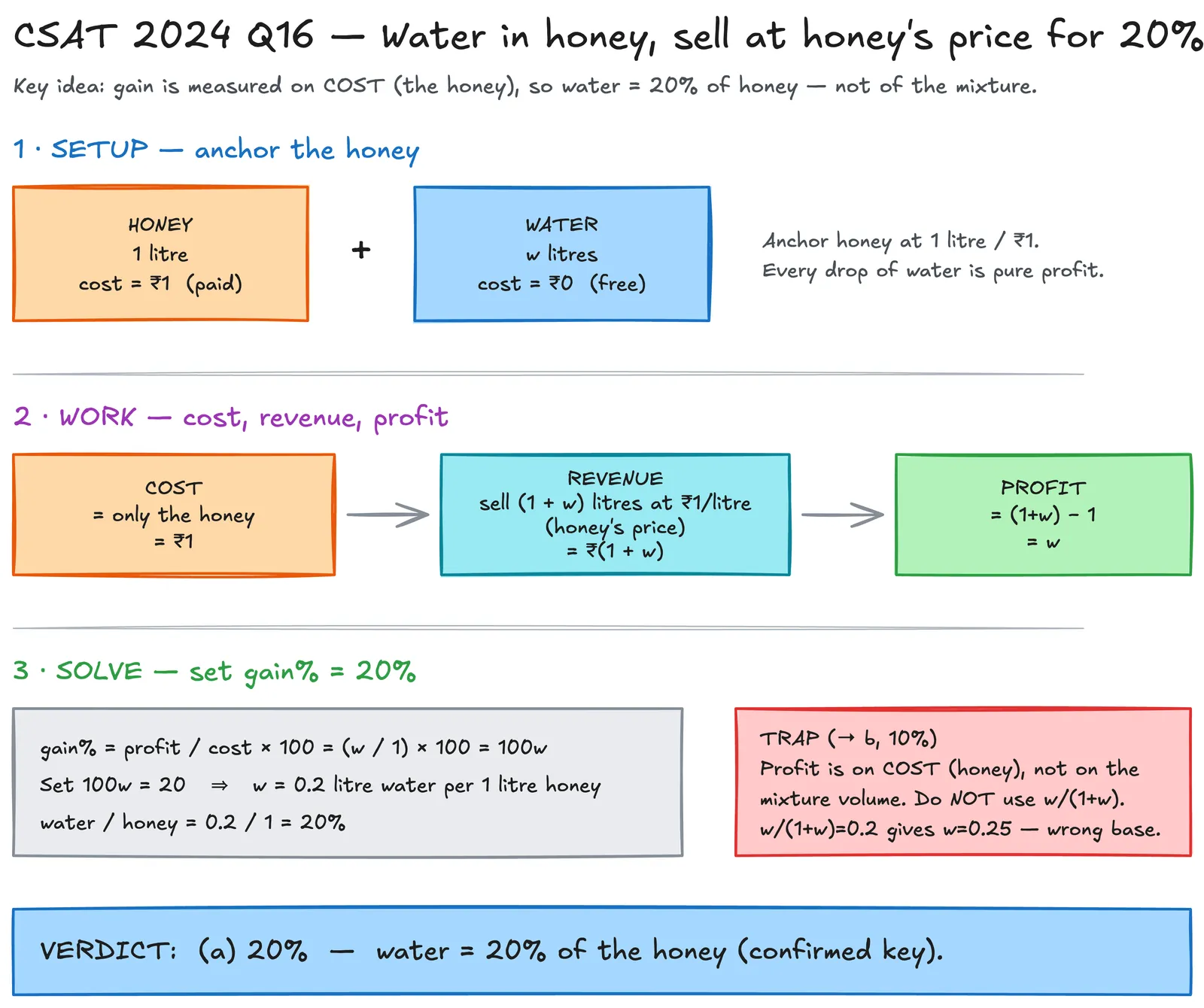
Water is free; honey costs money. Take 1 litre of honey at cost ₹ per litre (a convenient anchor), and add litres of water (cost ).
- Cost of the mixture ₹ (only the honey cost anything).
- Mixture volume litres.
- It is sold at the cost price of honey, i.e. ₹ per litre, so revenue ₹.
Profit on a cost of , so gain . Set equal to :
Answer: (a) 20%.
Visual solution
The same solve, worked by hand — read it, then trace it.
Why the other options miss
- B the wrong base: applies the gain on the selling/total volume instead of on cost, e.g. treats as profit on the mixture and solves then mis-reduces, or simply halves on a wrong-base instinct.
- C an arithmetic slip: inverts the relationship ( gain water), a reflexive “take the reciprocal” error.
- D two wrong steps stacked: combines of , or of — landing on .
Specialist insight
The whole class of “adulterate with a free component, sell at the pure price” problems reduces to one line: the gain percent equals the fraction of free stuff added, measured against the paid stuff. Selling the diluted mixture at honey’s price means every drop of water is pure profit. So gain of the honey’s volume is water — no equations needed once you see it. The trap is the base: profit is on cost (the honey), not on the mixture volume, so it is , not . Anchor the honey at litre / ₹ and the arithmetic disappears. (This is the same engine as “milkman adds water”; recognise the template and it’s a 30-second item.)
Profit is measured on the cost (the honey), so water of honey — not of the mixture.