2024 CSAT — Q5
What is the least possible number of cuts required to cut a cube into identical pieces?
Worked rationale
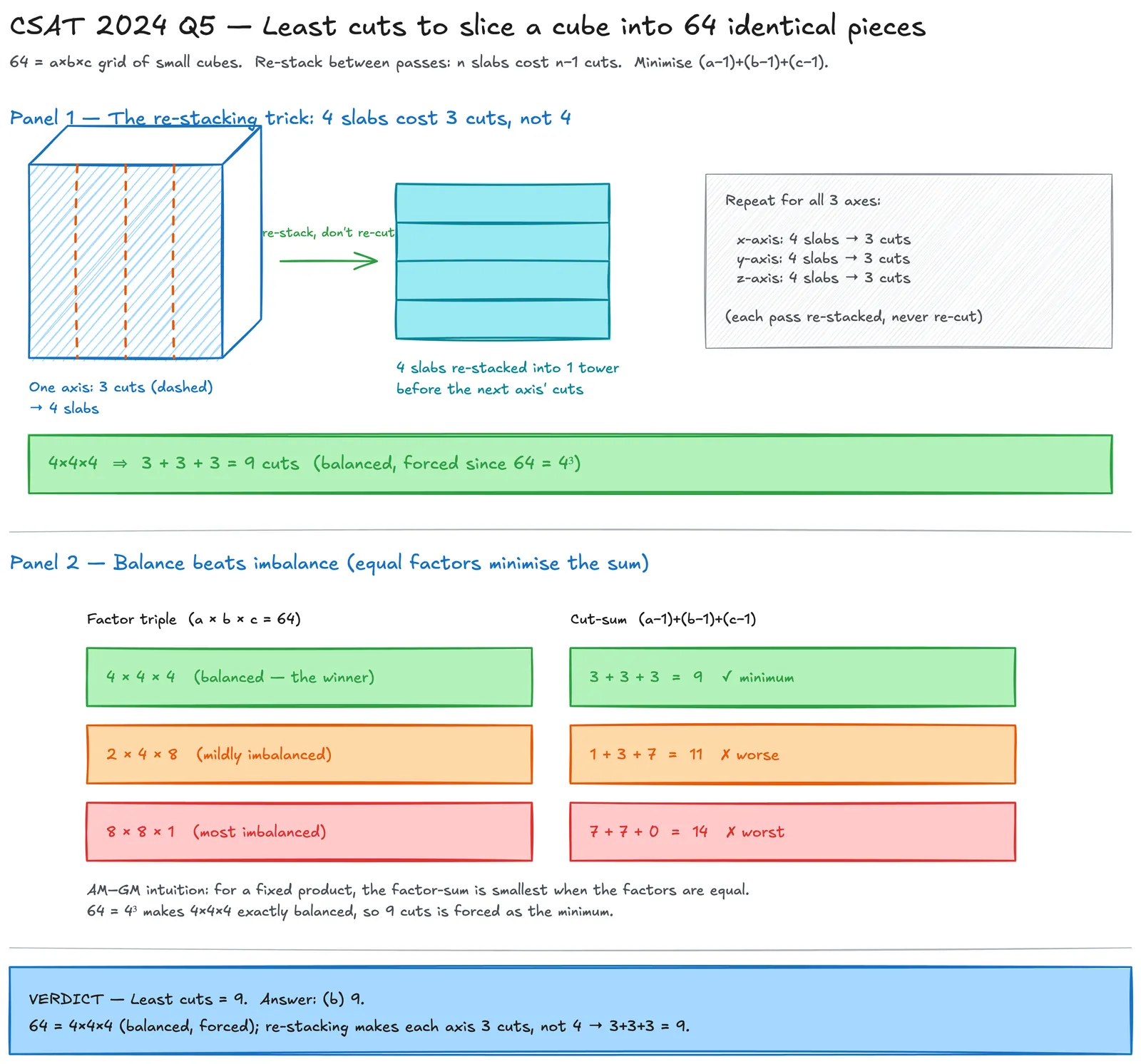
Each straight planar cut along one axis multiplies the piece-count along that axis; cuts may be re-stacked between passes, so cuts along one direction produce slabs. To get identical small cubes we need a grid with and we want to minimise the total cuts .
For a fixed product, the sum of factors is minimised when the factors are as equal as possible. Since ,
Any less-balanced split costs more: ; . The balanced is the optimum.
Answer: (b) 9.
Visual solution
The same solve, worked by hand — read it, then trace it.
Why the other options miss
- A an arithmetic slip: takes and reports cuts per axis but then sums only , dropping one cut on the third axis.
- C forgets that slabs can be re-stacked: assumes a but counts cuts per axis () instead of the cuts that already make slabs.
- D wrong method: uses a -style imbalance, or counts faces not cuts.
Specialist insight
Two ideas win this: (1) re-stacking — pieces along one axis cost cuts, never ; and (2) balance — for a fixed product, equal factors minimise the factor-sum, the AM–GM intuition. is the perfect cube , so the symmetric split is forced as optimal: cuts on each of three axes . If were not a perfect cube you would pick the most-balanced factor triple. Recognising “minimise the sum of factors at fixed product” turns a fiddly 3-D visualisation into one line.
Re-stacking makes it per axis, not per axis; and the split must be the balanced — total , not .