CSAT Solved Papers/ 2024/Q56
2024 CSAT — Q56
A person walks m straight from his house, turns left and walks m, again turns left and walks m, then turns right and walks m to reach his office. In which direction does he walk initially from his house if his office is exactly in the North-East direction?
Worked rationale
Don’t guess the start direction — express the net displacement as a vector in terms of the unknown start direction, then force it to point North-East.
Let the initial heading be the unit vector , with “turn left” a counter-clockwise rotation . The four legs are walked in headings (the final right turn from heading returns to ):
using . So , which must point North-East, i.e. have equal positive North and East components.
Write ; then and . Setting the two components equal: . The components then become , both positive iff — that is, points South.
Check with (South): legs are , then East , then North , then East ; sum — exactly North-East. ✓
Answer: (c) South.
Visual solution
The same solve, worked by hand — read it, then trace it.
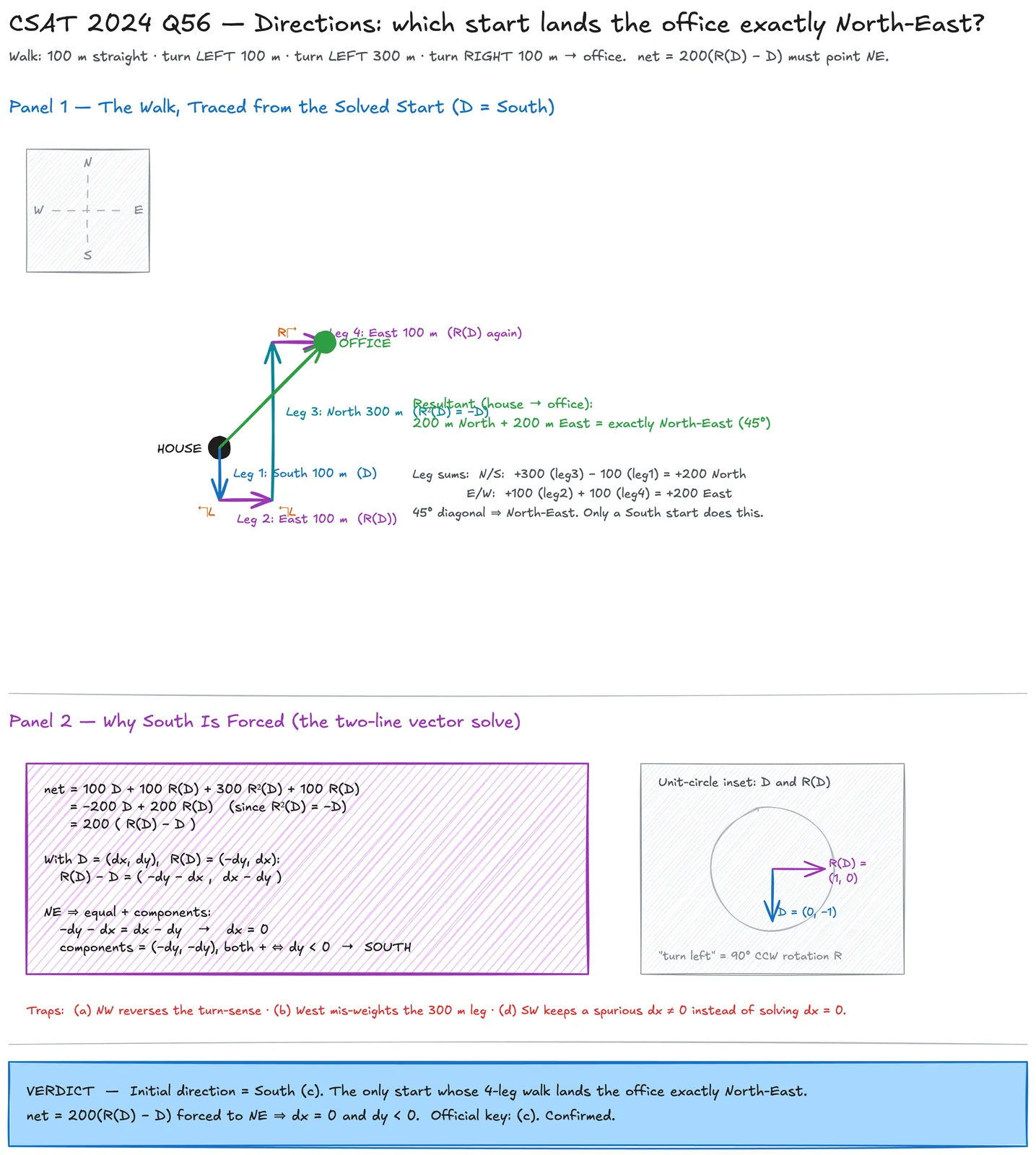
Why the other options miss
- A solved the wrong question: reverses the turn sense (treats “left” as a clockwise turn), pushing the resultant into the wrong quadrant.
- B an arithmetic slip: forgets that the m leg is double-weighted against the two m return legs, so the East–West balance is mis-set and the start is read as West.
- D missed a case: gets the southerly component but keeps a spurious westward component instead of solving , landing on a diagonal start.
Specialist insight
The whole item collapses to one identity: . Once you see that the two m legs along add while the outbound and the m along leave a net , you never have to draw a careful path — you solve a two-line vector equation. The “equal North and East components” condition for North-East is the lever: it forces and the sign of fixes South. Under the clock, set the office direction as the target vector and back-solve the start; it is faster and trap-proof than tracing arrows.
Resolve the walk into a vector and force North-East (equal components): it pins the start due South — tracing arrows by hand invites a turn-sense slip.