CSAT Solved Papers/ 2024/Q69
2024 CSAT — Q69
A Question is given followed by two Statements I and II. Consider the Question and the Statements.
A person buys three articles , and for Rs. . The price of the article is Rs. which is the least.
Question: What is the price of the article ?
Statement-I: The cost of is not more than that of .
Statement-II: The cost of is not more than that of .
Which one of the following is correct in respect of the above Question and the Statements?
Worked rationale
Set up the fixed facts first: and , so . Since is the least, and .
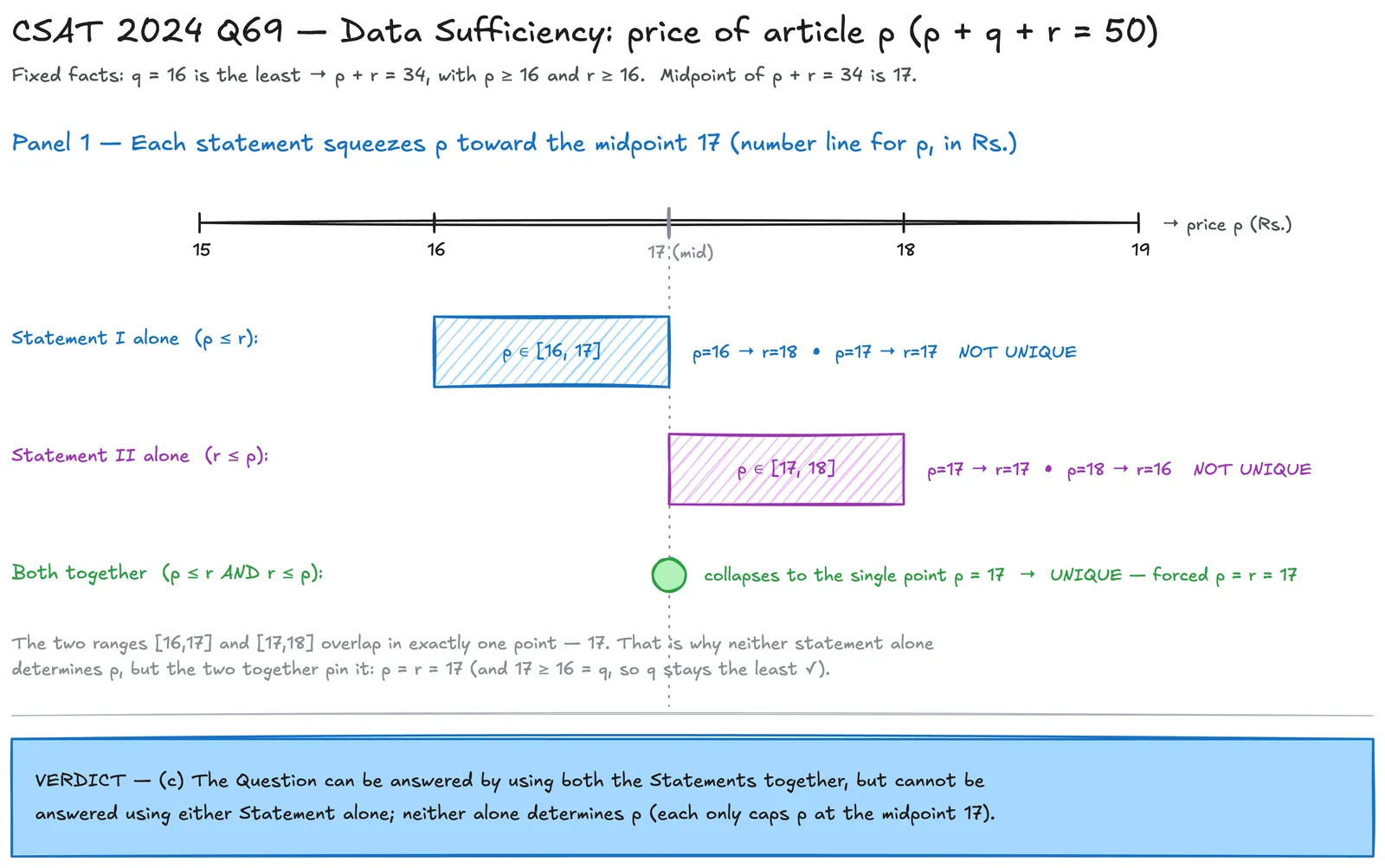
Statement-I alone (): with and , we get . Combined with , lies in — e.g. (then ) and (then ) both fit. Not unique.
Statement-II alone (): symmetrically so ; with (from ), lies in — e.g. or . Not unique.
Both together ( and ): force . With , — a single value. Check: , and is the least ✓. Unique: .
Answer: (c) The Question can be answered by using both the Statements together, but cannot be answered using either Statement alone.
Visual solution
The same solve, worked by hand — read it, then trace it.
Why the other options miss
- A thought a statement was enough when it wasn’t: assumes "" already squeezes to a single value, forgetting it only bounds and leaves and both open.
- B read an inequality as an equality: reads each inequality as an equality, treating “not more than” as “equal to.”
- D missed that the two bounds combine to an equality: misses that the two “not more than” statements combine into , which the sum then pins exactly.
Specialist insight
The engine here is the classic squeeze: "" and "" are weak alone (each only caps one side around the midpoint ), but together they are an equality , and a linear sum closes the problem. Spot that the midpoint of is and that each statement merely says ” is on its side of ” — only both, asserting sits exactly at , decide it. The ” is the least” clause is the guardrail ensuring so no degenerate split sneaks in.
Each "not more than" alone only bounds around the midpoint of ; only both together give — don't read one inequality as an equality.