2024 CSAT — Q8
, and can complete a piece of work individually in hours, hours and hours respectively. However, only one person can work in each hour and nobody can work for two consecutive hours. All are engaged to finish the work. What is the minimum amount of time that they will take to finish the work?
Worked rationale
Use a common “work” unit of (LCM of ) so rates are whole numbers per hour:
total work units.
To finish fastest, use the strongest worker (, /hr) as often as possible — but cannot work two hours in a row. So alternate with a filler ( or , /hr). Greedy schedule, hour by hour (cumulative units):
| Hour | Worker | Units | Cumulative |
|---|---|---|---|
| 1 | 4 | 4 | |
| 2 | 3 | 7 | |
| 3 | 4 | 11 | |
| 4 | 3 | 14 | |
| 5 | 4 | 18 | |
| 6 | 3 | 21 |
After hours: units done, units left. Hour was , so hour may be . does units/hour, so the remaining units take hour minutes.
Total .
Answer: (c) 6 hours 45 minutes.
Visual solution
The same solve, worked by hand — read it, then trace it.
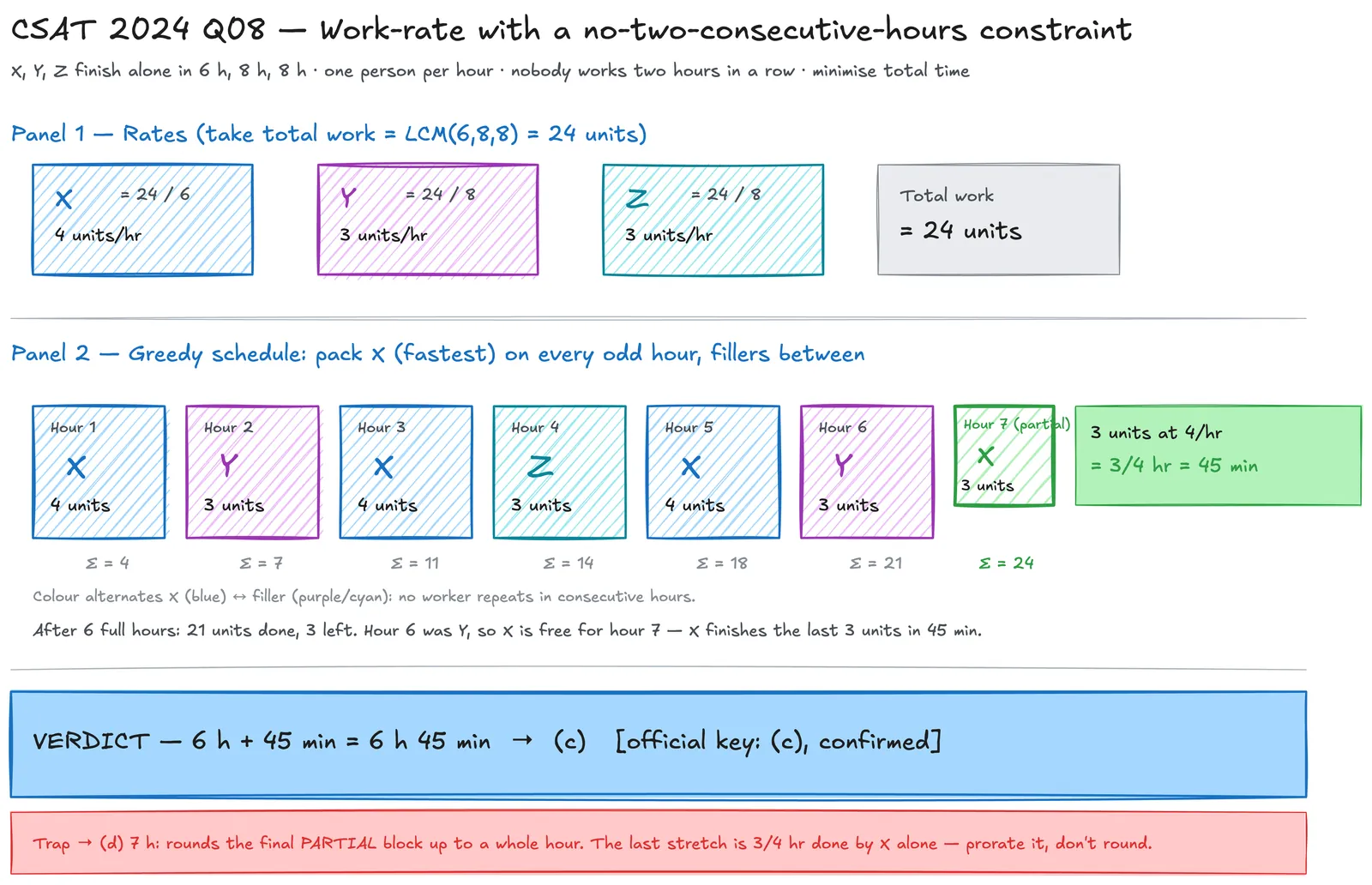
Why the other options miss
- A missed a case: assumes can run more often than every other hour, over-counting ‘s contribution and finishing the last sliver too fast.
- B an arithmetic slip: gets the right schedule but mis-prorates the final partial hour — e.g. divides the leftover units by an averaged rate (/hr) instead of by ‘s /hr, giving h.
- D solved a different question: ignores that the last block can be a fraction of an hour (assumes whole-hour shifts only), so rounds the final minutes up to a full hour. The “shifts must be whole hours” mis-assumption.
Specialist insight
Two moves crack this whole template. First, convert rates to integer units via the LCM () — fractions like are where people lose the thread; integers per hour make the schedule readable. Second, recognise it as a greedy scheduling problem: to minimise time, pack the fastest worker as densely as the constraint allows — here on every odd hour, fillers on the evens. The decisive insight the generalist misses is that the final block can be partial: once the leftover is below one worker’s hourly output, you prorate ( h), you do not round up to a whole hour. That single point is the gap between the right answer (c) and the tempting (d). The “no two consecutive hours” clause is the entire difficulty — without it the answer would just be hours with only; the constraint forces one extra fractional turn.
The last stretch is a *partial* hour ( h min) done by alone — don't round it up to a full hour ( wrong (d)).