CSAT Solved Papers/ 2025/Q15
2025 CSAT — Q15
A solid cube is painted yellow on all its faces. The cube is then cut into smaller but equal pieces by making the minimum number of cuts. Which of the following statements is/are correct?
I. The minimum number of cuts is .
II. The number of smaller pieces which are not painted on any face is .
Select the correct answer using the code given below:
Worked rationale
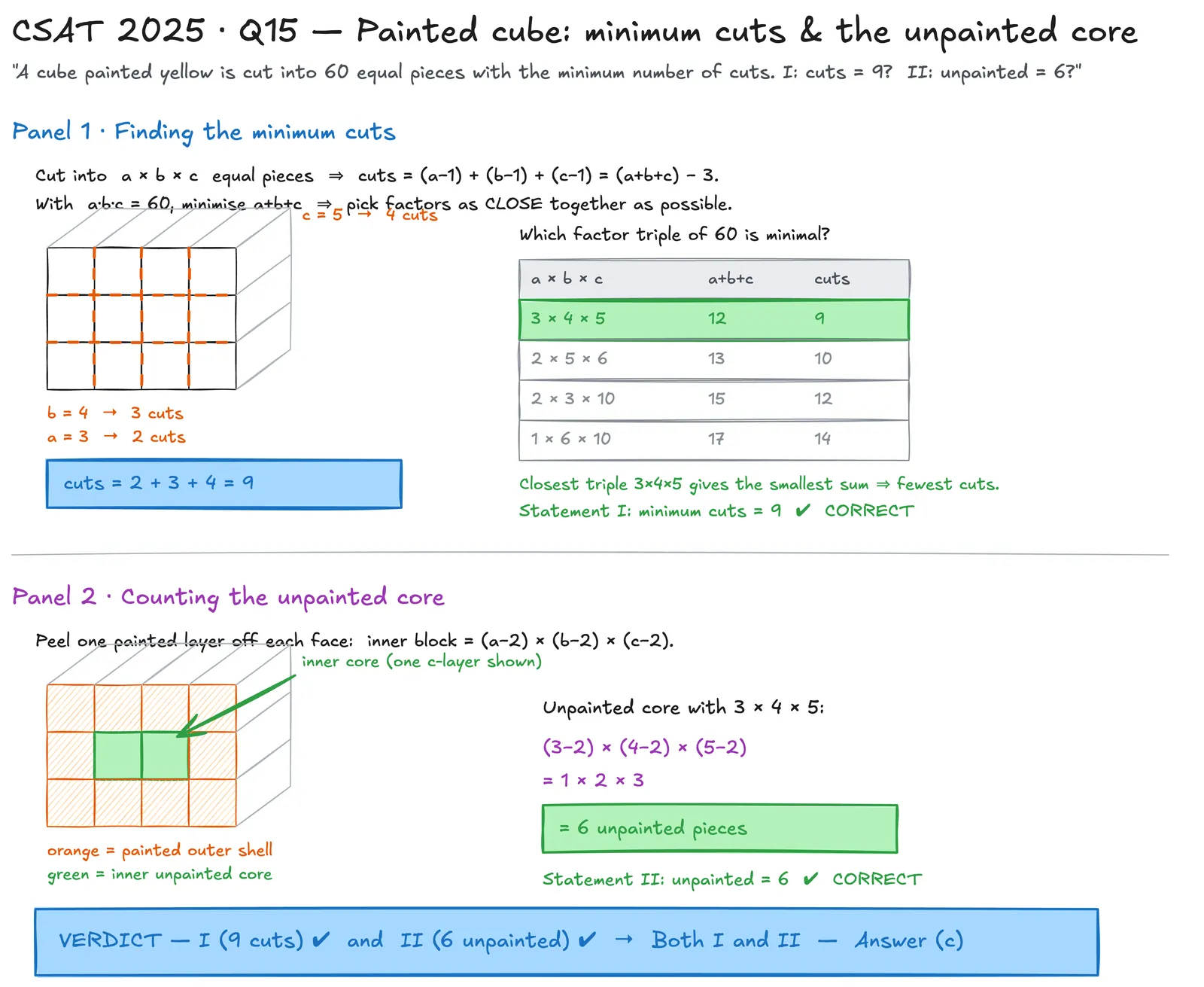
To split a cube into equal cuboidal pieces you slice along the three directions: , , cuts (parallel cuts in one direction can be made together, but the count of cuts is ). With , minimise
Sum is smallest when the three factors are as close together as possible. The factorisation of into three nearest factors is (sum ); any other, e.g. (sum ) or (sum ), is larger.
Unpainted pieces are the inner block stripped of the outer shell: . With :
Answer: (c) Both I and II.
Visual solution
The same solve, worked by hand — read it, then trace it.
Why the other options miss
- A an arithmetic slip on the inner block: gets the split and cuts but botches the inner block (e.g. computes , mis-subtracting), so rejects II.
- B wrong cut count: counts unpainted but uses cuts (or some other count), so rejects the "" in I.
- D uses a non-minimal split: picks a non-minimal factorisation (e.g. , cuts, inner ) and finds both statements false.
Specialist insight
Two facts carry this template. First, minimum cuts ⇔ factors closest together: for a fixed product, is minimised when are near-equal, so always reach for the “middle” factorisation ( for ). Second, the unpainted core is — peel one layer off each face. The dangerous slip is using a dimension that is too thin: a side of length contributes , which is not a piece — but with the smallest side is , so is a genuine single inner layer. Here both numbers land cleanly, and checking the inner block confirms the chosen factorisation was the minimal one.
Minimum cuts use the closest factor triple (, so cuts), and the unpainted core is — both statements hold.