CSAT Solved Papers/ 2025/Q30
2025 CSAT — Q30
Consider the sequence that follows a certain pattern. Which one of the following completes the sequence?
Worked rationale
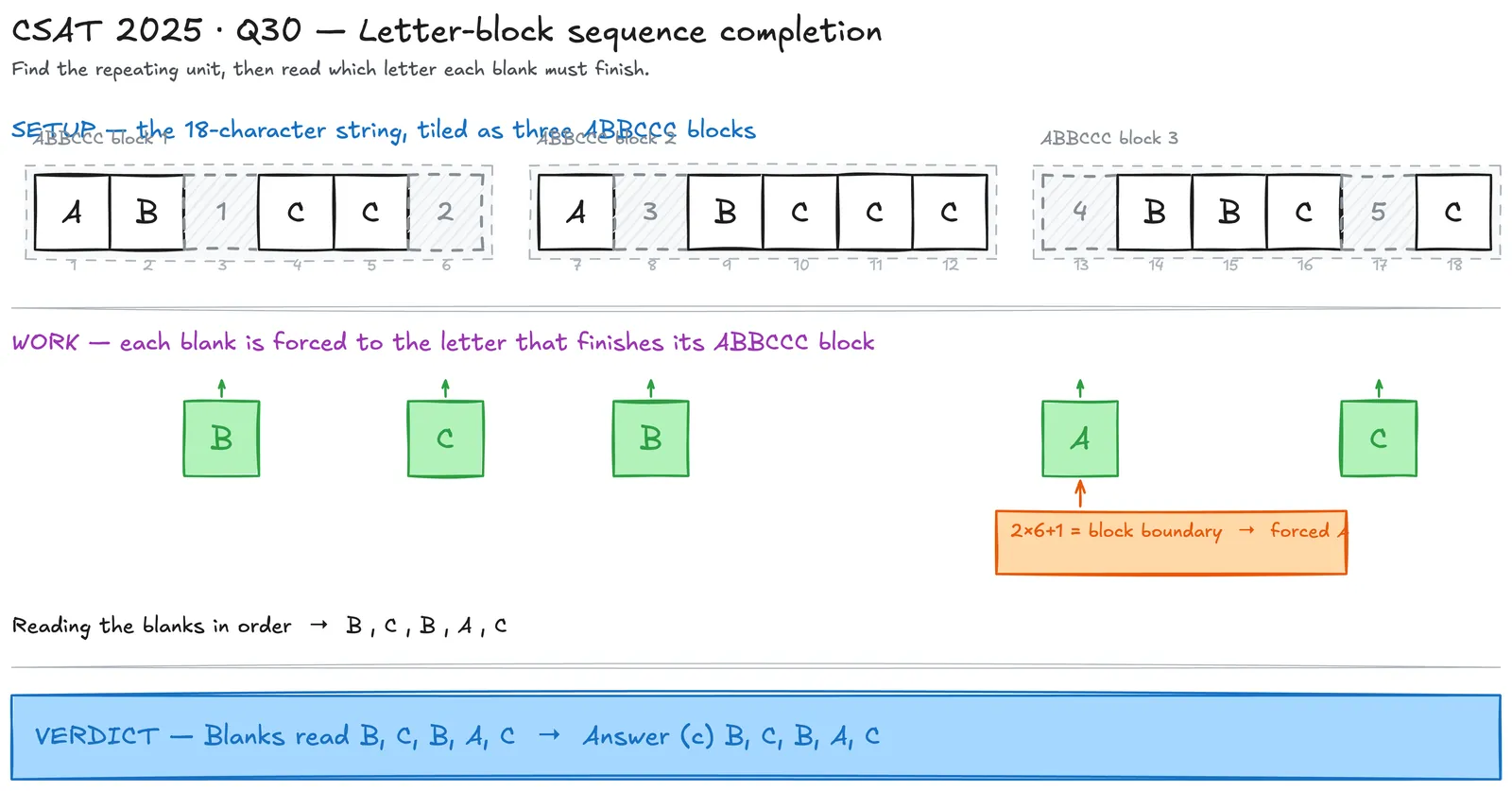
The pattern is the repeating block ABBCCC (one A, two B’s, three C’s), laid down end to end. The string has exactly characters — three full blocks of six — so the tiling is forced. Mark off the blocks and read which letter each blank must carry.
Write the string with the five blanks numbered:
- Block 1 must read A B B C C C blank , blank .
- Block 2 must read A B B C C C blank .
- Block 3 is the third ABBCCC block (it starts at character , exactly a block boundary), so it must read A B B C C C blank (the block-opening A), blank .
Reading the blanks in order: .
Answer: (c) B, C, B, A, C.
Visual solution
The same solve, worked by hand — read it, then trace it.
Why the other options miss
- A off by one: the engineered near-miss — fills blanks – correctly but swaps the last two (puts at the third block’s opening and at its interior), displacing the block-opening A by one position and corrupting the boundary at character .
- B solved the wrong question: mis-starts block 1 as AA…, breaking the one-A-per-block rule.
- D solved the wrong question: abandons the ABBCCC block entirely, reading a different (inconsistent) grouping.
Specialist insight
Letter-block completion is won by finding the repeating unit first, then treating every blank as “which letter finishes this block.” The unit here is ABBCCC (counts ); once you see it, blanks – are forced immediately. The decisive check is the third block’s opening: character is a block boundary (), so it must be the block-opening A — this is exactly what separates the answer from the near-miss , which swaps the last two fills. The engineered distractors each break a different structural rule — the one-A-per-block count, the block boundary, or the unit itself — so verifying that your fill reproduces a clean ABBCCC | ABBCCC | ABBCCC tiling is the discipline that scores.
The -character string is three ABBCCC blocks; the third block opens at character (a boundary), forcing an A there — completing the blanks gives B, C, B, A, C.