CSAT Solved Papers/ 2025/Q37
2025 CSAT — Q37
and walk along a circular track. They start at a.m. from the same point in opposite directions. walks at an average speed of rounds per hour and walks at an average speed of rounds per hour. How many times will they cross each other between a.m. and a.m.?
Worked rationale
Walking in opposite directions, their meeting rate is the sum of speeds:
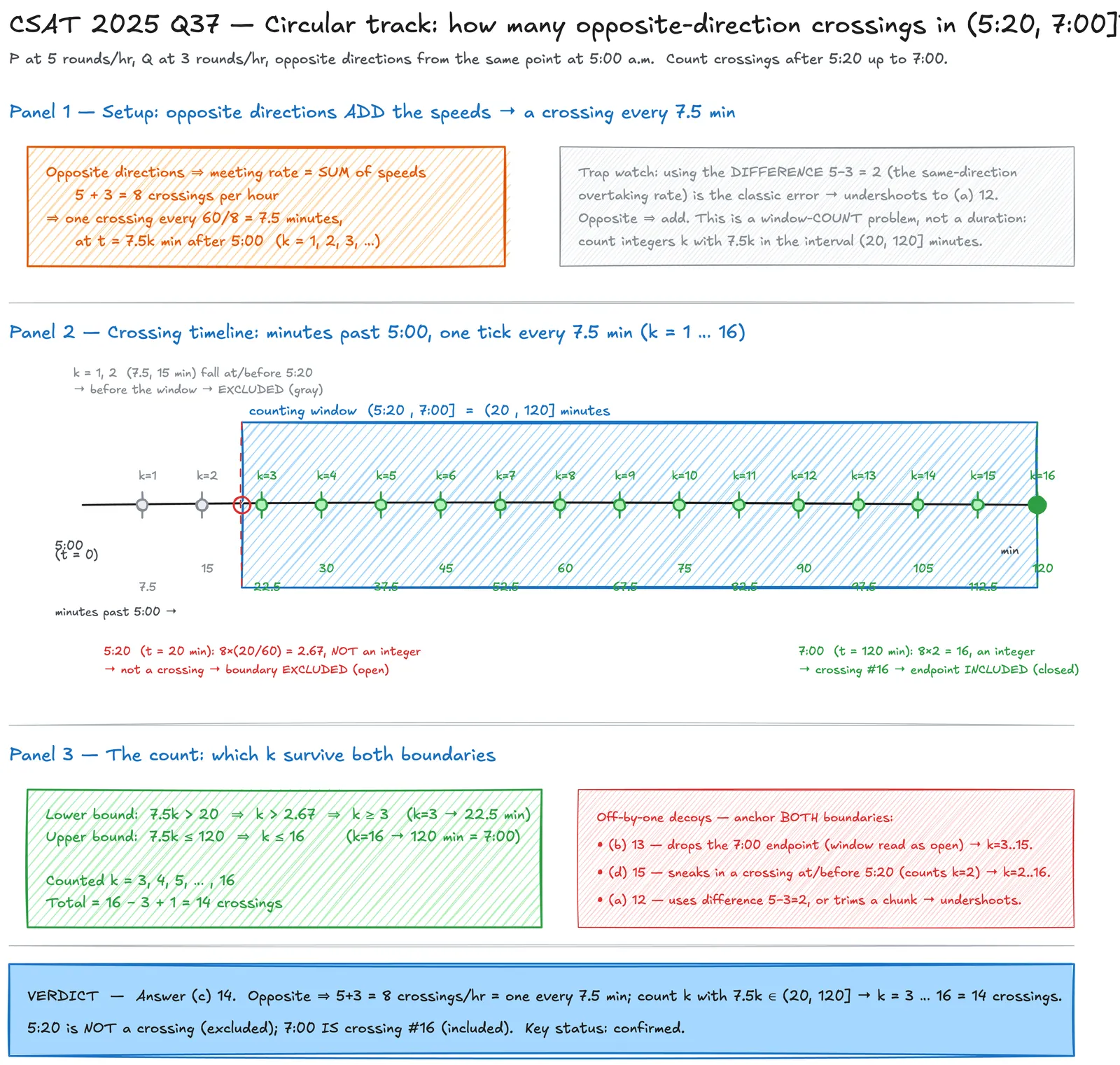
Starting together at , a crossing occurs each time their combined rounds total an integer, i.e. every hour minutes. Crossings happen at minutes for
Count the with crossing-time in the window , i.e. minutes in :
So — that is crossings. (At exactly, is not an integer, so is not itself a crossing; at , is, so the endpoint counts.)
Answer: (c) 14.
Visual solution
The same solve, worked by hand — read it, then trace it.
Why the other options miss
- A the proportion runs the wrong way: uses the difference (the same-direction overtaking rate) somewhere, or measures the full – minus a chunk, undershooting.
- B off by one: excludes the endpoint crossing (treats the window as open), giving .
- D off by one: includes a phantom crossing at or before (counts ), overshooting by one.
Specialist insight
Two things decide this item. First, opposite directions ⇒ add the speeds (meetings per hour ); using the difference is the classic same-vs-opposite confusion. Second, it is a window-counting problem, not a duration: convert to “crossing instants every min from ” and count integers with . The endpoints are where marks are lost — is not a crossing, is — so anchoring both boundaries explicitly is the discipline that separates from the off-by-one decoys and .
Opposite directions give meetings/hour (every min from ); counting with gives .