← 2023 Paper 1

UPSC 2023 Maths Optional Paper 1 Q5c — Step-by-Step Solution

10 marks · Section B

Equilibrium of Forces in Three Dimensions · Dynamics & Statics · Read the full method →

Question

A cylinder of radius 'aa' touches a vertical wall along a generating line. Axis of the cylinder is fixed horizontally. A uniform flat beam of length 'll' and weight 'WW' rests with its extremities in contact with the wall and the cylinder, making an angle of 45°45° with the vertical. If frictional forces are neglected, then show that

al=5+542.\frac{a}{l}=\frac{\sqrt 5+5}{4\sqrt 2}.

Also, find the reactions of the cylinder and wall.

Technique

2D vertical cross-section; place wall and cylinder explicitly; force balance + moments. Take moments about the bottom contact to eliminate RcR_c and find Rw=W/2R_w=W/2 cleanly. Then horizontal balance and the cylinder-constraint pin down a/la/l.

Solution

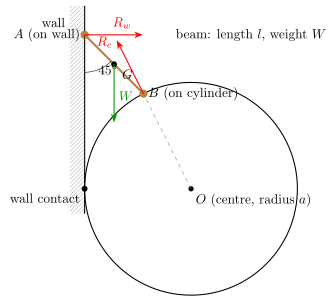
Vertical cross-section of the configuration. The wall is the line x=0; the cylinder appears as a circle of radius a centred at O, touching the wall at the origin. The uniform beam AB runs at 45° to the vertical, with top end A on the wall and bottom end B on the cylinder. The forces shown are: weight W acting downward at the midpoint G; the wall reaction R_w horizontal at A (perpendicular to the smooth wall); and the cylinder reaction R_c at B along the outward normal O\to B (the dashed radius).

Setup

Work in the vertical 2D cross-section perpendicular to the cylinder’s axis. Wall = x=0x=0. Cylinder centre O=(a,0)O=(a,0), touching wall at origin. Beam: top end on wall at (0,h)(0,h), bottom end on cylinder at (l/2,hl/2)(l/\sqrt 2,h-l/\sqrt 2) (since beam is at 45°45° with vertical, length ll).

Bottom of beam is on the cylinder: (l/2a)2+(hl/2)2=a2(l/\sqrt 2-a)^2+(h-l/\sqrt 2)^2=a^2.

Step 1 — Force balance

Forces on beam:

Vertical equilibrium: Rc(hl/2)/a=WR_c\cdot(h-l/\sqrt 2)/a=W, so Rc=Wahl/2R_c=\dfrac{Wa}{h-l/\sqrt 2}.

Step 2 — Take moments about the bottom of the beam

About the bottom (l/2,hl/2)(l/\sqrt 2,h-l/\sqrt 2):

Set M=0\sum M=0: Wl/(22)=Rwl/2W\cdot l/(2\sqrt 2)=R_w\cdot l/\sqrt 2, so

Rw=W2.R_w=\frac{W}{2}.

Step 3 — Horizontal equilibrium gives the geometry

Fx=0\sum F_x=0: Rw+Rc(l/2a)/a=0R_w+R_c\cdot(l/\sqrt 2-a)/a=0, so Rc(al/2)/a=Rw=W/2R_c\cdot(a-l/\sqrt 2)/a=R_w=W/2.

Using Rc=Wa/(hl/2)R_c=Wa/(h-l/\sqrt 2):

Wahl/2al/2a=W2al/2hl/2=12hl/2=2(al/2)=2al2.\frac{Wa}{h-l/\sqrt 2}\cdot\frac{a-l/\sqrt 2}{a}=\frac{W}{2}\Rightarrow\frac{a-l/\sqrt 2}{h-l/\sqrt 2}=\frac{1}{2}\Rightarrow h-l/\sqrt 2=2(a-l/\sqrt 2)=2a-l\sqrt 2.

So h=2al2+l/2=2al/2h=2a-l\sqrt 2+l/\sqrt 2=2a-l/\sqrt 2 (since l2l/2=l(21)/2=l/2l\sqrt 2-l/\sqrt 2=l(2-1)/\sqrt 2=l/\sqrt 2).

Step 4 — Apply the cylinder constraint

(l/2a)2+(hl/2)2=a2(l/\sqrt 2-a)^2+(h-l/\sqrt 2)^2=a^2. Substitute hl/2=2al2h-l/\sqrt 2=2a-l\sqrt 2:

(l/2a)2+(2al2)2=a2.(l/\sqrt 2-a)^2+(2a-l\sqrt 2)^2=a^2.

Expand: (l/2a)2=l2/22al+a2.(l/\sqrt 2-a)^2=l^2/2-\sqrt 2\,al+a^2. (2al2)2=4a242al+2l2.(2a-l\sqrt 2)^2=4a^2-4\sqrt 2\,al+2l^2.

Sum: l2/2+2l22al42al+a2+4a2=(5/2)l252al+5a2l^2/2+2l^2-\sqrt 2 al-4\sqrt 2 al+a^2+4a^2=(5/2)l^2-5\sqrt 2\,al+5a^2.

Set =a2=a^2: (5/2)l252al+4a2=0(5/2)l^2-5\sqrt 2\,al+4a^2=0. Multiply by 22: 5l2102al+8a2=05l^2-10\sqrt 2\,al+8a^2=0.

Solve for a/la/l. Let u=a/lu=a/l:

5102u+8u2=0u=102±20016016=102±21016=52±108.5-10\sqrt 2\,u+8u^2=0\Rightarrow u=\frac{10\sqrt 2\pm\sqrt{200-160}}{16}=\frac{10\sqrt 2\pm 2\sqrt{10}}{16}=\frac{5\sqrt 2\pm\sqrt{10}}{8}.

Take the larger root (physically the configuration where beam reaches farther down the cylinder):

u=52+108.u=\frac{5\sqrt 2+\sqrt{10}}{8}.

Rationalise: 52+108=2(5+5)8=5+542=5+542\dfrac{5\sqrt 2+\sqrt{10}}{8}=\dfrac{\sqrt 2(5+\sqrt 5)}{8}=\dfrac{5+\sqrt 5}{4\sqrt 2}=\dfrac{\sqrt 5+5}{4\sqrt 2}.

  al=5+542.  \boxed{\;\frac{a}{l}=\frac{\sqrt 5+5}{4\sqrt 2}.\;}

Step 5 — Compute reactions

Rw=W/2R_w=W/2 (already found).

Rc=Wa/(hl/2)=Wa/(2al2)R_c=Wa/(h-l/\sqrt 2)=Wa/(2a-l\sqrt 2). With a/l=(5+5)/(42)a/l=(\sqrt 5+5)/(4\sqrt 2), a=l(5+5)/(42)a=l(\sqrt 5+5)/(4\sqrt 2):

2al2=l[5+5222]=l[5+5422]=l(5+1)22.2a-l\sqrt 2=l\Bigl[\frac{\sqrt 5+5}{2\sqrt 2}-\sqrt 2\Bigr]=l\Bigl[\frac{\sqrt 5+5-4}{2\sqrt 2}\Bigr]=\frac{l(\sqrt 5+1)}{2\sqrt 2}. Rc=Wa2al2=Wl(5+5)/(42)l(5+1)/(22)=W5+542225+1=W(5+5)2(5+1).R_c=\frac{Wa}{2a-l\sqrt 2}=W\cdot\frac{l(\sqrt 5+5)/(4\sqrt 2)}{l(\sqrt 5+1)/(2\sqrt 2)}=W\cdot\frac{\sqrt 5+5}{4\sqrt 2}\cdot\frac{2\sqrt 2}{\sqrt 5+1}=\frac{W(\sqrt 5+5)}{2(\sqrt 5+1)}.

Rationalise: multiply by (51)/(51)(\sqrt 5-1)/(\sqrt 5-1):

Rc=W(5+5)(51)2(51)=W(5+5)(51)8.R_c=\frac{W(\sqrt 5+5)(\sqrt 5-1)}{2(5-1)}=\frac{W(\sqrt 5+5)(\sqrt 5-1)}{8}.

(5+5)(51)=55+555=45(\sqrt 5+5)(\sqrt 5-1)=5-\sqrt 5+5\sqrt 5-5=4\sqrt 5.

Rc=4W58=W52.R_c=\frac{4W\sqrt 5}{8}=\frac{W\sqrt 5}{2}.

Answer

  Rw=W2,Rc=W52.  \boxed{\;R_w=\tfrac{W}{2},\qquad R_c=\tfrac{W\sqrt 5}{2}.\;}
We post more of this — worked solutions, CSAT trap breakdowns, guide chapters — a few times a week on Telegram. Free, no sign-in. Join

This solution is part of the Maths Coverage Map — 13 years, mapped. Get the take-away PDF free.